Today, Kansas City voters will decide whether to renew the city’s 1% earnings tax for another five years, a levy that helps fund nearly half of all city services.
The ballot measure does not raise the tax. But whether voters renew it or reject it will carry major consequences for how Kansas City funds services, safety, and daily life.
While the earnings tax helps pay for services residents rely on, it also helps sustain a city budget where policing remains a major priority while other forms of public safety struggle to compete. More than that, the vote underscores how tightly Kansas City has bound its ideas of growth, stability, and public safety to police and detention.
About the tax
The 1% earnings tax applies to people who live in Kansas City, even if they work elsewhere, and to people who work in Kansas City, even if they live outside the city. It also applies to certain business profits. It has been in place since 1963.
Missouri law requires Kansas City voters to revisit the tax every five years. If it passes, it will continue beginning Jan. 1, 2027. If it fails, it will not disappear overnight, but instead phase out over 10 years. And if that were to happen, it could not be brought back unless state law changes.
Supporters point to the services the tax helps fund, and they are not wrong.
The tax is Kansas City’s largest projected revenue source for the fiscal year. City officials estimate it will generate $379.3 million and account for roughly 45% of the city’s general fund, the main pot used to pay for core services such as road repair, weekly trash collection, snow removal, playgrounds, code inspection, firefighters, ambulance services, and more.
But that is only part of the story. Public safety remains one of the city’s dominant budget priorities, and policing continues to anchor how Kansas City defines and funds that priority.
Kansas City’s adopted FY 2026–27 budget allocates $744 million to public safety. In the city’s submitted budget materials, public safety accounted for about 75% of the General Fund operating budget, which is largely funded by earnings tax. Of that $744 million in public safety spending, about 49% goes to police alone. So while the earnings tax funds a range of everyday services, it also helps sustain a budget where public safety is entrenched with policing.
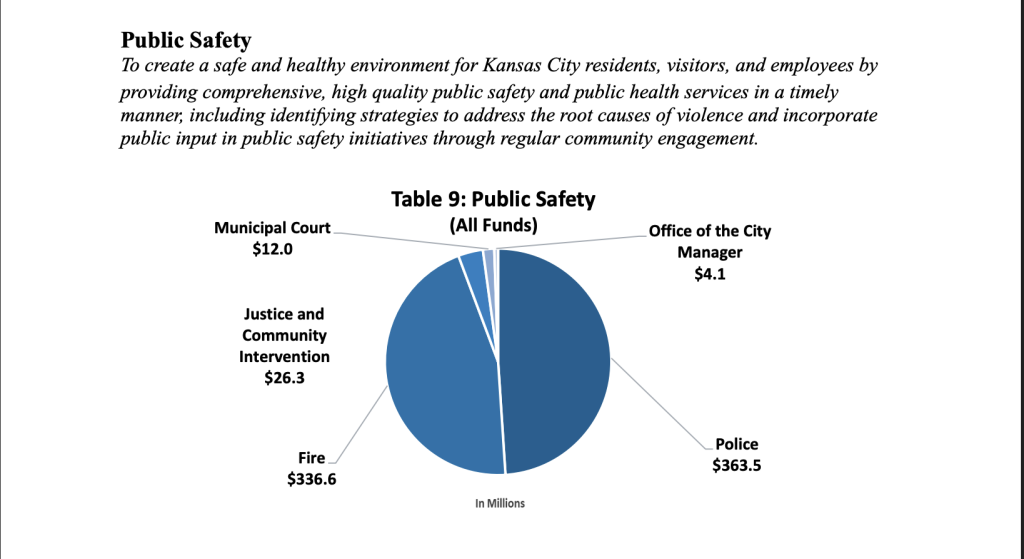
That imbalance is reinforced by state law, which requires Kansas City to commit at least 25% of its general revenue to KCPD, even though the city does not fully control KCPD. The department is governed by a board made up of the mayor and four commissioners appointed by the governor.
The earnings tax measure is backed by Together KC, a coalition that includes nearly every Kansas City Council member, the Missouri AFL-CIO, the Greater Kansas City Chamber of Commerce, the Urban League of Greater Kansas City, the Fraternal Order of Police, Freedom Inc. and several state lawmakers. That overlap matters. The same campaign now arguing the earnings tax is necessary to keep Kansas City running also backed the 2025 public safety sales tax renewal, which is funding a new city jail.
For Black and working-class Kansas Citians, that is the deeper tension inside this vote. The earnings tax helps fund daily life in Kansas City, and losing that revenue would carry serious consequences, but it also helps sustain a public safety model still rooted more in policing and detention than in care, housing and community repair.