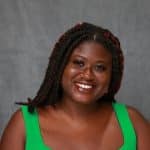
Melissa Ferrer-Civil came to Kansas City by way of a miracle. At least, that’s how she sees it. In 2017, the Brooklyn-born poet made her way out of a religious cult in Warsaw, Missouri. She came to the area seeking solace from her sorrow-filled past.
She thought the group would aid her in her mission of finding God and making the world a better place. But joy was the last thing she found in what turned out to be a cult.
Ferrer underwent a mental breakdown at that time, which she was still enduring when she left. She was taken to a local hospital at the peak of this breakdown. From there, she was transferred to a hospital in Kansas City.
At that time, Ferrer longed for community more than anything.
“I wanted a home,” she said. “I had been on my own since I was 14. I was lonely and I was always someone who prioritized relationships. I wanted to be around someone who would do the same.”
She remembers always feeling like the odd one out. Growing up, she moved between various cities in Florida, yet she was always one of a handful of Black students in her predominately white schools. And her Haitian-American cultural roots weren’t relatable to many of her Black classmates, let alone her white ones.
By middle school, she found support in the works of Black writers and scholars like bell hooks, Cornell West, and Maya Angelou. Black poetry became the catalyst for Ferrer’s creative growth, a new means of self-expression and healing from her past traumas.
“I was finding people who were saying the things that I had seen long before I was alive,” she said. “I started to find my people.”
Fast forward to 2024 and the 32-year-old creative has been named Kansas City’s inaugural Poet Laureate. Throughout this year-long position, Ferrer will serve as an ambassador and advocate for poetry and the arts. She hopes to radicalize the way Kansas Citians use art to understand themselves and others. Below, in 10 questions, she tells The Defender how she used art to help her understand herself.
Trigger warning: mentions of suicide, homelessness, and depression
What do you do?
Melissa Ferrer-Civil: I am a poet, both spoken word and page. I am also a musician. I play guitar and sing.
When did you start calling yourself an artist?
MF-C: I think we start doing art long before we consider ourselves artists. I remember the moment I decided to call myself an artist. I used to teach fifth grade and we had to put up monthly bulletin boards. I was making these designs for the board and drawing a basketball hoop and I was like, “I am an artist, aren’t I?” The feeling of being an artist suddenly just descended upon me.
I realized if I focus my mind on anything artistic, I can do it. And that’s what makes me an artist. Because I want to do it. And I want to keep doing it. Everything that I find myself drawn to is art. Whether it’s poetry, music, drawing, or dance — it’s all art. And that’s what makes me come alive.
When did you start making art?
MF-C: I was making art way before that then. I remember writing raps because I used to want to be a rapper. I decided to be a poet when I was 12 years old. And then I discovered spoken word when I was 14 years old.
How long have you been in Kansas City?
MF-C: Seven years.
Describe your work in three words.
MF-C: Spiritual, radical, intense.
What is your why?
MF-C: I think my “why” is best described by talking about how I decided to become a poet. So, when I was 12, my sister committed suicide. My oldest sister and my best friend, I loved her so much. It was horrible. What made it worse was my community was nowhere to be found. And not only was my community nowhere to be found, the people around me weren’t supportive about what I was going through.
Kids would make fun of me and tell me my sister was going to hell because she committed suicide. I tried to get counseling and on the first day, I went in the counselor was like, “Why are you here?” and I said, “Well my sister passed away.” The woman was like “Before we continue, your sister didn’t ‘pass away,’ she died. ‘Passed away’ is something we say to make ourselves feel better.”
My family was going through it too. I couldn’t really depend on anyone. I couldn’t depend on my mom, who I was very close to, because she was blaming herself a lot and going through it. I was also blaming myself because I was the last one to see my sister alive. Nobody was on my side.
When I get on a stage, what I’m trying to do is cultivate a space of community and intimacy that makes people feel held.
And then a teacher put “Still I Rise” by Maya Angelou on my desk because we were reading that in class. And as I was reading the poem, something in me — despite the darkness, despite what I was feeling — started to rise. And I was like, ‘Words can do this?’ Words can just like reach through time and space and be like, ‘get up?’”
And then I recognized that if I I was a poet, I would be able to help people feel better. And not just feel better, I was looking for solidarity and community. I knew that through my words, I could help provide solidarity and community for other people.
In my younger years, I would write a lot of poems that weren’t from direct experience, just things I deeply understood. They’re called persona poems… I had a few friends who had problems with self-harm. I wrote a poem from the perspective of a person who cut themselves and multiple people in middle school would come to me and be like, “I really needed that. I feel so seen.”
So many people will feel like they’re alone. So many people feel like nobody understands them. I want those people to feel seen, known and heard. More than being a performer, more than being a very talented person. When I get on a stage, what I’m trying to do is cultivate a space of community and intimacy that makes people feel held. So that’s my “why.”
How does Kansas City make an impact on your work?
MF-C: I got my restart here in Kansas City. I came broken to Kansas City. I came in an ambulance to a psych ward and had to decide to either be bused back to Florida or stay in a place I had never been, with people I had never met in a homeless shelter. And I chose to stay because when I was in the psych ward I had a lot of realizations that ultimately led me to understand that I had to be accountable for my life. And that no matter what I was going through, I had to trust in a God.
At that point, I didn’t know even who that God was — if God was what you called it or whatever — I just believed that there was some great thing that had my best interest in mind. And I wanted to be aligned with that thing. And I had to give everything that I had.
At the time, all I had were hallucinations, confusion, and strange experiences that I didn’t understand or know what to do with. I gave it all to God and decided to stay in Kansas City because I recognized if I went home to my family that day with a diagnosis on the bipolar-schizoaffective spectrum I would have all the reasons to not succeed. But if I stayed in a place where I didn’t know anybody, literally at rock bottom living in a homeless shelter with nothing but a backpack, then I would have to make steps forward.
And what I found when I chose to stay in Kansas City, where people were so loving and so kind. Just kind for the sake of being kind. I have been surrounded by such an amazing supportive community. And I recognize that I’m surrounded by unconditional love, by people who just let me be me. Kansas City has been absolutely integral in giving me space, time, and love.
Then also there’s the metaphorical value of Kansas City. It’s in the heart of the US, so sometimes I’d be feeling like we’re doing heart surgery out here on our country. It’s the Show Me state, right? So it’s the place where I get to be my full self, because it’s like, show me who you are. On multiple levels Kansas City challenges me to be my best self.
It’s the exact right pace. I’m originally from Brooklyn and I was raised in Florida. And Brooklyn is really fast while Florida is really freaking slow. But Kansas City is somewhere in the middle. And that pace is exactly what I needed at the time and still need to take the journey that I’m taking at my own pace.
I want to shout out the Poetic Underground, the For the Win poetry slam, The Regulators (which was the slam team I was on), and all these artistic institutions that supported that growth. My first book was published through Turnsol Editions. Revolution Records in the Crossroads published my first chapter book. And it’s just been such graciousness.

Do you think that art is inherently “Black” when it is created by a Black artist, or is art only considered “Black” when it reflects the Black experience?
MF-C: I think the first thing I want to say is that race is a construct that shouldn’t exist but does because we believe in it. And it is institutionalized into our daily lives. When I’m speaking from my experience, I’m speaking from the experience of having been a Black queer woman in America.
That is the identity that I have and that impacts my reality because all of the minor or major aggressions that I have experienced throughout my life, whether institutional or personal, helped to form my worldview.
In this world, you’re either under somebody’s foot or on a pedestal. And even if I’m not under someone’s foot, I recognize my perspective is always going to be coming from a Black perspective, whether or not I talk about Blackness. I’m working on an essay right now that’s called “I Gotta Find Peace of Mind. Madness, Confession, Exorcism, and Healing in Black Feminist Poetics.” And it’s about the impact of institutional oppression on mental health and Black women, and how Black women have been writing themselves into wellness just by speaking their truth. I’m making the case that whenever a Black woman speaks her truth, she is performing a form of exorcism and what she’s exercising are the demons of white supremacy, patriarchy, and capitalism.
What’s one question you want people to leave your work asking? Or what is one answer that you want them to have?
MF-C: There’s one that actually doesn’t come from me, but comes from an old friend of mine. This question drove him to find his path in life. The question is “What else is possible?”
And in the answer realm, the answer would be love. That’s what they receive. Whether a person is an atheist, a Christian, a Muslim, Buddhist…conservative, liberal, or an abolitionist….Black or white…. I want them to be able to ask, “What else is possible? What am I missing? What exists in me that I haven’t found yet?”
I’m trying to turn people toward God. That is my great mission. But I am not doing it in a proselytizing way. Because my faith is that God lives in us all. So when you get people to learn about themselves by asking “What else is possible?” and turning toward love, they’ll do it. And God will do the rest.
What is your mission as Kansas City’s first Poet Laureate?
MF-C: First, I want to make the position as radical as possible because the goal of Black American poetry is to help us remember humanity and bring equity and solidarity to our communities. I want to use my position to do just that in Kansas City.
I also want to do programming for youth and adults who use poetry as a medium to find agency and come into a process of self-actualization so that we can be a collective of self-actualized individuals.
I would like to bring in poets from other places to mingle and put Kansas City on the map in the literary scene.
I also want to use my platform to bolster the message of “A Nation in Exile.” We are a nation of exiles, in exile from ourselves, from our culture, from the land, and each other. Unless you’re indigenous, we are all in some way shape, or form refugees or immigrants. There are those of us who are political exiles and the big question is how do we return home, what does that look like, and who is doing that work to get us home?
Artists and organizers do the work to get us to home and call on all of us to make this place our home and honor people who are still indigenous.
Where can we find you? What’s up next?
MF-C: On February 8 I have my second installation of my event series called “A Nation in Exile: Heartwood Narratives.” The address is 21c Museum Hotel, Kansas City, 219 W 9th St. The Instagram is @anationinexile. My newer artistic pursuit is being a curator of events and performances. “A Nation in Exile” is how I’m doing that. That’s how I’m organizing as well.
It will be five to seven performances About 5-7 performers for each event. This event is for Black History Month and it’s going to be all Black fem writers and Black fem musicians. we’ll be working with Uzazi Village to raise money for their cause.
Audiences can keep up with Melissa via her website (www.melissaferrerand.com) or Instagram (@Melissaferrerand).