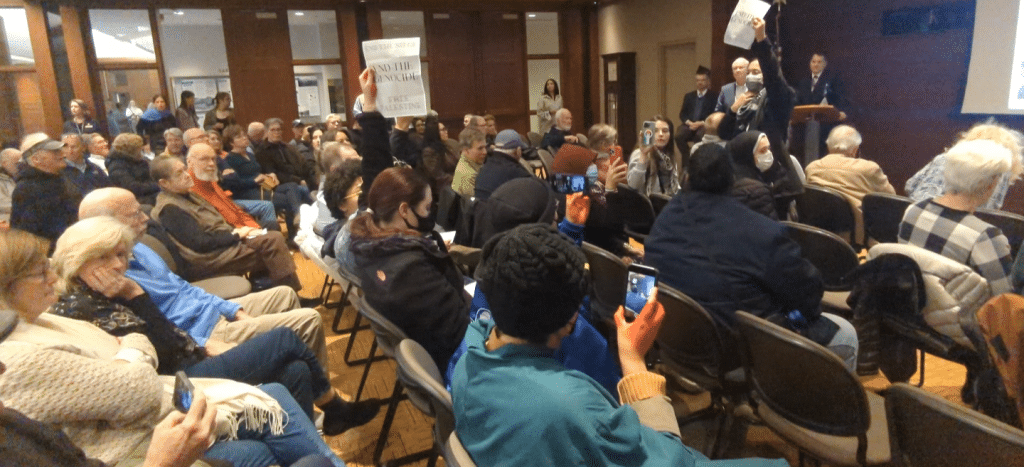
KANSAS CITY, MO – In the heart of Kansas City, a bold act of resistance unfolded Wednesday evening at the Kansas City Public Library.
A seminar, misleadingly titled “Crisis in the Middle East: Understanding the Arab-Israeli Conflict,” found itself at the center of fierce criticism.
The event, which glaringly overlooked Palestinians and labeled the ongoing genocide as a mere “conflict,” was led by two white military historians without any Palestinian or Arab representation.
John Hosler and Brian Steed, both deeply rooted in military history, are ill-suited choices for an event seeking to explore the Palestinian genocide. Hosler, primarily an expert in medieval European warfare, and Steed, with his background entrenched in U.S. military objectives in the Middle East, present unmistakable biases that could obscure an impartial understanding.
Neither can genuinely speak to the Palestinian experience, and relying solely on voices tied to military narratives without including Palestinian perspectives is not only deeply problematic but also perpetuates an erasure of Palestinian voices and their lived realities.
Undeterred by the looming shadows of revisionism, community members converged in protest.

They descended upon the library, their hands marked with red paint – a visceral and haunting reminder of America’s complicity in the ongoing genocide that has wrenched the lives of over 8,000 Palestinians in the past three weeks alone.
With placards reading “End the Siege” and “End the Genocide”, their chants of “Ceasefire Now!” reverberated throughout the forum.
Their testimonies bore witness to the raw pain of losing kin to the unabating violence, particularly evoking heart-wrenching stories like that of a member from Palestinian group, Al Hadaf, who recounted the agony of losing over 30 family members in a brutal israeli airstrike.
Another community member gave a speech saying “As the granddaughter of Holocaust survivors. israel and the west using Jewish people as political pawns to support their war crimes and genocide is antisemitic and violent.” As she went on, passionately stating “this can not be in our name. Not in my name, not in my grandmothers name, not in my great grandmothers name.
End the Blockade, end the occupation, ceasefire now.”
These demands for justice follow weeks of fervent rallies and incessant demands urging Rep. Emanuel Cleaver to join the Ceasefire Now resolution initiated by Reps. Cori Bush and Rashida Tlaib. Cleaver, currently, remains seemingly tethered to the rhetoric of President Biden and the settler colonial project, indicating unwavering support for the U.S. funded hostilities.
Contrary to this stance, the pulse of the nation reveals a different narrative. Recent polls highlight that an overwhelming 66% of Americans advocate for a ceasefire. The nation watches, with bated breath, as throngs amass in streets globally, categorically denouncing U.S. involvement in this glaring genocide.
Organizers from the disruption said they are committed to escalating their actions until Cleaver listens to the cries for peace and justice.
Their determination echoes in the statement issued by Al-Hadaf KC: “Institutionalized silencing of Palestinian voices is violence. We exist; we have existed; we are Palestinians; we are the vibrant voices of Nakba survivors. We will keep speaking out. Our existence is, and always will be, resistance. Free, Free Palestine.”
This episode, rooted in a library seminar, is more than just a singular event. It is emblematic of a broader struggle against the erasure of Palestinian stories, against silence, and for the unwavering pursuit of justice.
The world watches, and Kansas City has made its stand clear.