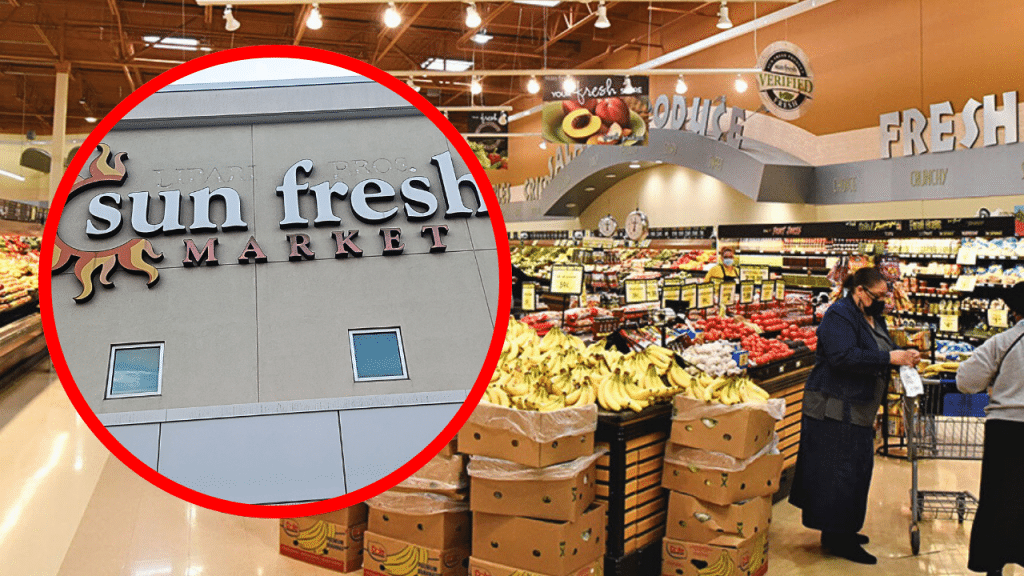
The doors are locked. The aisles are dark. And thousands of Black Kansas Citians now live in a deeper food desert than they did yesterday. Sun Fresh on 31st and Prospect, the last full-service grocery for miles, has closed, ending a decade of broken promises, empty shelves, and public dollars siphoned into everything but feeding the people.
On the front doors, a sheet of paper delivers the final insult: “Due to unforeseen circumstances… we are no longer able to serve the residents of this community.” For years, neighbors warned that without real investment in care, without treating food access as a public good, the store would wither. And now, with shelves stripped and doors shuttered, the warning has become reality.
But there was nothing “unforeseen” about any of this.
For a decade, the city refused to adequately support the Sun Fresh, allowing the store to collapse in slow motion. Neighbors watched shelves empty out. Workers rang up fewer and fewer items for families who had nowhere else to go. On Tuesday morning, the tarp went up over the sign and the doors locked. “I’m about to cry,” one neighbor told KCUR. “This is real life.”
In May, after Black elders, pastors, tenant leaders and organizers shut down City Hall and forced the issue, the Council finally released a measley $750,000, money that had been promised but never delivered, to keep the store afloat and upgrade security.
I covered the dramatic scene extensively in my piece Black KC Community Slams Mayor Lucas, Shuts Down City Council Meeting & Wins $750K for Black Grocery Store.
It took a chamber full of Black folks to scrape together what downtown developers get before breakfast.
As Bishop James Tindall put it: “If you can subsidize Power & Light and downtown condos, you can subsidize your own grocery store in the Black East Side.”
Even that lifeline wasn’t enough because the city has never built safety through care. After a high-profile visit last summer, KCPD rolled out promises of 24/7 patrols along the corridor. Cops, business owners, and the bourgeoisie framed the crisis as “crime and homelessness,” then cut another check for security while WIC and SNAP benefits were being slashed, bus routes gutted, and the housing crisis spiraled. Starvation that drives crimes of survival, and creates an unsafe grocery store environment, is not an “unforeseen circumstance.” It’s the predictable outcome of a city that invests in punishment over provision. And so, Sun Fresh still died.
The operator says they lost $1.3 million last year, blaming theft as a key driver. At a grocery store in the middle of a food desert, “theft” means bread, meat, baby formula, the bare minimum to stay alive. As Dr. Eddie Glaude Jr. told Prosecutor Melesa Johnson & attendees at the Urban League Luncheon during the jail tax fight earlier this year: “If I’m hungry, you’re not safe.”
The real crime is not that people stole food, it’s that our city built a system where stealing it was the only way to eat.
Meanwhile, the city just approved a new jail that will cost about $1 million per bed to build and nearly $1 Billion to operate over its lifetime. There’s always a blank check for cages. For groceries, there’s a magnifying glass and a timer. We demand “results” from a supermarket that feeds families, but never from the institutions that swallow billions and give us neither safety nor peace.
Nowhere is this more evident than in a recent KCUR piece which notes that the store “has been struggling to fill shelves recently despite 10 years of taxpayer money to renovate it and keep it in business.” But notice what’s missing from this and every other headline: in the same decade, Kansas City dumped over $3 billion into KCPD while homicide and violence have climbed to some of the highest levels in our city’s modern history. We scrutinize bread aisles more than we scrutinize a police budget that grows no matter how many lives are lost.
Sun Fresh didn’t “suddenly” close. It was starved. Our city has spent years choosing surveillance over services and concrete over care, then blaming the hungry for being hungry. That is how food deserts become death sentences. That is how a public asset becomes a vacant box while contractors line up for the next ribbon cutting across town.
The choice before us is simple and moral: Treat food access as public safety and fund it like we mean it.
We refuse a city that can find $1 million per jail bed but tells us it cannot afford to keep tomatoes on a shelf in a Black neighborhood. We refuse narratives that pretend this was unforeseeable when our people have been shouting it for years.
Editor’s Note: In the coming weeks, The Kansas City Defender will launch a major new initiative with every major Black-led farm in Kansas City — the Hamer Free Food Program — to directly confront this manufactured food crisis. Together, we will deliver free, fresh produce boxes from Black farms straight to the doorsteps of Black elders and neighbors within a mile of 31st & Prospect, inject thousands into local Black growers, train a new generation of Community Food Leaders, and print food justice education inside every box. This is about feeding our people now and building a self-sustaining, Black-led food system for the future.
Subscribe to our free newsletter or email me directly if your organization would like to be part of this initiative. Because when it comes down to it, we’ve always had to rely on ourselves to keep our people fed, safe, and alive.