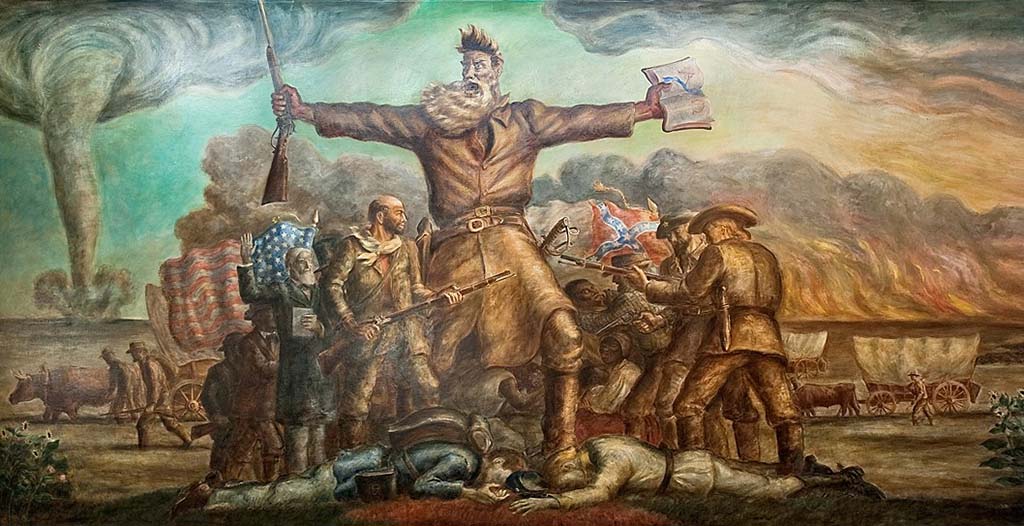
On April 21, 2026, the Kansas News Service, a public radio collaborative directed by Kansas City NPR affiliate KCUR, published a considered meditation on whether a man who was hanged in 1859 for trying to abolish the enslavement of human beings deserves to be called a hero. The piece does not reach a conclusion. The absence of one, in the tradition of white-led American public radio, is the conclusion.
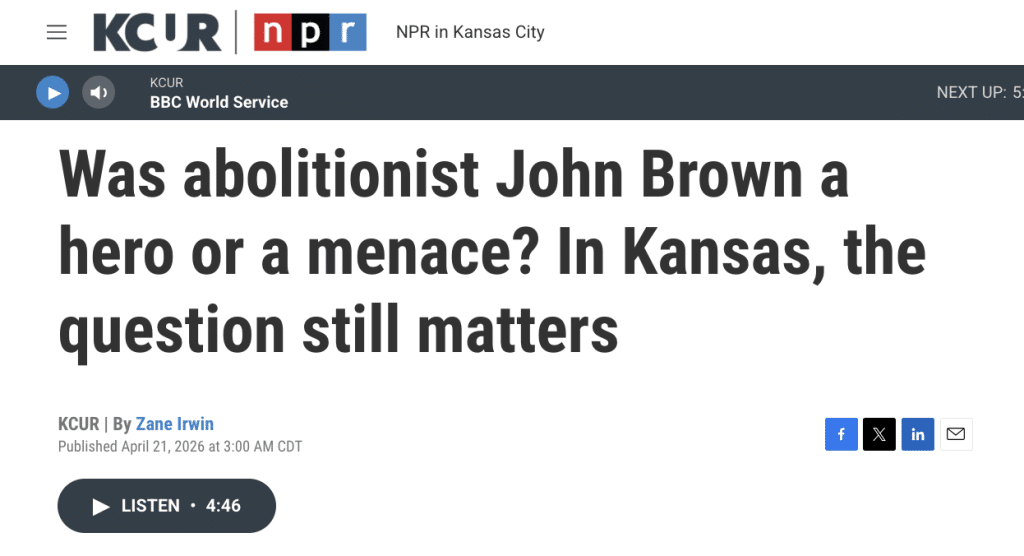
The question posed by the headline, “Was abolitionist John Brown a hero or a menace?”, can only be asked from a moral universe in which enslavement is a regrettable climate, and violence against enslavers is an ethical puzzle.
In that universe, Harriet Tubman is a kidnapper, Nat Turner is a murderer, Denmark Vesey is a conspirator, and John Brown is a question. In the actual universe, the one where four million human beings were human trafficked and under genocide, where children were torn from their mothers and sold at auction, where the federal government spent half a century protecting the right of one human being to whip another to death, the question answers itself.
Someone will ask why The Defender has given this much attention to a single NPR affiliate’s morning broadcast. The answer is that I am not simply concerned with KCUR. I find them emblematic of the contagion at the root of white American journalism.
When Samuel Cornish and John Russwurm published the first issue of Freedom’s Journal in 1827, the front they were fighting was a white American press that defended slavery, sanitized lynching, and laundered the sensibilities of the enslaver. Two centuries later, in a city where a public radio station still cannot bring itself to call a slaver a slaver, the fight has not ended. To read a piece like this one carefully is to learn how to read every piece like it.
The Missing
Let me begin with who is not in the room. The piece quotes a white middle school teacher, a white history lecturer, a white Wichita State professor, a white Republican state legislator, and, in a telling move, the all-white Kansas Council of Women of the 1940s, who declared that John Brown was “one of the freaks in its history.”
KCUR presents this quote without context. No mention of what Kansas was in the 1940s, who the Council of Women represented, why a segregation-era white women’s organization might have found abolitionists distasteful. The reader is invited to consider their opinion as though a century of Jim Crow were not sitting between them and us, chatting across a hedge.
Nowhere does KCUR reach for a Black scholar, a Black abolitionist historian, a descendant of the enslaved. Frederick Douglass, who knew Brown personally, who corresponded with him for years, who gave one of the most important speeches in American history about him at Storer College in 1881, does not appear. Not as a quote. Not as a name. Not as a footnote.
A piece about whether a white abolitionist deserves moral standing has been constructed entirely without the Black people whose lives and freedom he died to protect. One begins to understand, reading it, why John Brown felt the need to raise an army.
The question KCUR is asking is not a new question. It is the question the white press has always asked about people who fight for Black freedom.
Was Nat Turner a prophet or a butcher? Was Denmark Vesey a liberator or a terrorist? Was Malcolm a leader or a hatemonger? Was Fred Hampton a revolutionary or a threat? Was Assata a freedom fighter or a criminal?
The white press arrives, in every case, at the same shrugging ambivalence. It is the only answer its frame permits. Any other answer would require concluding that the violence of the enslaver, of the state, of the cop, was never one side of a debate but was the thing the debate was built to protect.
“Settlers” or Genocidal Supremacists?
The article devotes careful attention to the Pottawatomie Massacre, in which Brown and his sons killed five pro-slavery settlers. The word “settlers” is a lovely one. It does the work of softening.
A settler is a person who has built a homestead, planted a garden, raised chickens. The five men Brown killed had raised more than chickens. They had raised a political order in which human beings were tortured, sexually brutalized daily, trafficked, and treated no differently from a hog or a horse. Yet, the article does not call them enslavers.
It does not describe what they had done or were prepared to do. They are settlers who were hacked to death in the night by a religious fanatic. One can almost hear the violins.
We are not told, in comparable detail, about the enslaved people beaten, raped, sold, separated from their children during the same week. We are not told about the fugitive slave hunters who tracked Black families through the Kansas territory. We are not told about the pro-slavery ruffians from Missouri who burned Lawrence three weeks before Pottawatomie. The violence of the enslavers is wallpaper. The violence of the abolitionist is a story.
The teacher, Tom Barker, tells KCUR’s writer that he believes John Brown “wrought more harm than good.” The claim has the ring of balance to the untrained ears or eyes.
It is, in fact, a claim that requires a counterfactual in which slavery ended without Brown, or ended more quickly, or ended with less bloodshed. But as we know, no such counterfactual exists.
Slavery ended only through the bloodiest war in American history, a war Brown helped to catalyze, a war that was already coming. The claim that Brown’s violence wrought more harm than good holds up only if we treat the continued existence of slavery as a less grave injury than a failed armory raid.
The Line Has Never Broken
The article mentions, almost in passing, that an activist invoked Brown at a February 2026 meeting of the Leavenworth planning commission. This organizer and activist was protesting a new ICE concentration camp. The commission helped clear the way for it to open. The article does not linger on this or pause to notice that in the same state where John Brown fought to keep his neighbors from being put in chains, a panel of bureaucrats in 2026 voted to make it easier to put other neighbors in chains.
It does not observe that this is not a historical curiosity but a continuous line.
The piece also mentions, with the breezy tone of a weather report, that President Trump has ordered a review of Harpers Ferry, the historical site in West Virginia where Brown led his 1859 raid on a federal armory, to inspect the way it engages with race. This is the quiet center of the whole business.
The federal government is presently engaged in the active rewriting of abolitionist memory.
Kansas has passed legislation forbidding public universities from engaging diversity, equity, and inclusion in required classes. More than half of Barker’s fellow K-12 teachers, per the piece, have modified curriculum due to political pressure.
These facts are presented as background. They are, in fact, the foreground. The question of who John Brown was is being asked in 2026 because the people in power would like a different answer than the one history has already given.
The Apparatus Is Not Malfunctioning
The piece reads as strange only if one imagines KCUR has departed from the standards of its profession, but the sad truth is that it has not.
The “view from nowhere” was always the view from a particular somewhere.
It was the view from the newsroom, and the newsroom, for most of the 20th century, was an institution in which Black people could not work, could not complain, and from which Black stories could not safely emerge.
KCUR’s piece is the tradition performing exactly as designed.
There is, at the moment, a national mourning underway over the death of local news. The philanthropic foundations convene. The panels are held. The grant money moves. We are asked to consider what will be lost when local news outlets shrink or public radio stations retrench.
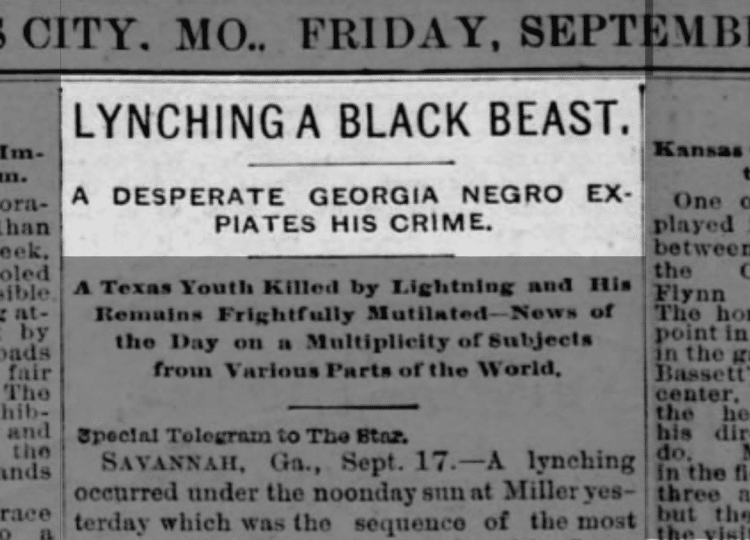
We are not often asked what was lost while these institutions were flourishing. We are not asked what it meant for a century of Black Kansas Citians to live in a town where the paper of record was, for most (some might argue all) of its history, an organ of white supremacy. The Kansas City Star apologized for this in 2020, one hundred and forty years into its operation.
The apology was welcome, but it did not raise the dead. A century of coverage had already done its work. The lynchings it sanitized, the mobs it flattered, the Black neighborhoods it redlined in print before the banks did it in ledgers, these were not undone by an editorial series of regret.
The Black press was built precisely because the white press was never going to do this work.
When Freedom’s Journal was founded, its editors declared that they wished to plead their own cause because for too long had others spoken for them. The Chicago Defender followed in 1905. The Pittsburgh Courier. The Baltimore Afro-American. Ida B. Wells, driven out of Memphis for the crime of counting lynchings and printing the sums.
These institutions did not arise because Black people lacked access to the white press. Instead, they arose because Black people had access to the white press and found it, overwhelmingly, to be an adversary.
The Kansas City Defender exists inside that lineage.
The Laundering
For as long as American journalism has existed, it has laundered white supremacist ideology through the respectable fabric of objectivity.
The both-sides frame is no innovation of the Trump era. It is how lynching was reported, as well as the Tulsa Race Massacre, as well as the civil rights movement, as well as mass incarceration today.
Our silence when the industry gathers to grieve its own decline should not be mistaken for agreement. We do not wish public media to die. We have simply watched, for generations, what public media does when it is alive.
We have watched it, in 2026, still wrestling with whether John Brown should have been so rude about chattel slavery.
We Are Not the Same
When the industry gathers to mourn the decline of its institutions, we are not the same. For much of white America, public media has been a companion, a thoughtful voice on the commute, a trusted guide to what the morning requires.
For Black America, those same institutions have been, at best, a distant observer, and at most honest, an adversary. The grief over their contraction is a grief we cannot fully share. We built our own. We are still building them. The Kansas City Defender sits where it sits precisely because KCUR, for half a century on these airwaves, could not be counted on to tell us who we are.
What, then, do we say about John Brown?
We say what Frederick Douglass said at Storer College in 1881, when the republic had moved on and the country was busy forgetting. “His zeal in the cause of my race was far greater than mine.” We say what the enslaved whispered to each other during the war. We say what the Union soldiers sang as they marched into battle, that his body lay a-moldering in the grave but his soul went marching on, and they were not singing about a villain.
John Brown was right. The people he fought were not settlers. They were slavers. The violence he committed against them was a small down payment on a debt this country is still refusing to pay. If that sentence is controversial at KCUR, or at any of its peers in any American city, the problem is not with the sentence.
The problem is with the apparatus that produced them. And the apparatus, we regret to report, is still producing.
This piece is part of the Writers at War series, named for the plain fact that the Black press has always been, and remains, a combatant in a longer conflict.