On Tuesday, May 12, the Missouri Supreme Court upheld a congressional map drawn under direct pressure from Donald Trump that uses Troost Avenue, the historic dividing line of racial segregation in Kansas City, as the boundary between two congressional districts. The map splits the Kansas City metropolitan area into three pieces. The ACLU said in plain language that the redistricting will harm political representation for Black residents of Kansas City, who have been divided along racial lines.
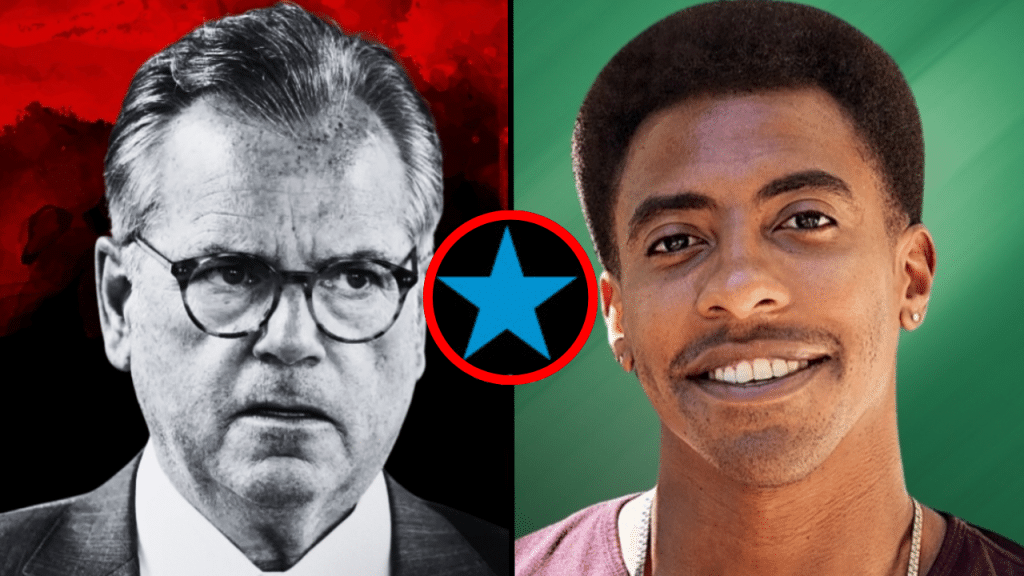
That same day, the Kansas City Star published a David Hudnall column titled “Hartzell Gray wants to go to Congress. He can’t even manage his own lawsuit.”
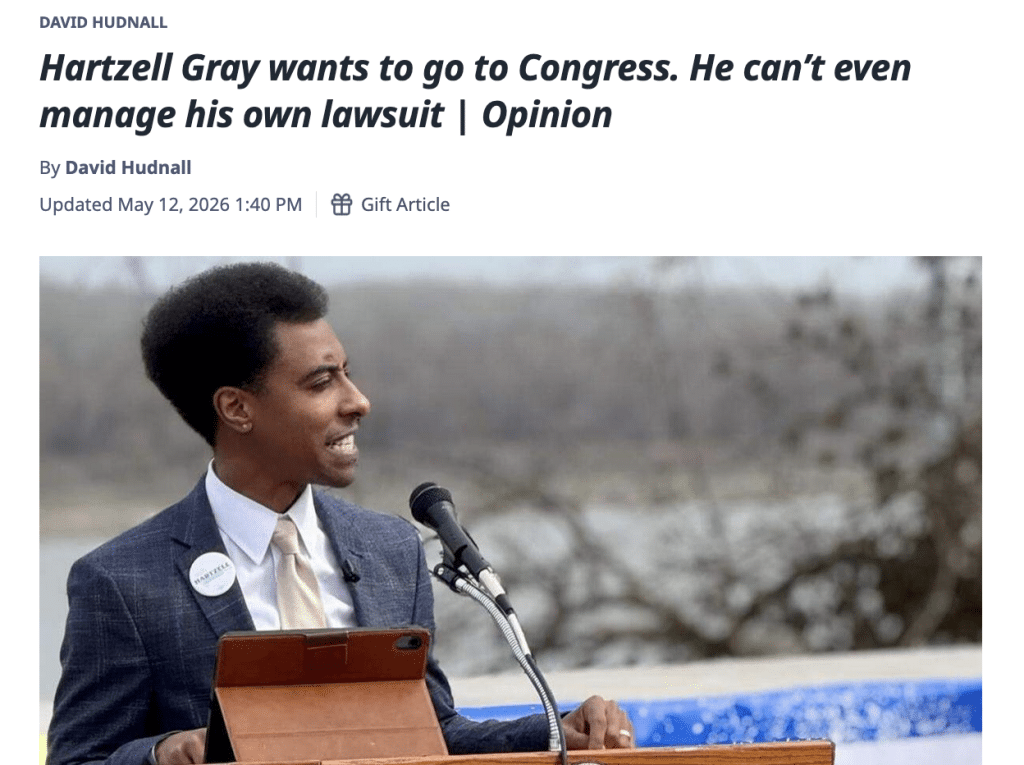
That is the Star.
At such corporate liberal outlets, the purity tests are always reserved for Black progressive challengers. Incumbents serving an adjudicated sexual abuser pass without scrutiny.
On the day Black Kansas Citians lost the last legal challenge to a Trump-backed gerrymander that splits their political voice into thirds, The Star’s opinion section declared that the one Black democratic socialist running in the August 4 Democratic primary, was “never a serious undertaking.”
Mark Alford, the sitting Republican congressman in MO-4 who has spent the last three years cheerleading every Trump policy from mass ICE detention and trafficking operations to the federal layoff campaign, has not received a single comparable column from Hudnall since he joined the editorial board in 2026.
From Procedural Failure to Political Illegitimacy
Hudnall’s column reports on a federal judge’s dismissal of Hartzell Gray’s First Amendment lawsuit against Kansas City and former mayoral Chief of Staff Morgan Said. The judge’s dismissal is a matter of fact. The judge’s language was indeed harsh. The procedural failings Hudnall describes are on the record. None of that is what is in dispute, and any honest response has to acknowledge as much.
Gray missed deadlines and canceled a deposition citing a family emergency and later appeared at a social event the same day. Whether a family emergency also existed that day is not established by the record.
The lawsuit’s collapse is a story worth covering.
But there is a difference between covering a story and constructing one.
Hudnall did not write a column about a lawsuit. He took a procedural setback and used it to mount a wholesale dismissal of a congressional campaign. That last move, from procedural failure to political illegitimacy, is the leap that requires interrogation.
Hudnall treats the order of a George W. Bush-appointed federal judge as a referendum on a Black progressive congressional campaign, without noting who put that judge on the bench.
The column’s closing verdict on Gray’s campaign is delivered by Tom Porto, the attorney the city paid to beat him in court. “He was never available,” Porto told Hudnall. “It did eventually make you wonder, like, wait a minute, is this lawsuit even a serious pursuit for this guy?” Hudnall does not note that Porto’s entire role in this matter was to defeat Hartzell Gray.
To make that leap honestly, a columnist would have to apply the same standard everywhere else. Hudnall does not.
What Mark Alford Has Done
Consider what Mark Alford has done in Congress since taking office in January 2023.
He has publicly supported the 2025 federal mass layoffs that the Trump administration imposed on hundreds of thousands of civil servants (a workforce in which Black women have been disproportionately represented and disproportionately harmed).
He has backed Trump’s mass deportation campaign, which United Nations human rights experts have condemned as a violation of international law, calling on the campaign trail for the completion of Trump’s wall and the deportation of immigrants from Kansas City and beyond.
He has voted to keep arming israel through the campaign in Gaza that international human rights organizations have named a genocide.
He has supported tariffs that raise costs on his own constituents, on the grounds that American consumers should accept the pain to fix the country.
Where is the Kansas City Star opinion column titled “Mark Alford can’t even break with a fascist president”? Where is the column titled “Mark Alford can’t even vote against arming a genocide”?
You will not find them, because they do not exist.
The Star and the Tabloid
It is worth naming what the Kansas City Star is now. The paper is owned by McClatchy, which has been controlled since 2020 by Chatham Asset Management, the hedge fund that also owned the National Enquirer at the height of David Pecker’s catch-and-kill operation for Donald Trump in 2016. “Catch-and-kill” is a name for a practice where a media company purchases exclusive rights to damaging stories in order to bury them.
The National Enquirer tabloid paid Karen McDougal a hundred and fifty thousand dollars for exclusive rights to her affair allegations against Trump and then buried the story. Pecker testified to all of this in the New York criminal trial that ended in Trump’s conviction on thirty-four felony counts of falsifying business records. In December 2024, McClatchy formally merged with a360media, the renamed parent company of the National Enquirer.
The Kansas City Star and the tabloid that bankrolled Trump’s hush-money operation now sit under one corporate roof. This is the ownership structure under which the Star concluded that Hartzell Gray’s campaign was “more like an extension of the same politics of performance” than a real run for Congress.
The most generous account of The Star’s coverage of the actual sitting representative of MO-4 is silence and the most accurate account is dereliction.
Where is the David Hudnall column titled “Mark Alford can’t even break from a president found liable in court for sexual abuse?”
Where is the column titled “Mark Alford can’t even disavow a president named throughout the Epstein files”?
Hudnall has written a column about the Kansas City connections in the Epstein files. He has not turned that lens on the congressman from MO-4 who has spent three years cheerleading the man whose name appears more than any other individual throughout them.
The standard that disqualifies a Black democratic socialist from polite Star opinion never reaches the white incumbent who serves a felon convicted of thirty-four counts of falsifying business records to cover up an affair with a porn star.
The purity test is the politics.
Not the Messenger. The Machine.
But the pattern is not Hudnall alone. As with every piece in my Writers at War series, I do not mistake the messenger for the machine. Hudnall is one moving part of a corporatist liberal white press apparatus that has been doing this work for a hundred and forty-five years. The columnist comes and goes but the function does not.
Instead, it is the Star’s opinion section as a whole, and the editorial board that decides what runs on it. In the same week that ended with the Hudnall column on Hartzell, that opinion section made another editorial choice worth naming.
On May 6, six days before the column on Hartzell ran, the Star handed Mark Alford its opinion page.
Alford published a guest commentary in The Star titled “Bill to protect America’s nuclear deterrent for US security,” writing in his own voice about his Strategic Assets Protection Act, invoking the Chinese Communist Party, and positioning himself as a serious national security legislator advancing Trump’s foreign policy agenda.
The opinion section has run some critical pieces on Alford in 2026. Joel Mathis wrote a commentary in March questioning Alford’s rhetoric on Trump’s Iran war and his framing of “sacrifice” for working Americans. None of those pieces argues Mark Alford is unfit for the office he holds. None concludes that his candidacy was never a serious undertaking. That language is reserved for a particular target. The opinion section has shown it knows exactly when to deploy that language, and exactly against whom.
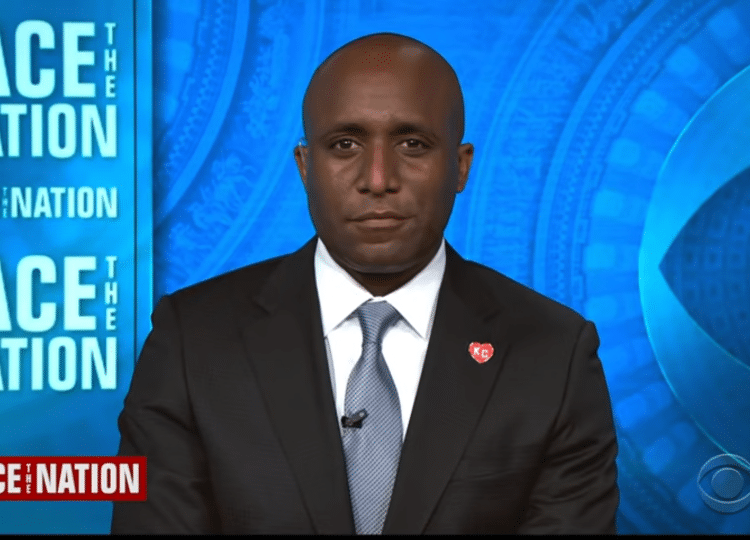
This brings us to the actual story Hudnall buried in his own column. The premise of Hartzell’s lawsuit was that Morgan Said, then the Chief of Staff to Mayor Quinton Lucas, leaned on the leadership of KCUR, the local NPR affiliate, to discipline Hartzell for his off-air activism with KC Tenants.
That is a serious allegation. A sitting Democratic administration allegedly used municipal political pressure to interfere with the employment of a Black on-air personality whose politics were embarrassing them at City Hall. If the pressure campaign happened as described, it is a public-radio scandal.
If true, it is a story about the misuse of mayoral power against journalism, against Black political voice, and against the right of a tenant organizer to keep his day job.
Hudnall acknowledges this in one sentence. He calls it “fair criticism” of the city. He then makes Hartzell, not Said, not the Mayor, not the institutional pressure, the subject of his column.
Once again, The Star reaches the edge of the structural story, recognizes it, and walks back.
The shape of the column protects the order. The activist becomes the problem and the institution becomes the aside. By the time the reader reaches the end, what they remember is not that a sitting mayor’s office allegedly tried to get a Black activist fired from public radio but instead that Hartzell Gray missed depositions.
May 12 Was Not Only Missouri
The story of what the Star did to Hartzell Gray on May 12 sits inside a national story older than the Missouri gerrymander and larger than any single column. In April, the United States Supreme Court ruled in Louisiana v. Callais, gutting what remained of Section 2 of the 1965 Voting Rights Act and giving Republican-led states legal cover to eliminate majority-Black congressional districts at will. Tennessee passed legislation within the week. Alabama, Louisiana, South Carolina, and Florida are following.
Tennessee split the state’s only majority-Black, majority-Democrat congressional district in Memphis into pieces. Then, on May 12, the same day the Missouri Supreme Court upheld the gerrymander against Black Kansas City, Tennessee Republican House Speaker Cameron Sexton stripped every one of the state’s twenty-four House Democrats from their committee assignments, removing every Black elected official in the Tennessee state legislature from the committees where the work of governance actually happens. The move also targeted Justin Pearson, a Black congressional candidate whose Memphis district was just dismembered by the new map. Pearson said the action “strips nearly 2 million Tennesseans from the representation they deserve.”
The Missouri map upheld on May 12 is the latest site of contestation in what political scientists at Berkeley and Stanford have described as a sustained nationwide assault on Black political power.
Sixty-one years after the Voting Rights Act passed, the country is doing in 2026 what it did in 1877 when federal troops withdrew from the South and the political life of Reconstruction was made to disappear.
A Hundred and Forty-Five Years
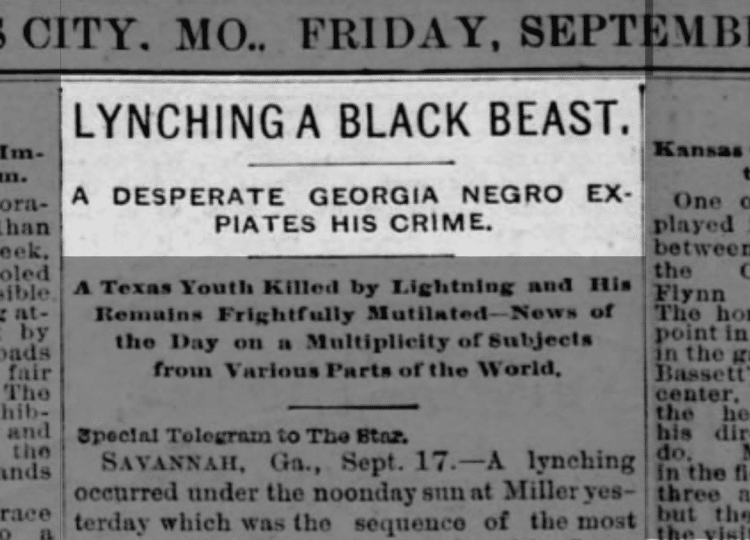
Again, it is worth saying out loud the role of a liberal corporate press like The Star in such contexts. In December 2020, on the back of the global uprisings against the police killing of George Floyd, they published a six-part series titled “The truth in Black and white” in which the paper apologized for 140 years of racist coverage. They acknowledged that the Star had “disenfranchised, ignored and scorned generations of Black Kansas Citians.” The paper had reinforced Jim Crow laws and redlining. It had robbed Black Kansas City of dignity, opportunity, and recognition.
The paper’s archives, the “investigation” found, depicted Black Kansas Citians for decades as criminals in a crime-laden world. When Charlie Parker died, the Star misspelled his name and got his age wrong. When Jackie Robinson, who had played for the Kansas City Monarchs, broke the color line in 1947, the Times buried the news on page 18.
That was five and a half years ago. The Defender exists because the institutional pattern the Star apologized for did not end with the apology.
The crude racism of the old front page became the curated scrutiny of the new opinion section. The reservation of personal language for Black candidates while sitting fascists go uncovered is the same practice The Star acknowledged in 2020, with slightly better manners.
The Star’s representative in this iteration is not the segregationist columnist of the 1950s, but now is the liberal opinion writer who has covered the right side of some issues, the wrong side of others, and trained his sharpest instincts on the candidates least useful to the white power establishment he claims to critique.
The Star’s verdict is the politics. And that verdict now gets distributed to a McClatchy readership of thousands of Kansas Citians who are slightly more likely to dismiss the leading democratic socialist candidate in MO-4 running against Mark Alford from the left.
A note on why this exists.
I am writing this piece as part of the Writers at War series. David Hudnall is a National Press Foundation award winner. I am not writing this piece because what David or the Kansas City Star says about Hartzell Gray, or about any Black candidate, or about Black Kansas City, has legitimacy with me. Quite frankly it does not.
The Star’s coverage of Black political life has been at best problematic and at worst deadly since long before any of us were born.
Further, I am writing this because legitimacy and reach are not the same thing. The Star does not need our trust to do its work. It needs the readership of thousands of Kansas Citians who still treat the opinion page as the default frame through which to interpret local political life. That readership is a weapon. Every time the paper does what it just did to Hartzell Gray, it deploys that weapon against a Black political movement that has neither the platform nor the institutional infrastructure to absorb the blow.
This is what the Star has been doing since it covered Black people in this city as criminals in a crime-laden world for the better part of a century. That coverage was the rhetorical infrastructure of the lynching era.
We write because they keep writing. We write back because the absence of our voice is the precondition the Star needs to do its work. We write inside the tradition of Wells, of the Chicago Defender, of every Black newspaper that emerged because white papers refused to tell the truth about us and about themselves. The Defender exists because of the Star, not in spite of it.
We will keep saying what the Star will not. Mark Alford is a fascist incumbent in a district drawn by the man he serves to silence the voters who oppose him. Hartzell Gray is running against that order. Hartzell’s lawsuit collapsed. His campaign has not. The next time David Hudnall finds his most personal language of the year, I suggest he aim it at the man already in Congress.
——————————————————————————————————————
A note on editorial intent. This piece is media criticism and press accountability journalism.The Defender does not endorse or oppose candidates for elective office, in this race or in any other. References to Mark Alford concern his public voting record and stated public positions, all of which are matters of documented fact. References to Hartzell Gray concern the coverage he has received in The Kansas City Star, not the merits of his candidacy. That determination belongs to the voters of MO-4.