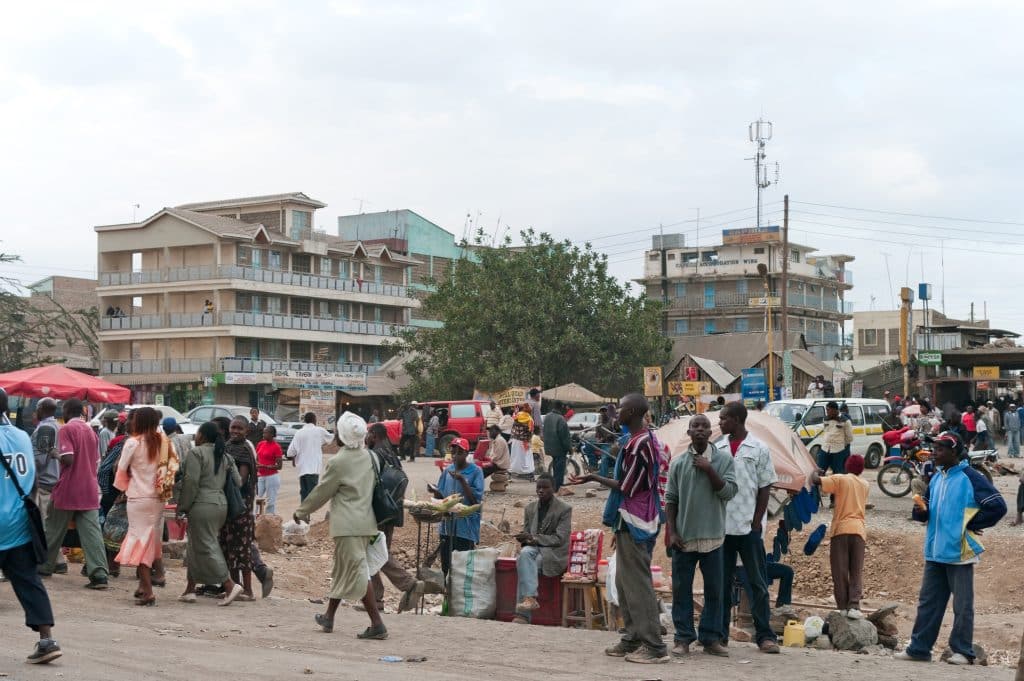
NAIROBI–With his bantamweight physique dissolved underneath a large purple smock, 51-year-old Nathan Muturi patrols the narrow aisles of a suburban neighborhood supermarket here like a beat cop—stocking, cleaning, bagging—for 15 hours a day, six days a week. That is 89 hours a week if you deduct the hour, or 10 minutes per shift, that he is allowed for lunch.
Awakening at 5 A.M. each workday to clock in two hours later— “7 to 2 in the afternoon just flies by but 2 to 10 is a grind,” he told the Kansas City Defender—before punching out at 10 P.M., hailing a motorcycle taxi, and typically arriving home an hour later. He talks to his wife and his 8-year-old daughter if she is up before he turns in, usually around midnight, only to be up and at it again five hours later.
Rinse and repeat.

In exchange for this grueling schedule, Nathan is paid 10,000 Kenyan shillings per month, or the equivalent of $77.40.
After two months on the job, he received his first paycheck on the morning of March 10th but he owed more than three months–about $386–in back rent, another $85 in school fees to lift his daughter’s two week classroom suspension, and a bevy of friends and coworkers who loaned him money over the past few months to keep him afloat until payday.
Doling out what he could afford throughout the day via his mobile phone app left him with roughly $2.32 at the end of his shift, scarcely enough to get home for the night and back to work the following day.
“Life in Kenya is not easy,” Nathan told the Defender. “It’s like you’re in jail and you’re constantly being frisked for whatever little money you have on you. All of us are constantly behind on our bills. “Everyone is literally living hand to mouth.”
Sixty-three years after winning its independence from British colonialism, half of this East African nation’s population of 53 million lives on the equivalent of $3 per day, and like Nathan, are barely getting by, if at all.
With inflation for basic goods continuing to rise, that means that most Kenyan households have more money going out than coming in, sharply reducing the consumer buying power that is the rebar of economic growth.
Nowhere is this truer than here in this teeming capital city of 5 million people. According to Kenya’s Bureau of National Statistics, 71 percent of Nairobi’s 1,661, 533 households earn less than $359 in monthly take-home pay, of which $100 is spent on food, $44 on housing and utilities, $29 on transportation, and $9 on medical bills, leaving the average family with only $177 to pay for their children’s school fees or college tuition, child care, phone and internet services, clothes, furniture and appliances.
Stunningly, only 7.7 percent of all households in greater Nairobi own their own homes; more than 92 percent are either renters or squatters.
This is key because the rate of homeownership is a primary indicator of economic development, whether in Nairobi, Newark or New Orleans’ Ninth Ward, and is the main engine, historically, for families to accumulate wealth and pass it down to future generations.
Similar to African Americans, Kenyans’ low rate of homeownership mirrors the colonial, or Jim Crow era, and Blacks’ failure to make ends meet, on the continent and abroad, reflects the long afterlife of two scourges, settler colonialism and slavery, both of which have assigned to people of African descent the status of a guest worker rather than full citizenship.
At a news conference earlier this year, Daniel Ndirangu, CEO of the Institute for Public Finance, a Kenyan think tank, told reporters:
“A lot of that has created an economy that (we) call a ‘survivalist economy.’ (It is) creating survival. You’re just moving from one day to the other…while falling real wages and rising service costs have dampened household consumption.”
Nathan’s tight finances and his daily struggle to earn the equivalent of what much of the West considers loose change is part of a worldwide cost-of-living crisis for Africans at home and in the diaspora that was introduced nearly 500 years ago when the first Europeans alighted on African soil and established the system we know today as racial capitalism. With the complicity of a quisling African political leadership, one group–the collective West– continues to accumulate wealth at the expense of the global South, especially Africans, on either side of the Atlantic.
Consider that of the 831 million people in the world who live on less than $3 per day, more than half, 460 billion, live on the African continent, according to a 2025 World Bank study.
Eighty-five percent of the continent’s population of 1.5 billion—roughly 100 million more than China’s—lives on less than $5.50 daily. Despite the Democratic Republic of Congo’s abundance of mineral resources used for personal computing and cell phones, nearly three quarters of the population, roughly 80 million people, live on less than $2.15 daily, according to a 2025 World Bank study.
The primary reasons are, of course, the theft of Africans’ labor, land and raw mineral resources, combined with the continent’s failure to industrialize in the decades since settler colonialism ended. The U.S. climbed to the global economy’s pole position after World War II by adding value to rubber, aluminum, copper, zinc, iron ore and other base metals to manufacture a wide range of consumer goods, including, most prominently, the automobile.
China would follow suit, and through industrialization and exports, expanded its share of world trade from 1 percent in 1970 to more than 12 percent in 2023, representing trillions of dollars in revenue annually, as well as wages paid to Chinese employees.
By contrast, while much of the world speeds off into a high-tech future, Africa is a study in stasis, its macro-economies no different today than in the colonial era when the European settler demanded little more than a hole in the ground to extract mineral wealth and a railway to the sea to export it, redolent of King Leopold’s rape of the Congo, which began to unravel when a Belgian accountant noticed African ships loaded with rubber coming into Belgian ports, but no Belgian vessels going out.
Though Africans account for nearly one in every five people on earth, the continent’s share of international trade and gross domestic product remains at about 3 percent, or roughly the same as in 1950, seven years before Ghana became the first nation south of the Sahara Desert to gain independence.
Worse yet is that raw, unprocessed commodities account for 70 percent of Africa’s exports today, and the continent’s manufacturing sector represents only 2 per cent of value- added industries worldwide. Conversely, value-added goods account for 84 percent of the imported goods pouring into Africa.
That’s financially debilitating for several reasons. First, the industrial process is where the money is to be found. Coffee growers, for example, typically pocket less than 10 percent of the retail price of the cappuccino that you buy from Starbucks or the pound of ground coffee sold on the grocery store shelf at Whole Foods or Cosentinos in downtown Kansas City.
Second, the industrial process adds jobs–tasks as simple as roasting coffee, shelling nuts, or bottling juices–that typically pay higher wages than what is found in service sector employment.
And thirdly, producing consumer goods at home rather than importing them from abroad sharply lowers the retail price.
As the Norwegian economist Erik Reinert pointed out many years ago:
“No nation has ever taken the step from being poor to being wealthy by exporting raw materials in the absence of a domestic manufacturing sector.”
It is no coincidence that Africa’s pre-industrial economy closely resembles the United States post-industrial economy. Without access to decent-paying, unionized jobs on the shop floor, or the spinoff employment opportunities that accrue from value-added industries, Kenyans are heavily reliant on low-paying service sector jobs such as Nathan’s grocery store gig, Uber and the hospitality industry.
What that means practically speaking is a proliferation of barber shops and hair salons on virtually every commercial strip in Nairobi as in African American neighborhoods in Detroit, Chicago, Atlanta or Philly, and the familiar, ubiquitousness of harried Black waitresses hustling to meet the demands of white women while shopping at high-end department stores or hip cafes.
“I call Kenya a man-eat-man-world,’ Nathan said. “And if you know anything about Africa, that is not who we’re supposed to be.”
Only 3.54 percent of all Nairobi households, 588,818, take home more than $1,425 per month in pay. Quadrupling that number would not only imbue the Kenyan economy with the buying power it needs to grow—comparable to the postwar U.S. economy that birthed the most prosperous middle class of the Industrial Age—it could potentially expand the customer base for goods and services produced by the West. Said Nathan:
“It seems that if you were to give Kenyans a raise, that would be a win-win for everybody.”
African American employees joined with their white coworkers at the nadir of the Great Depression to organize the workforce, transform bad jobs into good jobs, and lift all boats, albeit unequally. Black homeownership skyrocketed. But when President Ronald Reagan began to ship manufacturing jobs overseas in an effort to lower wages and atomize the interracial working-class coalition that pressured the New Deal administration, African Americans were the first and worst hit, losing jobs on the factory floor at an extraordinary clip.
No longer making anything of material value, America’s industrialists turned to loansharking to turn a profit, transforming Black neighborhoods into what the sociologist Sassia Sasken describes as “extraction zones.” As one example, African Americans were 80 percent more likely than whites to lose a home to foreclosure as the result of the subprime mortgage market that targeted people of color.
Concomitantly, Western financiers began to extract more and more wealth from African cities beginning with the disintegration of the Soviet Union, loaning the continent’s political leadership money at higher and higher interest rates while demanding that they open their domestic markets to the shrinking number of goods still manufactured in the U.S. and Europe. What’s more, Africans like Nathan are required to repay the loans in the form of higher taxes, school fees, low wages and unemployment.
Nickel and diming African workers is shortsighted, however. Similar to Henry Ford’s decision to pay his employees $5 per day so that they could afford to buy his cars, raising the pay of the continental workforce would stimulate the global economy by adding more than a billion paying customers. Hence, the world’s prosperity depends largely on Africans’ buying power.
For his part, Nathan dreams of the life he might build for his family with more money: buying a used car, perhaps, or a bed for he and his wife to sleep on rather than their worn mattress, or maybe send his precocious daughter to private school.
His wife just lost her job working as a personal assistant for a diplomatic couple that paid her a monthly salary of $232 per month. He continues to show up for work each day—partly because the job takes his mind off his financial woes—exerting so much energy that his younger co-workers nicknamed him “Gen Z.” With his next check, he plans to pay his pastor about $8 for finding him the grocery store job, and the store manager a $16 kickback for hiring him.
“These employers know how hard it is to find work nowadays,” he said, “so they blackmail you…These jobs are all terrible but you can’t quit because we’ve all got so many people depending on us.”
And then:
“By God’s grace, we’ll make it.”

On the day after payday two weeks ago, Nathan arrived at work and received some good news finally: in recognition of his hard work, the boss had decided to raise his pay to $116 per month.