The Kansas City Defender is proud to announce Jon Jeter as our first International Correspondent. A two-time Pulitzer Prize finalist, former Washington Post foreign correspondent and bureau chief, Jon brings more than two decades of experience chronicling the lives of Black people across the African diaspora to our growing team.
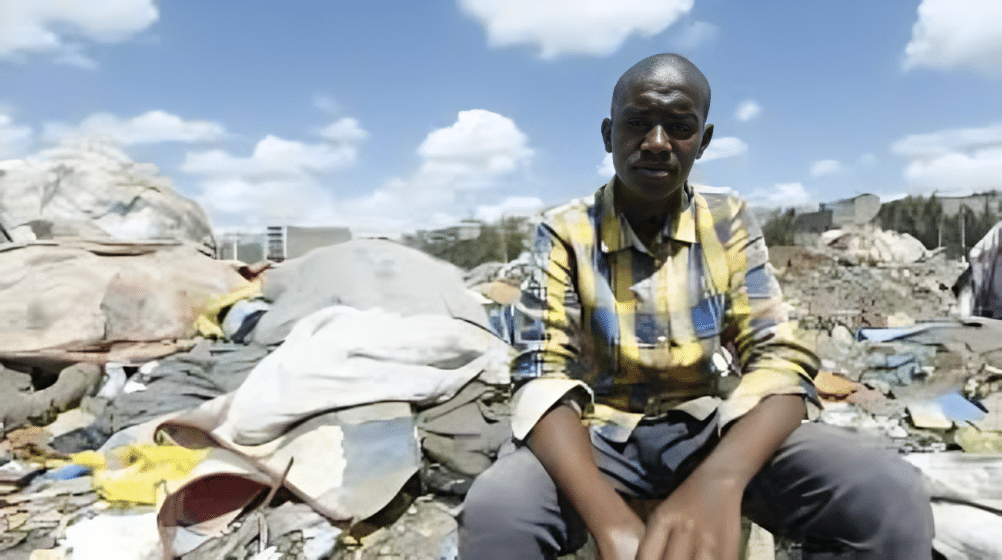
NAIROBI, February 2, 2026— For much of the last month, you could find John Mwalili on most days scouring the dumpsite in an abandoned quarry east of this city, his lithe frame stooped at almost a 90-degree -angle to rummage through a sea of trash for plastic bottles that he could sell for recycling at a penny per pound.
He is 16.
John is a high school dropout in circumstances that are quite different from what we might expect to see in Kansas City, Atlanta or Houston.
Had he the equivalent of roughly $415 in the local currency, John could afford to pay the school fees charged by one of Nairobi’s most prestigious public high schools for boys, Alliance, where he was admitted in December after scoring 64—out of a possible 72—on the Kenya Junior School Education Assessment, or KJSEA, 10 points higher than the second-highest score at his school.
Absent electricity in his family’s shanty, he often studied by candlelight in the months leading up to the nationwide placement exam.
“I want to be a doctor,” he told local reporters. “I want to help people who cannot afford treatment. And I want my family to have a better life.”
The school fees alone are about $115 more than the $300 in monthly wages earned by the typical Kenyan worker. Add on the cost of the boarding school’s mandatory uniforms, bedding, toiletries and other materials and the tab easily doubles. John’s father, Nicholas, a street vendor, tried to raise the money from local charities or government scholarships but to no avail. When John and his parents reported empty-handed to enroll in Alliance on January 12, “we were sent back home until we raise the school fees,” John said. Continuing, he said:
“I have no other means but to work in the dumpsite and see if we can raise the money so that I can raise the school fees. It is a hard job but we have no one else to rescue us.”
After a week at the notorious dumpsite, where police say that a serial killer dumped the bodies of at least 9 women in 2024, John had collected 220 pounds of plastic bottles earning him 300 Kenyan shillings, equivalent to about $2.33.
It is hardly a coincidence that the world’s poorest continent is also home to the world’s highest school dropout rates. While violent conflicts and teen marriage play a role, the primary factor is that public high schools in sub-Saharan Africa routinely charge fees to children whose families can least afford to pay.
According to World Bank data, nearly 60 percent of Africans between the ages of 15 and 17 are not in school, and of the 244 million children between the ages of 6 and 18 who did not attend school in 2021, the United Nations’ Educational, Social and Cultural Organization, or UNESCO, estimates that 98 million lived due south of the Saharan desert. Sixteen of the 20 countries in the world with the most out-of-school children are in Africa.
For Black Americans watching from Kansas City or Atlanta or Houston, John’s story may feel uncomfortably familiar. The same financial institutions that demand African governments slash education spending have spent decades defunding schools in Black neighborhoods across the United States. The same logic that sends a brilliant 16-year-old to scavenge plastic bottles in Nairobi sends Black children in America to schools without counselors, nurses, or air conditioning.
In Kenya, the continent’s 7th largest country with a population of about 59 million, 830,000 sophomores who took the KJSEA in December have not enrolled in school, with the first day of classes for the semester approaching next week. So desperate are some communities that a village chief in the country’s north two weeks ago wrote a letter on behalf of a family of seven orphaned children soliciting donations to raise $116 to pay school fees for a 15-year-old with outstanding grades. Last week, a 19-year-old woman, Sandra Cherono, walked 6 miles to the nearest police station in her rural Kenyan county to ask officers to help her pay her school fees for 10th grade. They complied.
“I had stayed at home for two weeks since other learners reported , then I decided to come here to the police station,” she told local news media this week. “I met the officers, told them my story, and I am happy that they listened. I knew whatever the case I would be safe. I did not tell anyone I was coming here.”
Typical of Kenyans’ loudening frustration, one wrote on social media:
“Every January, we see the same stories. Why? Because partial bursaries aren’t enough for a largely poor citizenry. Education must be fully subsidized or free to break this cycle.”
Wrote another:
“These are signs of a Failed state.”
Indeed, a 2025 survey found that more than half, 54 percent, of adults surveyed in sub-Saharan Africa told pollsters that they are “very worried” about paying school fees, and nearly a third, 29 percent, identify school fees as their biggest financial worry, eclipsing medical expenses and pensions.
Sixty-nine years after Ghana became the first African nation to liberate itself from European misrule and 32 years after South Africa became the last when voters of all races went to the polls to abolish the white-minority government known as apartheid, the continent remains unfathomably poor by Western standards, accounting for nearly 20 percent of the world’s population yet only 3 percent of its Gross Domestic Product, roughly the same as 70 years ago at the zenith of settler colonialism.
The correlation between a student’s grade point average, or GPA, and national GDP, helps explain why Africa seems stuck in time.
Development economists have known for decades that free, public education, quality, affordable healthcare and land reform are the cornerstones of industrialization, and ultimately, prosperity. So if school fees are antithetical to economic development, cui bono–who benefits– from a policy whose logic is redolent of the hut taxes charged by white settler governments of Africans whose family lineage preceded Europeans’ arrival by centuries?
Mostly the Western financiers who loan sovereign African states money at exorbitant interest rates, and the politicians who are in their pocket. Through the World Bank and International Monetary Fund’s structural adjustment programs,Western lenders in the late 1980s began requiring debtor states to reduce public spending on education, health care and social services as a condition of their loans, leaving government officials with more cash on hand to pay their creditors rather than the commonwealth.
Economists euphemistically refer to this “let-them-eat-cake” public financing scheme as “austerity” and the budget knife cuts deepest into schools, particularly those serving Africans both here and in the Americas.
When Chicago closed 50 schools in Black and Latino neighborhoods, when Philadelphia sold off school buildings to pay creditors, when Detroit emergency managers slashed education budgets to service municipal debt, they were running the structural adjustment playbook that has been utilized to starve African schools for decades.
Black communities on both continents have become laboratories for austerity, their children’s futures collateral for loans that enrich the already wealthy.
In 2013, Chicago Mayor Rahm Emanuel closed 50 public schools—the most by a single city at one time in the nation’s history—with a combined enrollment that was 88 percent Black or Latino. Just days before he announced the school closures, Emanuel (or Mayor 1 Percent as he was widely known during his tenure in Chicago) announced the city’s plans to invest $55 million to subsidize the construction of a new hotel and basketball arena for DePaul University, a private Jesuit university that charges each undergraduate roughly $30,000 annually in tuition and fees.
Similarly, in Uganda, annual GDP per capita is about $864, just slightly more than the nearly $700 in tuition charged by the East African nation’s top public high schools. A 2024 Associated Press story described school officials in Uganda’s capital city of Kampala sending a student home for unpaid tuition, then calling her mother to demand payment while she sat in the hospital by her husband’s deathbed.
Moreover, students are expected to pay for everything from the purchase of a new school bus to bags of cement to photocopying paper. Fagil Mandy, a former Ugandan schools inspector, told the AP:
“We can’t let education be treated like a market stall.”
The benefits of lowering financial barriers to education couldn’t be clearer. When Kenyan President Mwai Kibaki announced his administration would stop charging fees for primary school education just days before the start of the 2003 school year, more than a million students returned to the classroom, including 84-year-old Kimani Ng’ang’a Maruge, who is the oldest person ever to enroll in first grade, according to the Guinness Book of World Records.
“I wanted to learn how to read the Bible,” Maruge would explain.
Also returning to Kenyan schools after a two-year absence was 12-year-old Mike Wambui, who’d dropped out at the age of 10 when his mother fell deathly ill and his grandmother couldn’t earn enough from her job selling vegetables to pay his fee.Wambui remembers that on the day following Kibaki’s announcement, his grandmother skipped work to accompany him to school. He told the Kansas City Defender:
“It was a choice between having to eat that day or enrolling me in school. It was an incredible sacrifice but she knew how important education was.”
Empathetic teachers pitched in, finding a school uniform for Mike that was a size too big but appreciated nonetheless. And even after the layoff, Mike resumed his studies rather seamlessly. He told the Defender:
“I had dreams and I knew education would help me achieve them. Also, school was safe and there was food; it was an escape from a lot of the problems that were going on at home.”
Mike would go on to graduate from college and today he works as a social worker for two nonprofit organizations, one serving the elderly, the other children. He also volunteers with a number of charities. When asked how things might have turned out had he not returned to school, Mike answers unhesitatingly:
“I’d have ended up on the street like millions of other kids. There is a blueprint for these things. I’d have been a thief, and I’d have made a very good one because I’m smart just like a lot of thieves in Kenya.”
After Kenyan newspapers published accounts of John Mwalili’s plight, donations from both public and private sources poured in, enabling him to pay his school fees and all related expenses for his first year at Alliance.
But there remain millions of children across the continent whose futures are jeopardized by their inability to pay school fees. One young Kenyan woman who gave her name only as” Martha” because she fears violent reprisals from the government, described school fees as a “national disgrace,” and symbolic of the world’s loathing of Africans.
“This only goes to show that our political leaders are puppets of the Western (financiers) who line their pockets,” said Martha, who works in retail at a Nairobi mall. “Whose interest does it serve to have our best and brightest kids idled by unpaid school fees? What kind of future are they going to have and what kind of future is Kenya going to have?
This is plunder posing as public policy!”