That day, I felt as if we no longer had the right to play. He sat there in that condition, watching us, and it felt as though every glance he gave me was tightening something I couldn’t escape.
Today in Gaza, thousands of people live with amputated limbs as a result of the ongoing genocide. For many, dreams have been completely derailed, forcibly reshaped within a reality that bears no resemblance to what they once imagined. These are no longer isolated injuries; they have become another layer of an ongoing tragedy, one that continues even after what is so- called a “ceasefire.”
It all began when I went to Gaza City earlier this February to visit my university after it had been destroyed by Israeli airstrikes, and to see my friend Mahmoud, whom I had been unable to visit for months because of the genocide, despite his repeated calls asking me to come.
After visiting our university that day, Mahmoud and I went to play volleyball with his neighbors. The feeling was rare—playing, moving, laughing—as if we were on a normal court, lights all around us, briefly removed from everything that surrounded us after years of deprivation.
The next day, I returned to Al-Mawasi, a coastal area west of Khan Younis that had turned into a vast sprawl of displacement tents. I have lived there since I was displaced by that paper with evacuation orders that forced us to leave Rafah. There, I told my friends in the camp about what had happened, about that forgotten feeling: to play.
We tried to find a volleyball playground in Al-Mawasi, but there was nothing, so we decided to build one ourselves, on the beach.
We divided the tasks among us. Some searched for a suitable spot, others prepared the net, and I asked a friend to bring us a ball from Gaza City.
Two days later, we had our court by the sea.
When we started playing, friends and young men from nearby camps gathered around us. Suddenly, the place was alive, as if everyone had stepped out, if only for a moment, from the harshness of tents and the weight of daily survival. We were trying to steal small moments from a life that no longer existed.
As more people joined, we divided into teams. One team needed a final player. I looked around, searching for someone, until my eyes fell on a familiar face.
At first, I focused only on his features, trying to remember. Then I recognized him.
It was “Al-Asmar.”
We called him that since high school. He wasn’t very tall, so he didn’t continue with basketball, even though he had been the best player at the time. He later turned to volleyball, relying on his speed and intelligence. He was remarkable.
I hadn’t known he was living in the nearby camp.
“Come play with us, neighbor,” I called out.
I didn’t know that this sentence would become the heaviest one I would carry with me that night.
“I can’t,” he said.
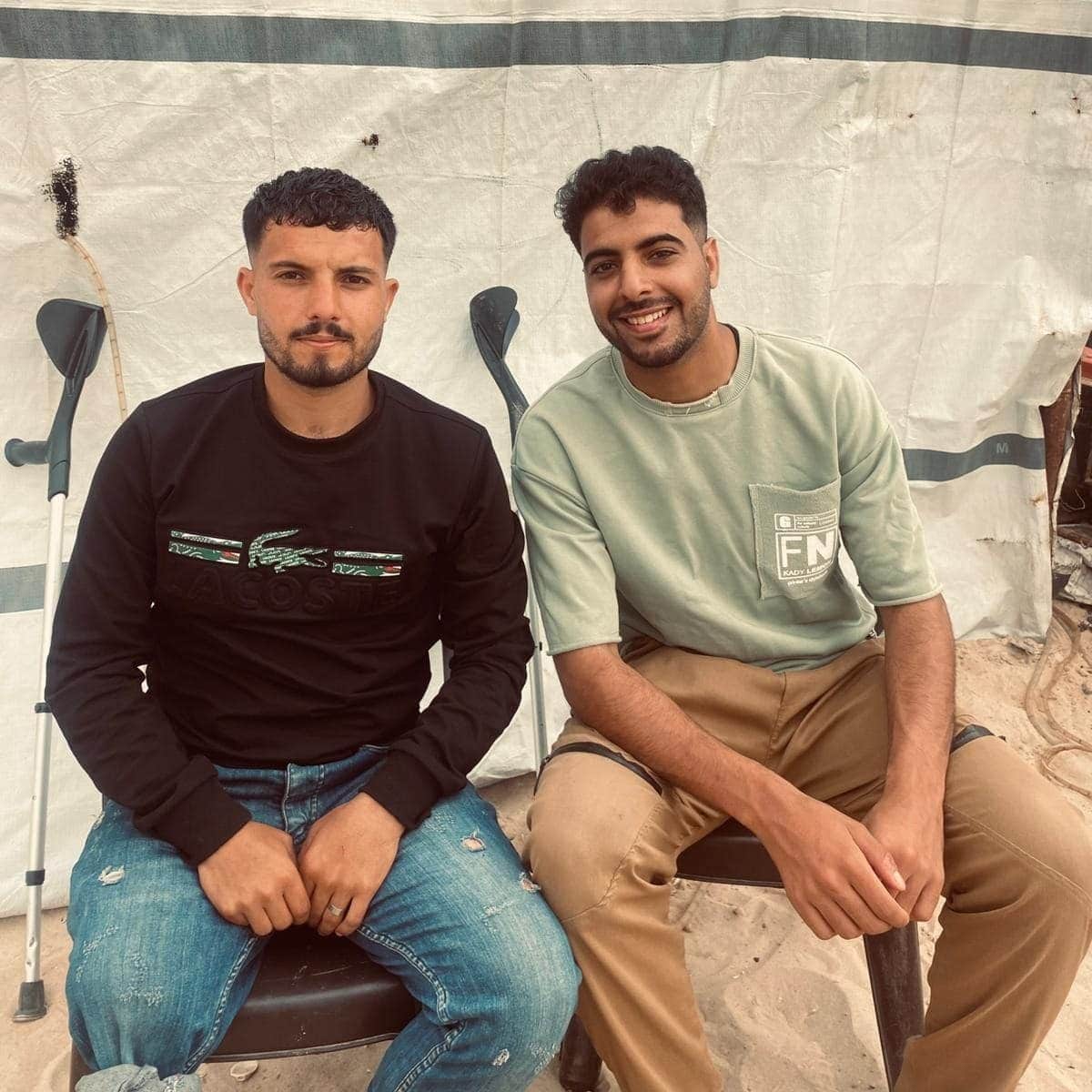
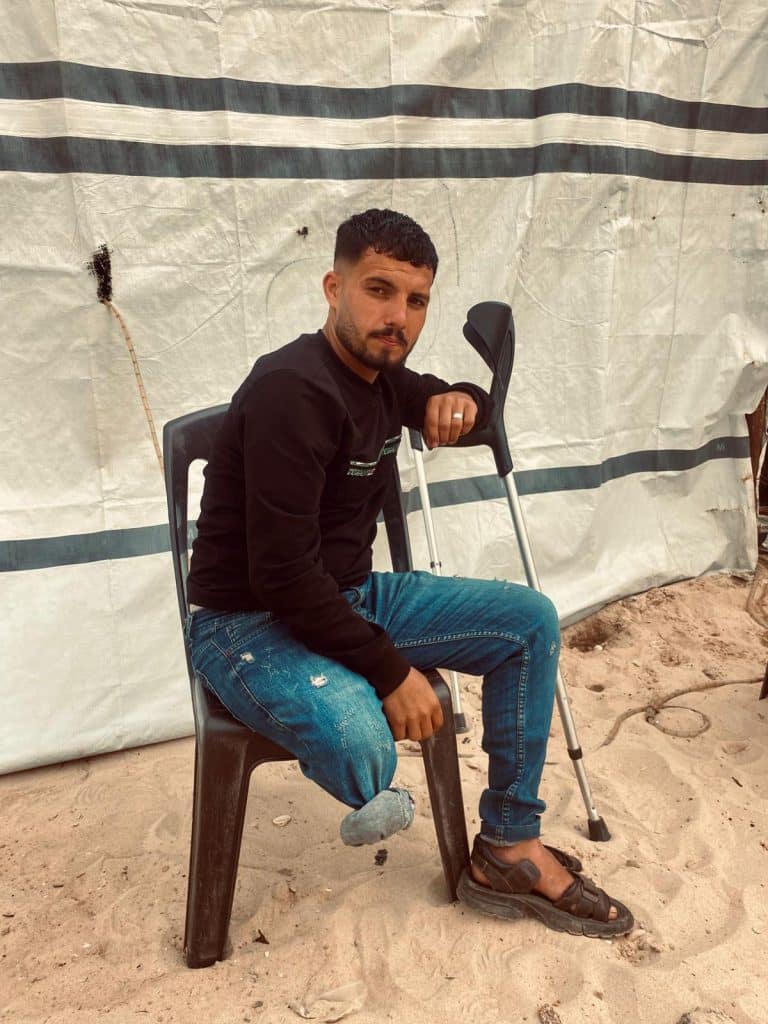
Another player stepped in, and the team was complete. We began playing, while he remained seated on a low chair, his trousers covering his leg, a crutch beside him, watching us.
After the matches ended, I went to sit next to him and asked, “Why didn’t you come play with us?”
He answered quietly that he couldn’t. Then he revealed his amputated leg.
That moment was a shock. Only then did I realize the crutches beside him were his.
He told me that after being displaced from Rafah in mid-2024, he had been displaced several times, like so many others. One day, he and a friend decided to return home to retrieve some of the belongings they had left behind, some clothes, because they could not afford to buy anything new while living in tents, since everything was unaffordable.
They were not in a battle.
They were not fighting.
They were simply trying to bring back something to protect them from the cold.
But that day, they were targeted by Israeli airstrikes.
His friend was killed instantly. He survived, but in a body that was no longer the same. He lost his leg and was hit by shrapnel in multiple parts of his body, beginning a different kind of suffering, one that does not end with the moment of explosion.
We spoke for hours.
Seeing a friend like Al-Asmar was not something I could process quickly. We sat together for a long time. I was trying to understand, not only what had happened to him, but what was still happening to him.
I asked if he had tried to travel for treatment.
He gave a faint smile, as if he had heard the question many times before.
He told me about the attempts. About patient names that are written down and forgotten. About lists that do not move. About crossings that open in theory but remain closed in practice for those in need of help. He said that thousands are waiting for urgent medical referrals outside Gaza, many wait, and some never get their turn.
Then he spoke about the first days after his injury.
About pain that was sometimes treated with nothing but patience, amid severe shortages of medicine and anesthesia.
He told me that losing his leg was not the end of the story.
It was the beginning.
He tried to work afterward, but he couldn’t. Before the injury, he helped support his family. Now, he depends on them completely.
In a tent, where everything is harder.
Even the simplest things.
He told me that going to the bathroom had become a daily struggle, and that even moving required effort and planning.
In that moment, I began to understand that what happened to him cannot be reduced to the word “injury.”
Here, amputation does not just stop a dream,
it opens the door to a chain of losses that does not end.
What makes it even harsher is that this suffering does not stop at the injury itself.
In Gaza, even the tools that could help restore part of life are not allowed in easily. Prosthetic limbs are prevented from entering through the crossings, or delayed under pretexts like “dual-use.”
In this way, disability becomes not just a result of war, but a condition that is politically prolonged and deepened.
What is happening here is not an exception. It is part of a wider global system that decides who is allowed to live whole, and who is left to continue life with only what remains of them. That system does not look the same everywhere, but its logic is familiar: in the disposability imposed on Palestinians in Gaza, and in the conditions that have long made Black life in the United States vulnerable to state violence, neglect, and premature death.
What is happening here is not an exception. It is part of a wider global system that decides who is allowed to live whole, and who is left to continue life with only what remains of them.
Al-Asmar’s story is not unique.
In Gaza today, limb loss can no longer be seen as a series of isolated incidents. According to the Ministry of Health in Gaza, as of December 2025, there are at least 6,000 amputation cases requiring urgent, long-term rehabilitation, with children making up 25 percent of those affected. These figures come at a time when the healthcare system is on the brink of collapse, leaving thousands without the care they critically need.
More alarming still, one in every four of the injured is a child. Gaza now holds the highest number of child amputees in modern history, according to UNRWA, the UN agency for Palestine refugees.
Yet numbers, as harsh as they are, do not tell the full story.
Because here, injury does not end at the moment of amputation; it begins there.
With the lack of prosthetics and the absence of rehabilitation services, many of the injured find themselves trapped in a reality that offers neither recovery nor a return to their previous lives.
In this sense, amputation is not merely a result of war,but the beginning of an accumulating series of losses that extend from the body into life itself.
That night, I returned to my tent.
I could not sleep.
It was not only what had happened to him that stayed with me,
but what it meant for all of us.
How an entire life can change in a single moment,
and how it can continue afterward, like this.
In Gaza, some stories do not end where they should.
They begin there.