For months, a dangerous narrative has been echoing across Columbia, Missouri: that homelessness is driving an uptick in “crime,” and that unhoused people pose a threat to public safety. In the latest escalation of that narrative, Missouri Gov. Mike Kehoe posted photos on Facebook in early December of a meeting with University of Missouri President and MU Chancellor Mun Choi to discuss what Choi has described as a “rampant” crime problem in the city. That meeting was Choi’s most recent effort to push public officials toward a crackdown framed around homelessness.
According to multiple city officials, none were aware that this meeting was taking place. Nor were they invited.
This narrative around homelessness was pushed to the forefront following the shooting death of Stephens College student Aiyanna Williams on September 27. The day after Williams was killed, Choi sent out a university-wide email demanding that the city take “immediate action.” However, instead of focusing on gun safety, alcohol-fueled violence, or broader public safety measures, he urged the city to pass a loitering ordinance and clear homeless encampments — even though police reports later confirmed the subject was not unhoused. In fact, the man charged with Williams’ death had recently moved to Columbia from Florida and had only lived in the city for about five months.
At a press conference the following day, Choi was asked about what practices “attract criminals” to Columbia. He had none to cite. But less than two weeks later, Choi doubled down on linking crime to homelessness at a Downtown Community Improvement District board meeting.
Choi’s claims are part of a larger rhetoric that blatantly pushes unhoused residents to the center of a public safety debate driven more by stigma than by evidence. What began as a response to tragedy — and could have elicited a much-needed conversation about community safety — has now escalated into a citywide debate over fear, misinformation, and finger-pointing.
Behind Columbia’s “Rampant Crime”
In a Oct. 8 Columbia Missourian article, university spokesperson Travis Zimper said in a statement that “‘while violent crime and the crime committed by the unhoused may not be intrinsically connected, the unhoused contribute to — and suffer from — criminal activity downtown, which impacts the overall well-being of University of Missouri students, faculty and staff as well as Columbia residents, visitors and its business community. ‘”
An October presentation from Choi at the Downtown Community Improvement District board meeting further claimed that between 2019 and 2025, there were 156 arrests and 150 trespassing incidents at MU involving unhoused individuals.
But the details of these incidents are what matter.
While overall crime in Columbia has fluctuated in recent years, the data does not support claims of a dramatic surge in violence. Property crime has decreased, and there has been a slight uptick in violent crime, increasing by just over 3% from 2023 to 2024, according to Columbia Police Department data analyzed by KBIA, Columbia’s NPR affiliate. But that modest uptick stands in contrast to claims that violent crime is skyrocketing. Data reported to the Missouri State Highway Patrol similarly shows no dramatic increase in violent crime during the same period.
Through an open records request submitted by The Kansas City Defender, the Columbia Police Department confirmed it does not track violent crime data based on housing status, meaning there is no credible evidence linking unhoused residents to the increase in violent crimes. The Columbia Police Department also acknowledged overreporting some crime figures in 2023, particularly sex crimes, and had to revise the crime numbers when reviewing 2024 data. After correcting those errors, the year-over-year increase in violent crime dropped from 3% to 0.64%.
Nationally, there is little evidence to suggest that unhoused people contribute disproportionately to violent crime. Current research is limited and relies on inconsistent data that produces mixed results. While unhoused people are arrested at higher rates than housed people, those arrests are typically for non-violent offenses like public intoxication or shoplifting, rather than violent crimes, according to research from the University of Central Florida. When it comes to violent crime, researchers consistently find that people experiencing homelessness are more likely to become the victims of violent crime rather than the perpetrators.
Violent crime in Columbia rose slightly between 2023 and 2024, but longer-term data shows no sustained increase. Overall crime in the city declined by 13% between 2021 and 2024, according to Missouri State Highway Patrol data. (Mili Mansaray/The Kansas City Defender)
Choi’s framing has also been challenged by students who say their experiences downtown do not align with the narrative of unhoused people as a public safety threat.
MU student Saige Cabral said she and her friends regularly interact with unhoused people while downtown and often stop to share food and conversation.
“We have the most wholesome, beautiful conversations with them,” Cabral said. “They’re lovely people.”
Other students have criticized Choi’s response more directly. In a commentary published in the Columbia Missourian, Mizzou student and co-chair of Mizzou Young Democratic Socialists of America, Truman Oaks, argued that Choi’s rhetoric relies on what he described as “baseless fearmongering about crime.” Oaks wrote that Choi’s demands run counter to recent electoral outcomes in Columbia, where voters rejected a campaign centered on heightened crime enforcement in the April mayoral race.
“A right-wing program of harsh sentencing, mass incarceration and attacks on our most vulnerable community members is not only ineffective at reducing violent crime,” Oaks wrote, “but also unpopular here in Columbia among the progressive constituencies that proudly elected the city government President Choi thinks he can overrule.”
The Harmful Side Effects
There are layers to this crime narrative in Columbia. There are also consequences. As fear-based narratives spread without nuance, unhoused residents in downtown Columbia are already experiencing increased harassment both on and offline.
“We’ve heard stories of folks having urine thrown on them while they’re sleeping,” said Jessica McNear, the shelter director of The Opportunity Campus, an upcoming project that will help unhoused residents of Columbia transition into stability.
That abuse can extend beyond public harassment to interactions with police. Advocates say the criminalization of the effects of homelessness makes many unhoused residents fearful of negative interactions with cops, even in moments of crisis.
“We had one of our unhoused neighbors [who] was really severely attacked, and because of the stigma, didn’t want to go to the hospital, didn’t want to call law enforcement,” she said.
On social media, public scrutiny of unhoused residents has intensified. One Instagram post from the account @campustweakers showed clips from Homecoming weekend of unhoused people in extreme distress or interacting with police. One clip depicts an unhoused man being placed in a chokehold by another man during Mizzou homecoming, followed by footage of the same man being restrained while flailing his arms. That video has garnered nearly 3,300 likes.
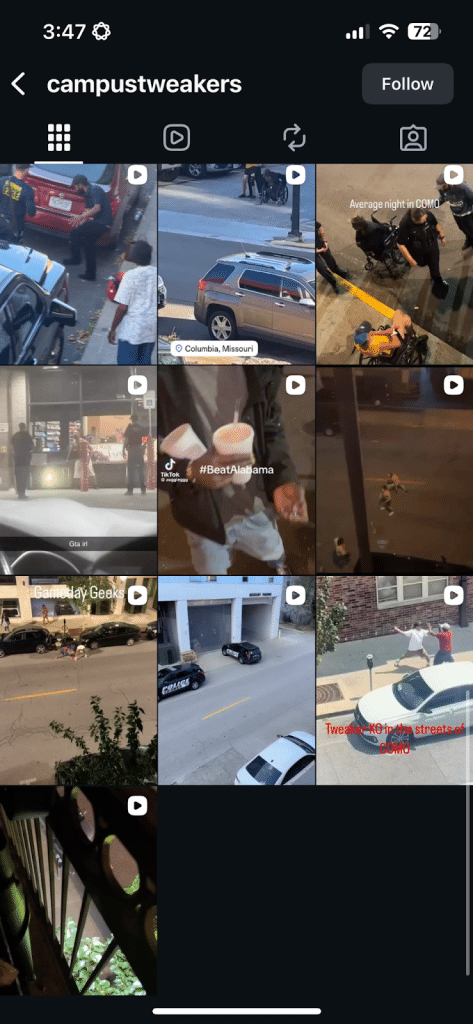
Additional posts on the account show unhoused people being mocked, forcibly handled, or recorded in humiliating situations, often without their knowledge.
The Big Picture
The deeper issue underlying Columbia’s homelessness crisis is the lack of adequate resources and the systemic conditions that produce housing instability.
McNear said that there are at least 323 unhoused residents of Columbia as of 2024, though the actual number is likely higher. She said there are only 293 shelter beds in Columbia at this time.
That gap means many people have no choice but to sleep outdoors or in encampments.
But efforts are underway to serve the city’s unhoused population and provide them with the resources that they need to get on their feet.
Opportunity Campus is set to open in the summer. Powered by the Volunteer Action Center and with the support of several other local organizations, this initiative will provide a shelter, a resource center, and a medical clinic to the unhoused community and help them transition into permanent housing.
“We see [this project] as a huge benefit for us to reach additional folks in need in our community,” said VAC Executive Director Ed Stansberry.
In Missouri, just under 2,400 Black residents experienced homelessness in 2023. And while Black Missourians make up around 13% of the state population, they account for about 36% of those who experience homelessness on any given night. Advocates say punitive responses such as loitering ordinances and encampment sweeps fall hardest on Black and Indigenous residents. This sort of anti-homeless legislation also fails to confront the factors contributing to homelessness, like a lack of affordable housing and historical income inequality.
“It’s a systemic issue that’s rooted in poverty,” McNear said, “and until we address that, we’re going to continue to see it.”
Stansberry added that he is open to speaking with Choi about his comments and the efforts that are being made to help the community at large. He said that broad assumptions about the unhoused community cannot be made in a “blanket manner.”
“Every individual has a different story to tell,” he said. “The vast majority of them have some sort of trauma in their life.”
He encouraged Columbia residents to get involved with their community and learn more about their unhoused neighbors. “They aren’t scary,” he said. “If you approach them the right way, in a non-threatening way, they’re like the rest of us.”