Black joy has been stripped from Mizzou students yet again as the university cancels a back-to-school event that centers its Black community. Nearly a decade after the hunger strike that brought the school’s racist history to light, little has changed.
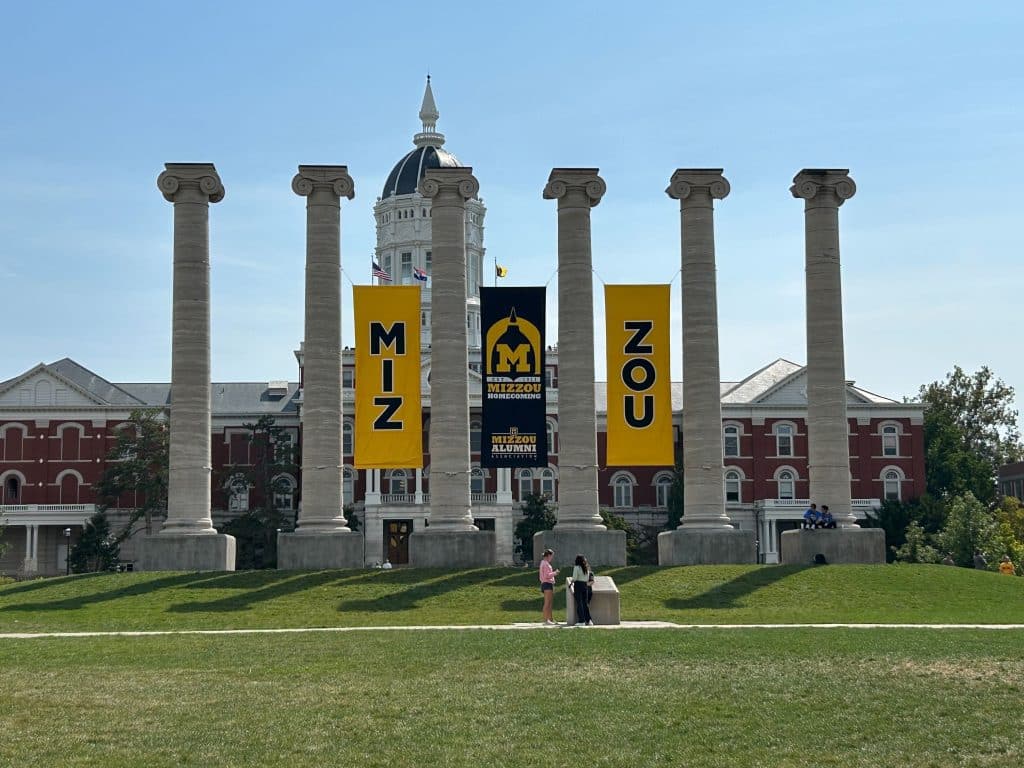
The University of Missouri-Columbia (MU) is once again at the center of racial controversy. The school came under fire after administrators cancelled the Legion of Black Collegians’ Black 2 Class Block Party, simply because the word “Black” was in the title.
On August 20th, LBC posted on its Instagram about the school’s decision to cancel the block party, which was supposed to take place at the Gaines/Oldham Black Culture Center on August 22nd. LBC executives expressed their willingness to comply with the school’s guidelines and change the name, but administrators stood firm in their decision.
LBC outlined a list of demands along with slides explaining the racism Black students continue to face on campus.
- Public Condemnation of Racial Harassment: The University must release a clear, public statement condemning harmful racial profiling on campus. This statement must make all students aware of the consequences already enforced through the Office of Institutional Equity. This statement must make all students aware of the specific consequences they will face if these incidents are reported–including suspension, expulsion, and legal action. Silence around consequences protects racists, not students of color.
- Town Hall Within 60 days: University officials to schedule a joint town hall meeting with the Legio n of Black Collegians within the first 60 days of the semester, looking to address cultural identity and climate issues on campus.
- Mandatory Campus-Wide Messaging: At the start of each semester, all students should receive a campus-wide communication, making clear the University’s policy on all forms of harassment, with clear and direct steps to the reporting process, and examples of potential disciplinary outcomes.
The university’s account left a comment on the post, which was signed off by MU Chancellor & University of Missouri (UM) System President, Mun Choi. It reads as follows:
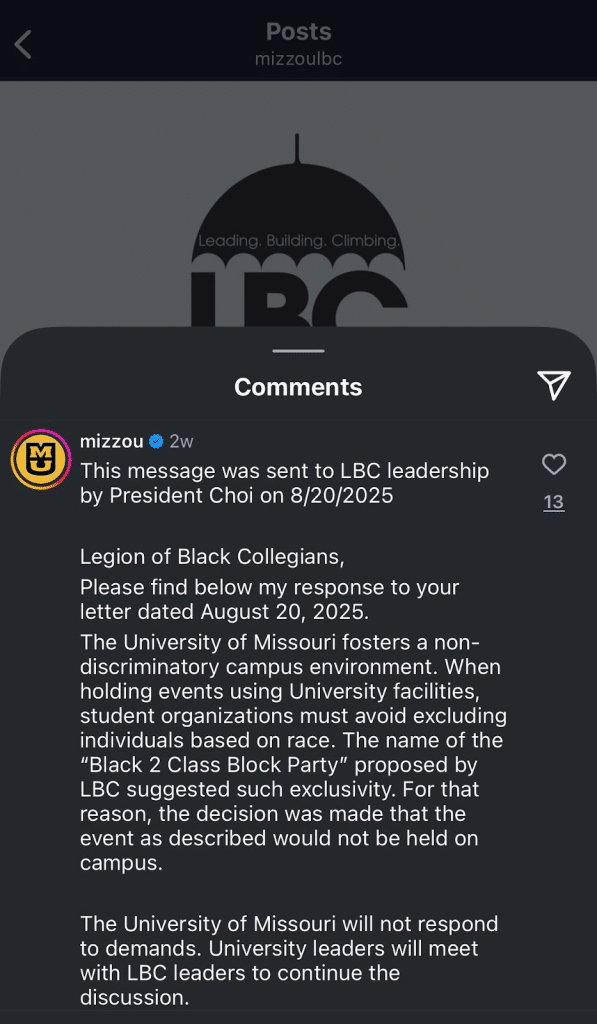
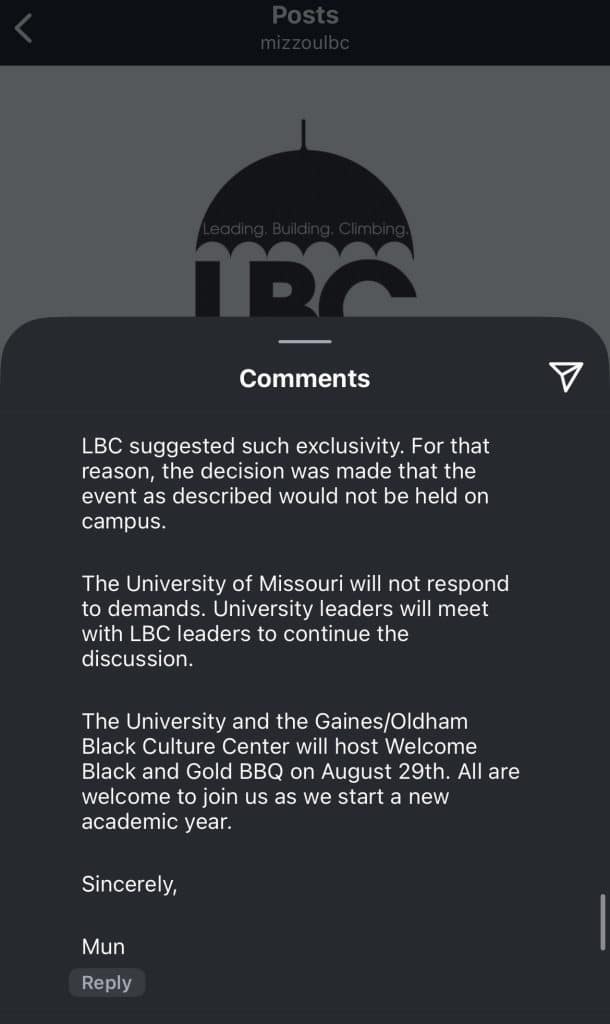
Former and current students flooded the comments to criticize the administration’s decision to cancel the event and discuss their experiences with racism on Mizzou’s campus, a cycle I’d seen time and time again during my undergraduate years.
The Welcome Black & Gold BBQ mentioned in Mizzou’s response was originally called the Welcome Black BBQ, which was held annually at the GOBCC and hosted by LBC. The organization made a post ahead of the 2024-2025 academic year that they fought to keep the original name and message, but the new name prevailed.
The pain goes beyond a student event being cancelled. For Black students, this cancellation reflects years of suppression at MU. The racism that has been displayed at the school is merely a pattern that continues to loop.
The disappointment is especially sharp for those hoping the block party would create a safe space to connect with other Black students. It also comes during the 10th anniversary of the Concerned Student 1950 protests, the movement that forced UM System President Tim Wolfe to resign after failing to address racist incidents on campus. A movement that called for racial equality.
Yet, we continue to make the same plea a decade later.
Let’s Take it Back
Let’s start with Sept. 11, 2015:
Then-Missouri Student Association President Payton Head posted a video on Facebook that stunned both students and administrators, listing the racist encounters he had at Mizzou. One night, he was walking on campus when a pick-up truck rode by and someone called him the N-word. Another night, drinks were thrown at him while he was downtown. On a separate occasion, he and his friend were called the N-word again while walking behind a fraternity house.
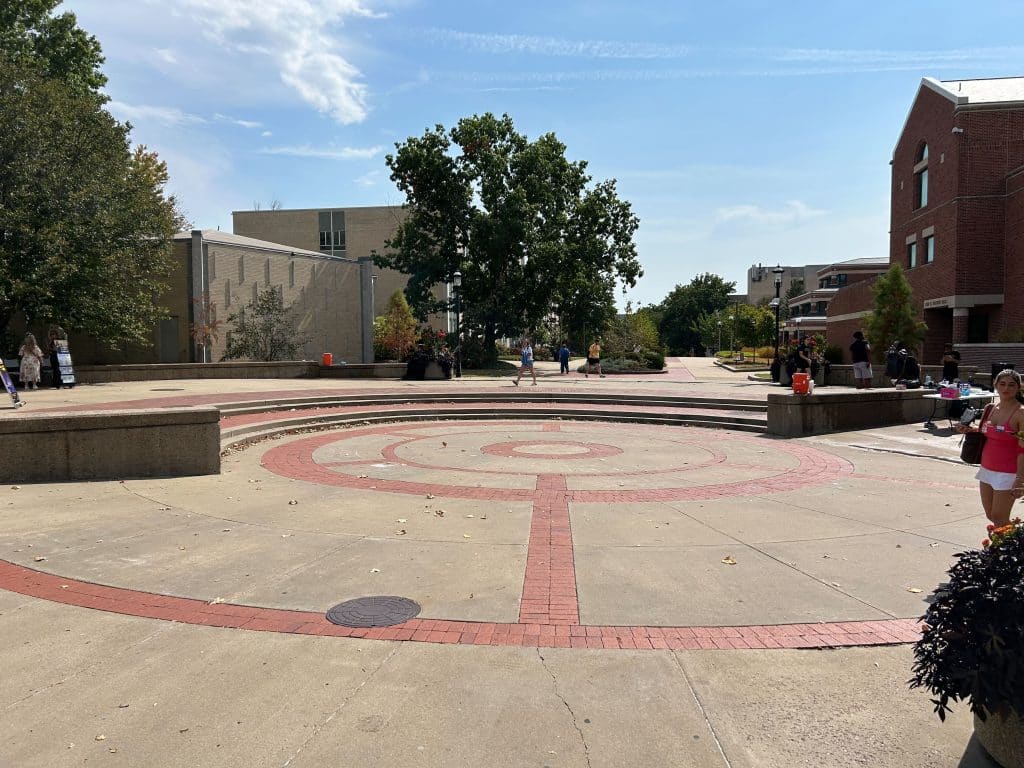
Head’s post galvanized students at Mizzou who were frustrated by the administration’s failure to respond to racist incidents on campus. Students eventually took matters into their own hands when then-graduate student Danielle organized two “Racism Lives Here” rallies: one in Speaker Circle on Sept. 24 and another in the MU Student Center on Oct. 1. A total of about 140 students participated in the rallies, sharing their experiences with racism at Mizzou.
Then on Oct. 10, a group of Concerned Student 1950 organizers stopped former UM System President Wolfe’s car during the annual Homecoming parade, publicly calling him out for his inaction to condemn racism on campus. In the documentary, Concerned Student 1950, then-graduate student Jonathan Butler held a megaphone and told the crowd the story that Head shared on Facebook a month earlier. Wolfe hardly reacts in the footage. The students are pushed away by security, with the crowd cheering afterwards.
By Oct. 20, the group issued a list of demands, calling for Wolfe’s resignation, an increase in Black faculty by 10%, and more structural reforms.
I. We demand that the University of Missouri system president, Tim Wolfe, write a handwritten apology for the Concerned Students 1950 demonstrators and holds a press conference in the Mizzou Student Center reading the letter. In the letter and at the press conference, Tim Wolfe must acknowledge his white male privilege, recognize that systems of oppression exist, and provide a verbal commitment to fulfilling Concerned Student 1950 demands. We want Tim Wolfe to admit to his gross negligence, allowing his driver to hit one of the demonstrators, consenting to the physical violence of bystanders, and Leslie refusing to intervene when Columbia Police Department use excessive force with demonstrators.
II. We demand the immediate removal of Tim Wolfe as UM system president. After his removal a new amendment to the UM system policies must be established to have all future UM president and Chancellor positions be selected by [a] collective of students, staff, and faculty of diverse backgrounds.
III. We demand that the University of Missouri meets the Legion of Black Collegians’ demands that were presented in 1969 for the betterment of the black community.
IV. We demand that by the academic year 2017–2018, the University of Missouri increases the percentage of black faculty and staff campus wide to 10%.
V. We demand that the University of Missouri compose a strategic 10 year plan by May 1, 2016 that will increase retention rates for marginalize students, sustain diversity curriculum and training, and promote a more safe and inclusive campus.
VII. We demand that the University of Missouri increases funding for resources for the University of Missouri Counseling Center for the purpose of hiring additional mental health professionals; particularly those of color, boosting the mental health outreach and programming across campus, increasing campus-wide awareness and visibility of the counseling center, and reducing lengthy wait times for prospective clients.
VIII. We demand at the University of Missouri increases funding, resources, and personnel for the social justices center on campus for the purpose of hiring additional professionals, particularly those of color, boosting out reach and programming across campus, and increasing campus-wide awareness and visibility.
Just four days after that list was sent, someone drew a swastika in feces in the bathroom of a residential hall.
Butler began a hunger strike in response. Students camped out in the Mel Carnahan Quadrangle in solidarity.. And more students would join as the week-long strike progressed, while trucks waving the Confederate flag circled the campus.
(Insert photo on Mel Quadrangle)
The football team soon joined the cause and announced a boycott of all activities, including games and practices. The move came with the threat of a $1 million price tag if the team forfeited in the upcoming game against Brigham Young University.
At the same time, Black students held mock tours for prospective students and families during recruitment day, detailing the racism that happens on campus and what they experienced. To protect their identities, protesters told the media to refer to them collectively as “Concerned Student 1-9-5-0.”
Students confronted Wolfe at a fundraiser that week, asking him what systematic oppression is. In the footage of him being passive with students, he replied:
“Systematic oppression is because you don’t believe that you have the equal opportunity for success.”
That response elicited an uproar from students as Wolfe walked away.
His remark underscored how deeply out of touch he was. Systemic oppression is not a matter of belief — it is a lived reality, reinforced by centuries of discriminatory laws and practices. Wolfe’s dismissive response only fueled the outrage and helped seal his fate.
After being condemned by several Missouri lawmakers, including former Governor Jay Nixon, Wolfe resigned the morning of Nov. 9, marking the end of Butler’s hunger strike.
The tensions, however, didn’t stop there.
Journalists clashed with student protestors and supporters at the encampment who came out to celebrate Wolfe’s resignation. In the documentary, one journalist can be seen manhandling former Professor Melissa Click, who was protecting a student protester who was uncomfortable with the media. Click would also be filmed pushing another journalist’s camera away from the scene, for which she was charged with a misdemeanor. She was fired months later due to this.
Within days, someone spray-painted over the word “Black” at the Gaines/Oldham Black Culture Center, and threats to shoot Black students spread on social media in the weeks following the hunger strike. Many students sheltered indoors, fearful even in the wake of their success.
For Black students, the moment revealed both the power of collective resistance and the heavy cost of demanding change.
The cycle continues
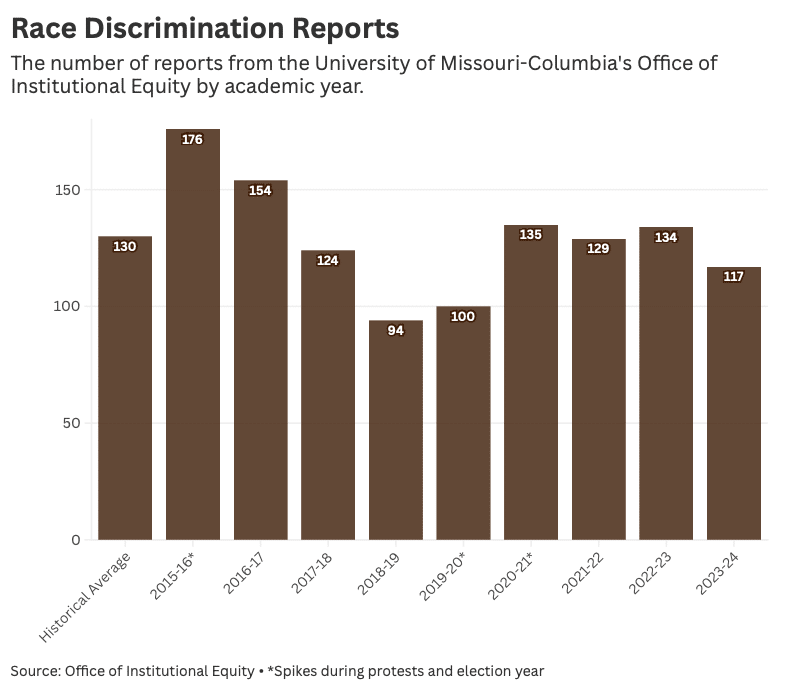
In the years after Concerned Student 1950, MU tightened its rules on campus protest, banning encampments without administrative approval. The Office of Institutional Equity began publishing race discrimination statistics, which initially declined after 2015 but began rising again around the 2020 election cycle.
In the past three years alone, students have seen white supremacist propaganda left on poles on campus. In 2022, a Snapchat post from student Meg Miller, making a disgusting, racist Snapchat joke about Black people getting killed, was left unpunished by the university. President Choi sent out an email explaining that the post was not directed at a specific person and was off-campus. He also said Miller’s speech was protected by the First Amendment, hindering the university from disciplining her.
Black students also report that trucks of white men yelling racial slurs — the same harassment that Payton Head endured in 2015 — still circle campus.
In one instance, I was the one called the N-word twice on my way to work on campus.
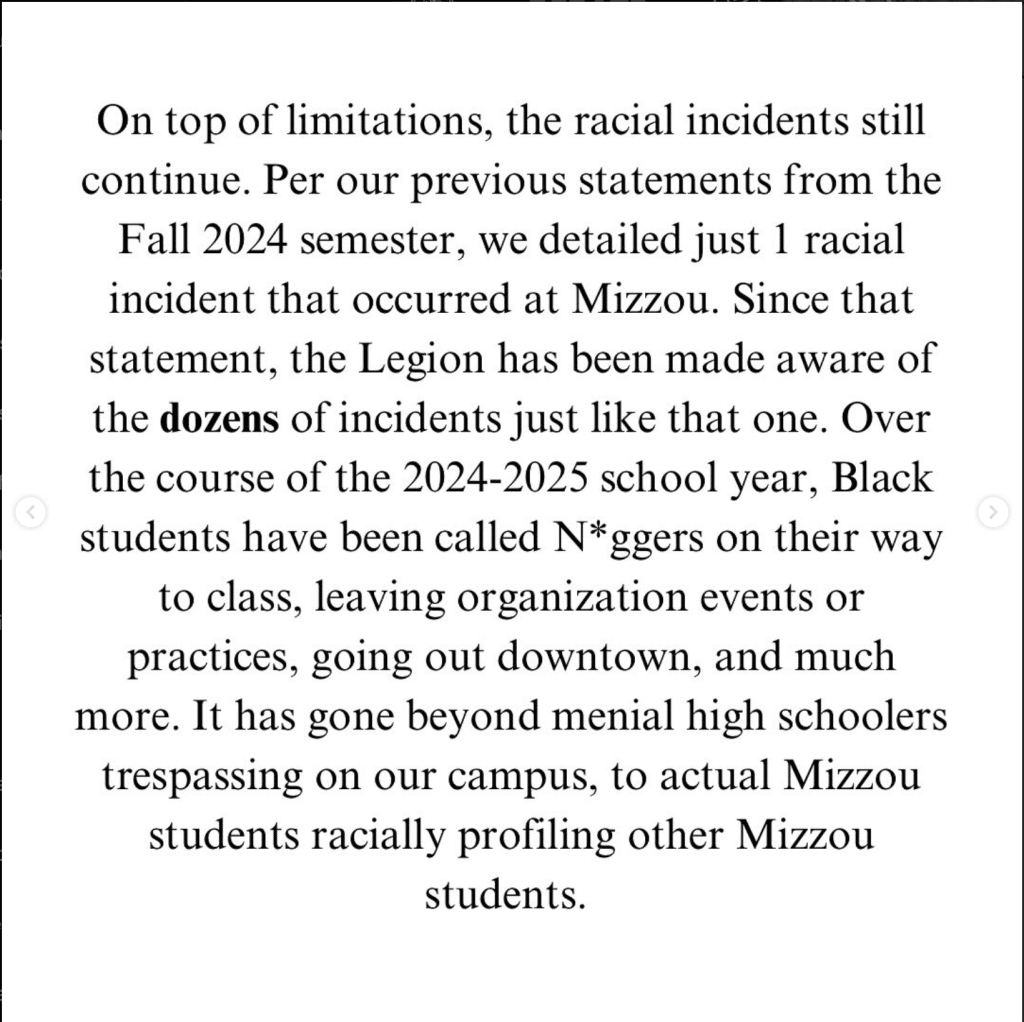
Administration organized meetings to address these racist incidents in response, but many say the university’s actions have been inconsistent. LBC reported that Black students were verbally attacked last school year, with little pushback from the university.
In 2024, MU allowed a truck covered in Trump slogans like “Save America Again” to roll through its Homecoming parade. Meanwhile, the school has swiftly stripped scholarships for students of color after the Supreme Court ended affirmative action. These decisions show whose comfort the university prioritizes.
While some efforts have been made by university administrators to curb racist encounters, such as adding more street lights to easily identify perpetrators, it is still not enough.
Students of color consistently beg administrators to call out blatant racism and warn students about the repercussions they will face if they harass students of color on campus.
But the cycle continues.
The same story 10 years later
In 2025, Black students at the University of Missouri are stuck in a never-ending loop of isolation, feeling unwelcome at their own school. As Homecoming Week is underway, a time of joy and camaraderie for others, a wrench of pain has been exposed for Black students.
If one thing was made clear when I observed the comment section of LBC’s post announcing the cancellation of the Black 2 Class Block Party: Black students want a safe space. Black students want to feel seen and accepted. Black students aren’t making unreasonable “demands.” They want to be heard and most of all respected by the university that they are paying their hard-earned money to attend..
How many more lists of demands have to be made? Will it take another hunger strike? Will it take something more dire, like a student being physically attacked, for change to come?
The university often hides behind federal guidelines, but the First Amendment is not a free pass to ignore racism. Words are never “just words” — they lay the foundation for hostility that quickly becomes action.
Black students have a right to feel safe on campus. Nobody should be demanding the right to be treated fairly. Let the burden of fighting racism be lifted from Black students. It’s time for the university to listen attentively and take action.
If you would like to watch the documentary concerning the 2015 protests, here is the link.
Student Testimonials
“Got followed from campus and down [C]ollege [A]ve while being called a n*gger b*tch over and over.” – I.I., graduate student
“Last year when I was a sophomore, I was walking home from work late at night downtown, when a car sped past and white men called me a ‘f*ck n*gga’ and drove off.” – Patrice G., junior
A’justin P., a senior Mizzou student, described an incident where he was playing intramural basketball at the university’s recreation center. The players on the opposing team were being disrespectful towards him and his teammates during the match, but the officials were condemning his reaction versus correcting the behavior of the opposing team.
“After the game conceded, staff or whoever were all congregating to me saying stop being disruptive and I didn’t do anything but…defend my teammate after. While they were talking to me the opposing team literally came over and called me a B*tch to try to get me to get out of character but the attention was still on me…yet they [the officials] didn’t bat an eye when he literally came and screamed B*TCH, right behind them….It was that moment I knew I was just racially profiled.”
“My friend and her room[m]ates are some of the only Hispanic people on her dorm floor… Someone wrote ‘beans’ on her whiteboard outside of her door.” – A.N., sophomore
ABOUT DEFENDER EDITORIALS
This article is part of The Defender Editorial Series, our official opinion section.
At The Kansas City Defender, we distinguish between reporting and editorial writing:
- Our reporting is rooted in data, documentation, and on-the-ground sourcing. It exposes injustice, centers Black voices, and holds power accountable.
- Our editorials and opinion columns are explicitly framed pieces. They go beyond the what/where/when to offer cultural context, political analysis, and movement-grounded perspective. They’re written not from above or outside—but from within our communities, our struggles, and our visions for liberation.
We proudly acknowledge that our editorial and opinion writers are often the same people who report our stories. We believe there is no contradiction between rigorous journalism and unapologetic moral clarity.
We are not neutral. We are with the people.