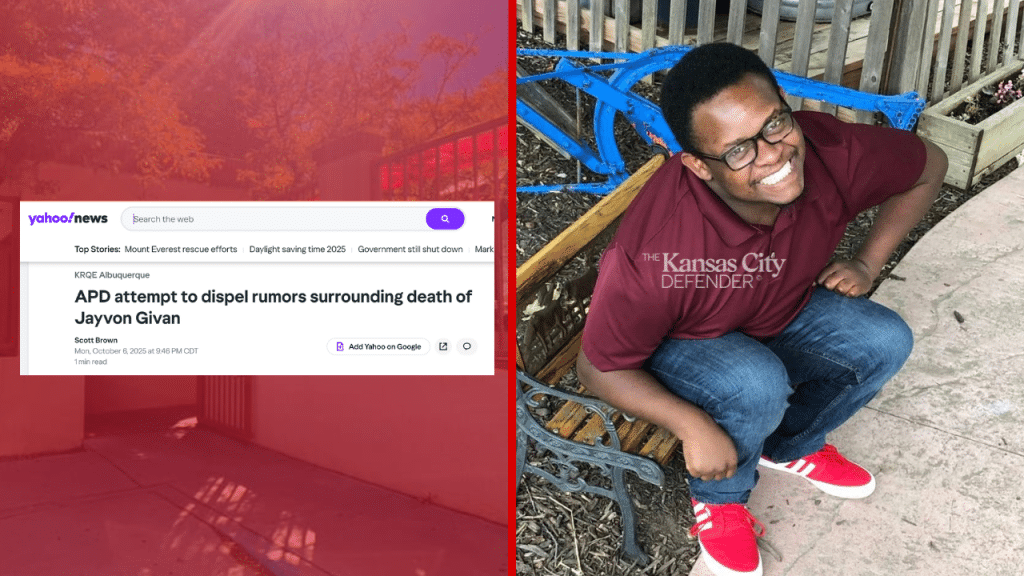
Within hours of The Defender publishing our investigative report on the suspicious death of Jayvon Maurice Givan—and within hours of masses of community members and organizers taking to the streets in Albuquerque New Mexico demanding answers—corporate media outlets rushed to do what they do best: run interference for police.
KOAT. KRQE. The Albuquerque Journal. Yahoo News. One by one, they published nearly identical stories, all designed to “dispel rumors” about Givan’s death.
All of them uncritically repeated the same talking points from the Albuquerque Police Department. Many of them cited the same source: Gilbert Gallegos, APD’s Director of Communications—a man so infamous for weaponizing his position to terrorize residents that the Albuquerque City Council passed what they literally called “The Gilbert Gallegos Bill” to try to stop him.
To be clear: The Defender published actual investigative journalism: we spoke directly with Givan’s family, obtained police reports that raise serious questions, interviewed organizers on the ground in Albuquerque, and presented evidence that demands an independent investigation.
Corporate media responded by telling you there’s nothing to see here, citing a man who has been found to have violated APD policies multiple times, who has attacked grieving families on social media, and whose behavior was so egregious that local New Mexico media called the City of Albuquerque’s Emergency Communications line to request a welfare check because his “posts were escalating and he seemed to be becoming unhinged.”
Meet Gilbert Gallegos: Albuquerque Police Department’s Attack Dog
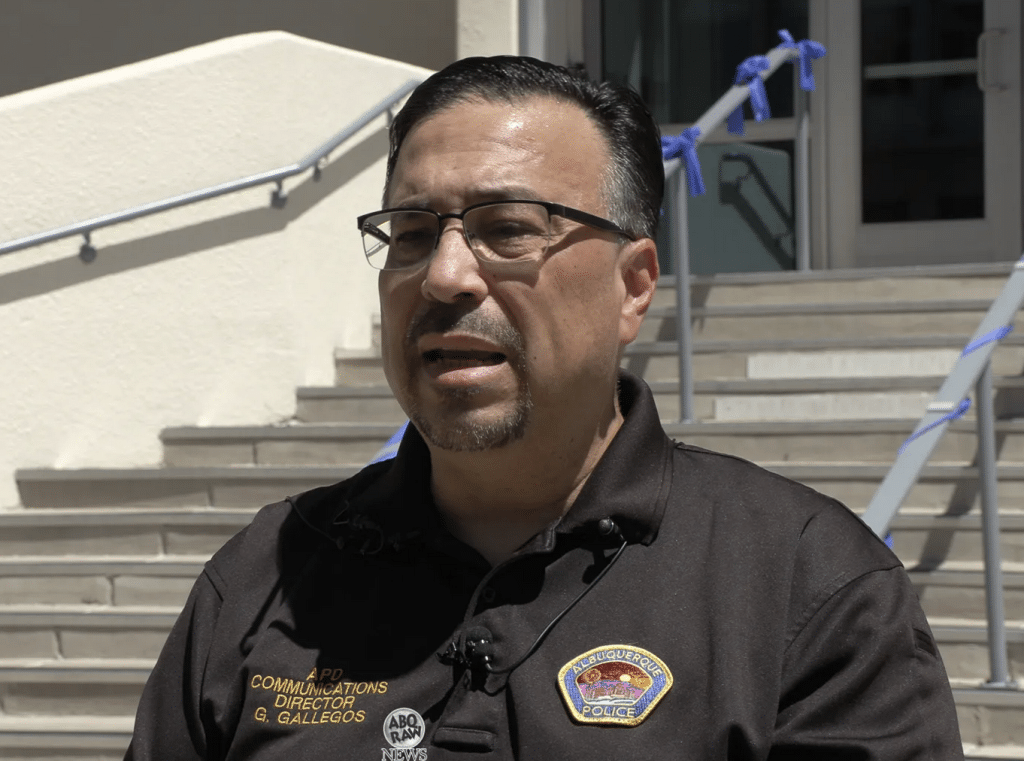
Gilbert Gallegos earns over $127,000 per year to serve as APD’s mouthpiece. But his job description seems to include far more than public relations. In 2021, the Civilian Police Oversight Agency found that Gallegos violated three APD policies by using his personal Twitter account as a work account and attacking members of the public.
In one instance, Gallegos mocked a homicide victim family member on X (formerly Twitter). Let that sink in: The man now telling you that Jayvon Givan’s family shouldn’t have questions has a documented history of mocking grieving families online.
On Labor Day 2024, Gallegos launched such an unhinged tirade from the official APD Twitter account that ABQ RAW staff became concerned about his mental state and called 911 dispatch requesting someone check on him.
In November 2024, the Albuquerque City Council voted 8-1 to approve a resolution directing the administration to create a social media policy with consequences for those who use official department accounts unprofessionally—legislation that councilors explicitly called “The Gilbert Gallegos Bill.”
And yet, when Jayvon Givan’s case exploded on social media, demanding answers about a Black man found hanged whose family was never notified for over a year, corporate media outlets turned to this man as one of their primary sources. They interviewed him on camera. They trusted him. They amplified his narrative of what events occurred.
APD’s Long, Documented History of Brutality and Racism
Perhaps corporate media outlets chose to trust Gallegos and APD because they’re unfamiliar with the department’s history. Let us refresh their memory.
The DOJ Investigation
In 2014, the U.S. Department of Justice issued a devastating report finding that the Albuquerque Police Department engaged in “a pattern or practice of use of excessive force, including deadly force, in violation of the Fourth Amendment”. The DOJ investigation, which began in 2012, documented how APD officers “shot and killed civilians who did not pose an imminent threat of serious bodily harm or death to the officers or others” in a pattern of “unconstitutional use of deadly force”.
The DOJ concluded that “a majority” of APD’s use of force incidents “were unconstitutional,” and a significant amount of the force was used “against persons with mental illness and in crisis”.
In 2015, a federal consent decree was imposed on APD, placing the department under federal oversight to force constitutional reforms. The department has been under this consent decree for a decade—meaning that even after years of supposed reform, federal oversight was necessary because APD could not be trusted to police constitutionally on its own.
Recent History: “Savages”
Think APD has changed? In July 2024—just last year—body camera footage revealed APD officers calling Indigenous people “savages,” a derogatory and discriminatory term dehumanizing Native Americans.
The footage, recorded after officers fatally shot a man, captured multiple officers inside a police car making racist comments. One officer said: “I like violent encounters with violent people. That’s why I became a cop. I didn’t come to f****** help old ladies who can’t cross the f****** road. I want to take actual s***heads that are actually doing stuff off the street”.
The same officer continued: “If that means we shoot some of them, so be it”.
When discussing Indigenous people, officers on the tape said: “What’s going on over there now?… savages… it’s getting out of control”. One officer then began discussing his son dating an Indigenous woman from Isleta Pueblo: “She gets the check; he’s going to get a f****** free trailer, and some f****** land, a farm down there”.
This was not decades ago. This was 2024. This was after a decade of federal oversight. This was after millions spent on “reform.”
The Coalition To Stop Violence Against Native Women issued a statement saying: “These vile remarks are not isolated incidents but are emblematic of the systemic failures within law enforcement that devalue and dismiss the lives of Indigenous people”.
The Washington Post: “A Long History of Police Abuse, Cover-Up and Scandal”
In 2014, The Washington Post published an article titled “Albuquerque’s long history of police abuse, cover-up and scandal”, documenting decades of constitutional violations, cover-ups, retaliation against whistleblowers, and a culture of impunity.
The Post reported: “In cases where outside entities did find that city police had used unreasonable force, police department supervisors responded by lavishing praise on those officers, even holding them up as examples other officers ought to follow. As of 2012, no shooting by an Albuquerque cop had ever been found unjustified by a grand jury, leading critics to label the process a ‘sham'”.
There is also the case of Officer Sam Costales, a 23-year police veteran who testified that deputies had abused race car driver Al Unser. APD Chief Ray Schultz responded by opening an investigation—of Costales, for testifying against fellow police officers. The Albuquerque police union sent the sheriff a letter apologizing for Costales breaching the “Blue Wall of Silence,” saying the union was “embarrassed and ashamed” of him for implicating “our brother and sisters in blue”.
Costales was hounded into retirement. In 2009, a federal jury awarded him $662,000 in his lawsuit against the city.
This is the department corporate media wants you to trust without question.
What Corporate Media Refuses to Ask
Here are the questions that remain unanswered—questions corporate media should be asking instead of running interference:
Timeline Discrepancies:
- Why was Givan’s body cremated so quickly when no next of kin had been located?
- Why did it take police over a year to notify his family?
The Evidence:
- Why have the 39 photographs taken at the scene not been released to the family despite their requests?
- Why has the body camera footage not been made public or released to the family?
- Why has the OMI examination not been released to the family?
The Investigation:
- Why was no autopsy performed?
- Why did police never interview shelter staff who saw Jayvon in his final weeks?
- Why did detectives stop returning the family’s calls after they sought more information?
The Pattern:
- Why is this another case of a Black man found hanged that police immediately ruled suicide?
Corporate media outlets didn’t ask any of these questions. They simply repeated what Gilbert Gallegos told them to say.
“Misinformation” or Inconvenient Questions?
Several corporate outlets framed their coverage around the claim that “misinformation” and “rumors” were spreading on social media about Givan’s death.

Yes, some early social media posts incorrectly stated Jayvon was found hanging from a tree in a wooded area—details that appear nowhere in the police report. But corporate media seized on these minor discrepancies to frame the entire story as “misinformation” and “rumors,” weaponizing factual errors to dismiss a family’s legitimate demands for answers. When you use inaccuracies about where someone died to avoid questions about why they died and why police never told anyone for over a year, that’s not journalism. That’s gaslighting.
Let’s be explicit about what they’re calling “misinformation”: A family demanding answers about why police never contacted them for over a year after their loved one was found hanged. A community refusing to accept a suicide ruling when no investigation was conducted. Organizers calling for the release of evidence that police admit exists but won’t make public.
UNM professor Gwyneth Doland told KOAT: “Social media is a tool for connection for many of us, but it’s also a tool that people use to stir up anger and divide us”.
But who is really “stirring up anger”? The family asking why police destroyed their loved one’s body before they could identify him? Or the police department with a documented history of killing Black and Brown people unconstitutionally, covering up abuse, and attacking anyone who questions them?
The organizers who held Monday night’s press conference were explicit in their demands and their analysis. They told The Defender in a statement: “This department concealed the lynching of a Black man for over a year, and had the audacity to label it a ‘suicide.’ We reject that narrative outright. Black people do not hang themselves in public in America. We know this because the history is written in blood. From Reconstruction to Jim Crow to right now, police and coroners have covered up racial terror by calling it ‘self-inflicted.'”
Corporate media’s response? Quote Gilbert Gallegos saying there’s nothing to see here.
The Real Story: Media Complicity in Police Violence
Again, we don’t know all the facts that will come out of this case, but we do know this: there is an undeniable pattern of how corporate media operates as a direct mouthpiece for cops when Black death intersects with police narratives.
When a Black man is found hanged and his family has questions, corporate media’s first instinct is not to investigate. It’s not to demand answers. It’s not to ask why evidence is being withheld or why a body was cremated before family notification.
They dress it up in the language of “fact-checking” and “dispelling rumors.” They bring on professors to lecture about “misinformation.” They quote police spokesmen who have been formally sanctioned for attacking grieving families. They frame demands for transparency as “stirring up anger.”
But what they’re really doing is running cover for a police department that has:
- Been under federal oversight for a decade because of constitutional violations
- Been caught on camera calling Indigenous people “savages” just last year
- A documented history of retaliating against officers who tell the truth
- A spokesman so notorious for weaponizing his position that the city council had to pass special legislation to try to control him
And they’re doing this while a Black family grieves, while their cousin was found hanged, while they received no answers for over a year, while evidence is being concealed, while an independent investigation is being denied.
What Real Journalism Looks Like
The Kansas City Defender spoke directly with Jada Walker, Jayvon’s cousin who filed the missing persons report that finally forced police to acknowledge his death. We obtained the police reports. We examined the timeline. We spoke with organizers who are demanding accountability. We presented the evidence and the questions that evidence raises.
We did not simply call the police department and ask them if they killed someone. We did not treat Gilbert Gallegos as a neutral source of truth. We did not frame a grieving family’s demands for answers as “misinformation.”
This is what real journalism looks like. This is what happens when media is accountable to community rather than to power.
Corporate media outlets had a choice when this story broke. They could have done actual journalism—investigating the discrepancies, demanding the release of evidence, centering the family’s concerns. Instead, they chose to be stenographers for a corrupt police department, amplifying the words of a man whose behavior has been so egregious that elected officials literally passed legislation to try to stop him.
The Demand Remains: Independent Investigation
Despite corporate media’s attempts to shut down this story, the demands remain clear:
- An immediate, independent investigation into Jayvon Givan’s death
- Full public release of all evidence, photos, and body camera footage
- Accountability for every officer and official who concealed, delayed, or distorted the facts
- A public acknowledgment from city and state leadership that anti-Black violence is alive in New Mexico—and that silence is complicity
Jada Walker told The Defender: “I don’t care who’s uncomfortable. I don’t care. I want justice for my cousin.”
The family deserves answers. The public deserves transparency. And Black New Mexico deserves better than a police department with a decades-long history of brutality presenting itself as a credible source on anything—especially the suspicious death of a Black man found hanged in public.
Corporate media can keep quoting Gilbert Gallegos. We’ll keep quoting the family. We’ll keep demanding answers. We’ll keep doing actual journalism.
Because Jayvon Maurice Givan’s life mattered. And no amount of police spin or media complicity will change that.
ABOUT DEFENDER EDITORIALS
This article is part of The Defender Editorial Series, our official opinion section.
At The Kansas City Defender, we distinguish between reporting and editorial writing:
- Our reporting is rooted in data, documentation, and on-the-ground sourcing. It exposes injustice, centers Black voices, and holds power accountable.
- Our editorials and opinion columns are explicitly framed pieces. They go beyond the what/where/when to offer cultural context, political analysis, and movement-grounded perspective. They’re written not from above or outside—but from within our communities, our struggles, and our visions for liberation.
We proudly acknowledge that our editorial and opinion writers are often the same people who report our stories. We believe there is no contradiction between rigorous journalism and unapologetic moral clarity.
We are not neutral. We are with the people.