Editor’s Note: The terms used in this report are in accordance with human rights law and criminal legal definitions.
According to the Holocaust Encyclopedia, a concentration camp is“a camp in which people are detained or confined, usually under harsh conditions and without regard to legal norms of arrest and imprisonment that are acceptable in a constitutional democracy.”
Under the Model Penal Code of the American Law Institute, kidnapping occurs when a person “unlawfully removes another from his place of residence or business, or a substantial distance from the vicinity where he is found” through “force, threat, or deception” for purposes including “to inflict bodily injury on or to terrorize the victim” or “to interfere with the performance of any governmental or political function.”
Less than a mile from where Kansas City’s Honeywell factory manufactures 80% of America’s nuclear weapon components, ICE is planning to build one of the largest concentration camps in the United States.
A leaked document marked ‘FOR OFFICIAL USE ONLY,’ which has circulated widely on social media and formed the basis of reporting by the Washington Post, reveals that Kansas City is one of seven ‘mega centers’ planned across the country, part of a nationwide concentration camp network.
The Kansas City Defender obtained the spreadsheet independently and verified its authenticity: the site inspection listed for Kansas City occurred at the exact date, time, and location specified in the document.
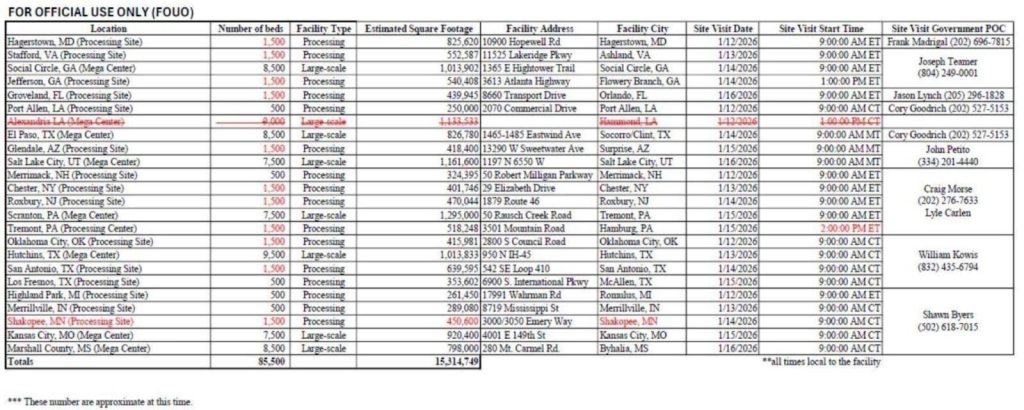
The Kansas City Defender’s reporting is consistent with documents obtained by the Washington Post, which reported ICE plans to establish a “deliberate feeder system” to accelerate the operation.
People kidnapped by ICE would be held in “processing sites” for a few weeks before being funneled into one of seven large-scale concentration camps holding 5,000 to 10,000 people each, where they would be staged for trafficking to unknown locations, including the CECOT torture camp in El Salvador and other concentration camps throughout South America and Africa.
The list may not be final. ICE Senior Advisor David Venturella told WFTV that a site in Orlando, not included on the spreadsheet, is now under ‘exploratory’ consideration, suggesting the network could expand beyond the 22 locations currently identified.
Federal officials have compared the system to Amazon’s logistics network.
ICE acting director Todd M. Lyons said at a border security conference in April, that the administration aims to treat deportations “like [Amazon] Prime, but with human beings.”
Feds Attempt to Intimidate & Terrorize Lee’s Summit Mother
On January 14th, a woman in Lee’s Summit was scrolling through Facebook when she came across the leaked DHS documents. She saw Kansas City listed. She saw a site inspection scheduled for 9:00 AM the following morning at a warehouse in south Kansas City. She reposted the information to Facebook and TikTok.
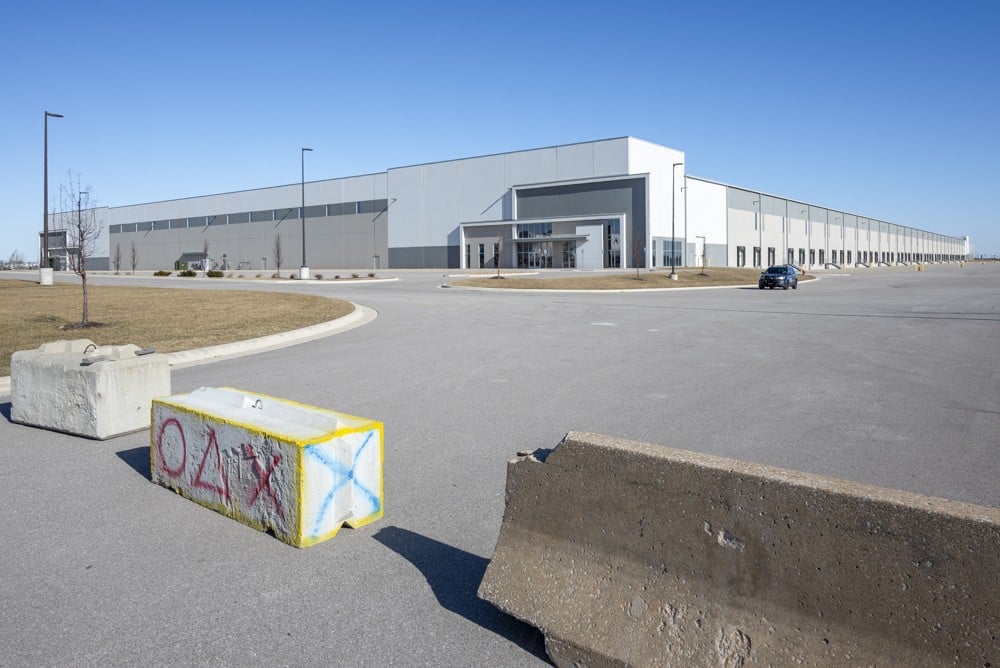
The next day, after dropping her child at school, she decided to take the long way home. She wanted to see with her own eyes whether federal agents would actually show up. She drove by the warehouse at 4001 E. 149th Street and saw news cameras, reporters, and protesters already gathered. She stopped briefly to say hello to friends she recognized, spoke a few words to an Associated Press reporter, and went home.
That afternoon, she says, Department of Homeland Security agents showed up at her front door.

“I’m a 49-year-old mom of two in the suburbs with no criminal history whatsoever,” she told The Kansas City Defender in an exclusive interview. “I don’t even have a passport. So the idea that Homeland Security would be on my front porch is crazy.”
“All I did was repost something on social media that I found on social media, and take the long way home so I could see with my own eyes whether or not they showed up,” she said. “That was it. That was the extent.”
She believes agents ran her license plates when she drove past the facility. From 2:30 PM until nightfall, she says federal vehicles circled her house. She believes they were waiting for her to leave.
Jackson County Legislator Manny Abarca, who was also confronted by federal agents at the warehouse site that morning, told her he believes the visit to her home was targeted.
Door-to-Door
The woman is not alone. Across the Kansas City metro, federal agents have been conducting door-to-door operations that residents describe as terrorizing.
The woman told The Kansas City Defender that agents have been going door-to-door in neighborhoods on both sides of Highway 291 in Lee’s Summit. On one street, they pulled someone over in front of a resident’s house.
The Warehouse
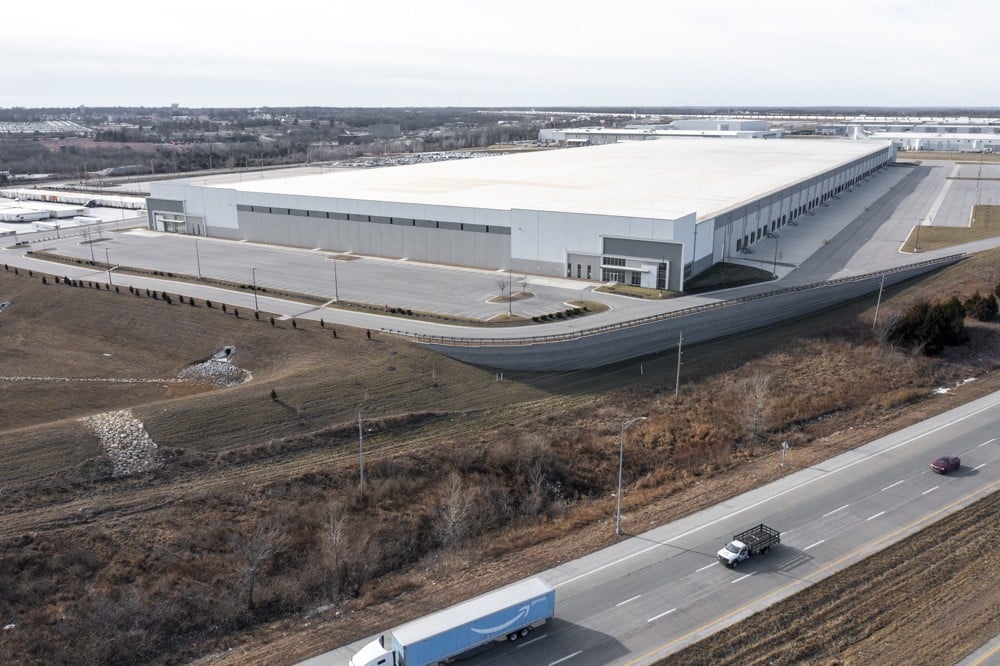
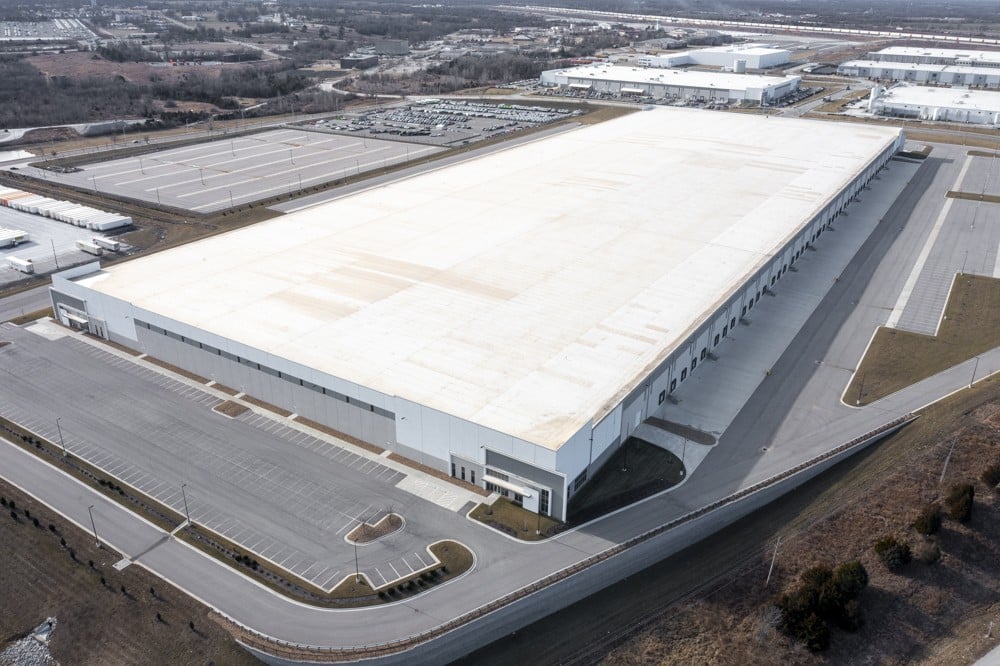
The concentration camp planned for Kansas City, would be built in a 920,400-square-foot warehouse at 14901 Botts Road in the city’s far southern reaches.
ICE conducted that walkthrough last Wednesday morning. Jackson County Legislator Manny Abarca arrived at the facility to observe. Federal agents surrounded his vehicle, threatened him with arrest, shined flashlights through his windows, and blocked his truck from leaving. Off-camera, a Department of Homeland Security supervisor confirmed to Abarca that the facility would hold at least 7,500 people.
Platform Ventures, a Kansas City-based real estate firm with $2.7 billion in assets under management, is the property owner. According to Councilman Johnathan Duncan, Polsinelli, one of the nation’s largest law firms, was the legal representative handling the transaction. Duncan told me in a statement that “the attorney involved in the transaction is Korb Maxwell, the same lawyer who helped negotiate the Kansas City Chiefs’ move to Kansas.”

The Secret Deal
On Friday, Platform Ventures broke its silence. In a statement, the company confirmed that “all negotiations are complete.”
The statement claimed Platform Ventures was approached in October 2025 with an “unsolicited offer” to purchase what it called a “vacant industrial warehouse.”
“PV does not question prospective buyers on their intent after close,” the statement read. “And we will not engage in public conversations involving speculation over future uses.”
But according to City Councilman Johnathan Duncan, whose district includes the site, Platform Ventures originally notified Port KC that the firm was selling the warehouse to the Honeywell national security campus located across the highway.
It was only through leaked documents that the city discovered the actual buyer was the Department of Homeland Security.
In an interview with The Defender, Jonathan Duncan told me “calls to Platform Ventures have gone unanswered.”
“We should be publicly and privately shaming Platform Ventures,” Duncan said in a statement to the KC Star. “They are a Kansas City company that has received public dollars for years and they need to get the message that the Kansas City community does not appreciate being sold out by a local company for quick financial gain.”
Numerous pages on Platform Ventures’ website now return a 404 error (including those that previously listed the staff).

The company’s LinkedIn profiles have been removed. According to Councilman Duncan, their phones ring unanswered to his calls. “Their offices have gone dark,” Councilman Duncan told me.
Public Money for Concentration Camps
The warehouse was built with public support on land that Kansas City spent decades developing.
The former Richards-Gebaur Air Force Base was decommissioned in 1994. Port KC, the city’s development authority, led the conversion of the property into an industrial hub, transferring parcels to private developers with the stated goal of bringing jobs to an economically distressed area.
In 2022, Port KC entered into a development agreement with Platform Ventures to construct multiple industrial buildings on the site. The agreement’s stated purpose: “to bring logistics and manufacturing jobs to an area and community of need.”
Port KC released a statement acknowledging it has “very limited ability to disallow a sale of the facility.” The development at Richards-Gebaur includes multiple warehouse buildings. Both 4001 E. 149th Street and 14901 Botts Road are/were owned by Platform Ventures.
Inside the Camps
In a statement, ICE claimed the planned facilities “will not be warehouses” but “very well-structured detention facilities meeting our regular detention standards.”
The statistics and eyewitness testimony tell a completely contradictory story.
At least 32 people died in ICE custody in 2025, the highest death toll ever recorded outside the COVID-19 pandemic, according to the American Immigration Council. Four more have died in the first two weeks of 2026.
“If we are seeing that sort of outward extreme violence in broad daylight in the streets of Minneapolis and streets across the country, imagine what people must be facing behind closed doors and behind bars in ICE detention centers,” Setareh Ghandehari, advocacy director at the Detention Watch Network, told Truthout.
“The number of people imprisoned by ICE increased by 75 percent to nearly 66,000 in 2025. Despite repeated claims by administration officials about targeting “the worst of the worst,” nearly 74 percent have no criminal convictions, according to the Transactional Records Access Clearinghouse immigration database.
Even prior to the Trump administration, a 2024 report by Physicians for Human Rights examined 52 deaths in ICE custody and found that 95 percent were preventable with appropriate medical care.
In December 2025, the ACLU and human rights groups sent a letter to ICE documenting conditions at Fort Bliss, the largest detention facility in the country. The letter described beatings and sexual abuse by officers, coercive threats to compel people to accept deportation to third countries, medical neglect, hunger, and denial of access to legal counsel.
The facility is located on the same military base used to intern Japanese Americans during World War II. Detained people have described the facility as a “torture chamber.”
Also at Fort Bliss, the county medical examiner will likely rule the death of 55-year-old Geraldo Lunas Campos a homicide due to asphyxiation after a witness at the facility claims they saw guards choke him to death.
In Philadelphia, 46-year-old Parady La died from untreated drug withdrawal nine days after ICE arrested him. Withdrawal is fatal but easily treatable with proper medical supervision. When La was found unresponsive in his cell, officers administered naloxone, a drug used to treat overdoses, not withdrawal. It was the wrong medicine. He died of brain and organ failure.
Pregnant women have reported being shackled at the ankles, hands, and waist during transport. The ACLU documented women restrained while actively miscarrying. One woman detained at a facility in Louisiana was taken to a hospital after experiencing severe abdominal pain and bleeding, where medical personnel performed an invasive uterine procedure without her consent and injected her with an unknown medication. She was informed she had miscarried. ICE returned her to detention that same night and held her for two more months. She continued to experience heavy bleeding, swelling, fever, and severe pain. Her sick call requests went unanswered.
A Senate investigation led by Senator Jon Ossoff identified 510 credible reports of human rights abuses in ICE detention between January and August 2025, including 85 reports of medical neglect. Detainees described meals too small for adults, expired milk, and water that smelled foul. At one Texas facility, a teenager reported that adults were forced to compete with children for bottles of clean water.
These are ICE’s “regular detention standards.” This is what Platform Ventures sold Kansas City to in order to make a quick buck.
The City’s Response
Hours after ICE conducted its site walkthrough, Kansas City’s City Council voted 12-1 to pass a five-year moratorium on permits, licenses, and zoning approvals for any non-municipal carceral facility. The ordinance took effect immediately and extends through January 15, 2031.
Mayor Quinton Lucas issued a statement attributing the action directly to reports of the planned concentration camp. “We consistently hear from residents that Kansas City’s focus should be on economic development and housing, not mass detention facilities holding thousands,” Lucas said.
The sole dissenting vote came from First District Councilmember Nathan Willett, who argued that the city should not obstruct federal law enforcement.
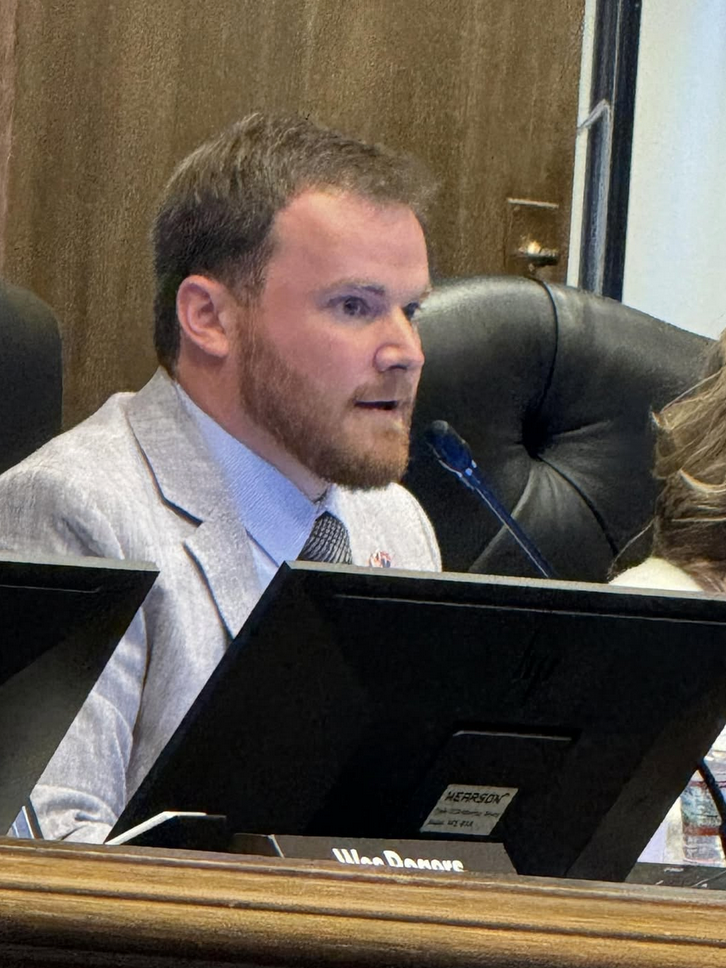
Asked whether the moratorium could actually stop the facility, Mayor Lucas told KSHB “I think the simplest way I can answer that is it would probably end up in court.”
The moratorium applies only within Kansas City limits. The federal government could pursue locations in neighboring Grandview, unincorporated Jackson County, or across the state line in Kansas. But even with the moratorium, the federal government has vast authority to override local ordinances through eminent domain and the Supremacy Clause. City council members told The Kansas City Defender the ordinance will slow the process, but stopping it entirely will require sustained pressure.
This is a developing story. The Kansas City Defender will continue to investigate.
Ryan S. is the Founder & Executive Editor of The Kansas City Defender.