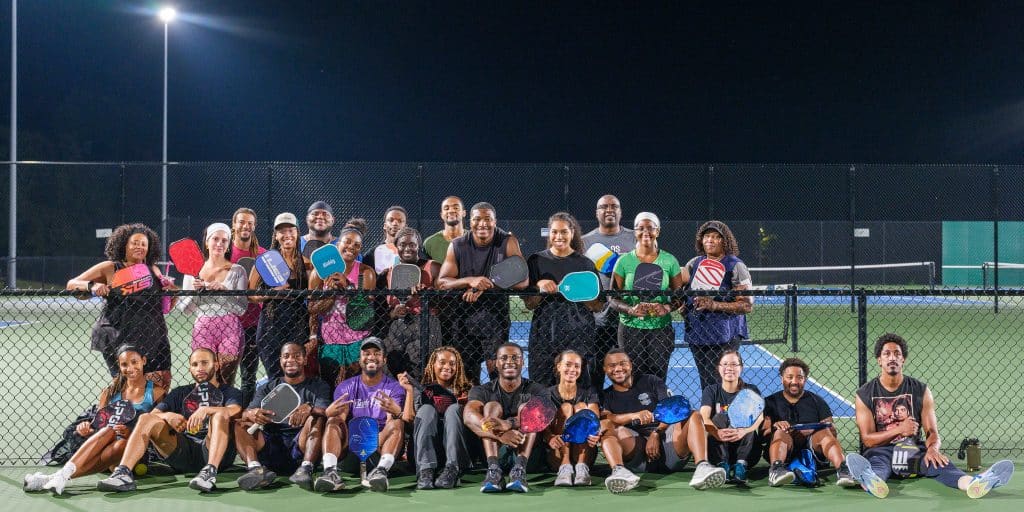
Klamm Park, KCK, tournament night. The courts hum like a block party. A gentle pop at the net, then, in chorus: “that was out!” What lingers isn’t any single point but the choreography of strangers moving as if they’ve known one another for years, beginners are waved onto courts, partners switching, someone calling “nice serve!” across the chain-link.
At the center, but rarely standing still, is Brandan Jackson. Clipboard in hand, he paces the sideline, eyes hawkish, counting points, checking brackets, scanning bodies for fatigue. When asked for a quick headshot, he shakes his head without pausing: he’s tracking multiple games at once. His coaching is mostly presence, but the room takes its cues from his steadiness.
Jackson is a Kansas City, Kansas firefighter and the founder of the Black Pickleball Club of Kansas City. Tonight is a tournament, someone will leave with a small trophy, but the mood stays relentlessly communal; in the best way, it feels like everyone is winning.
Origin Story
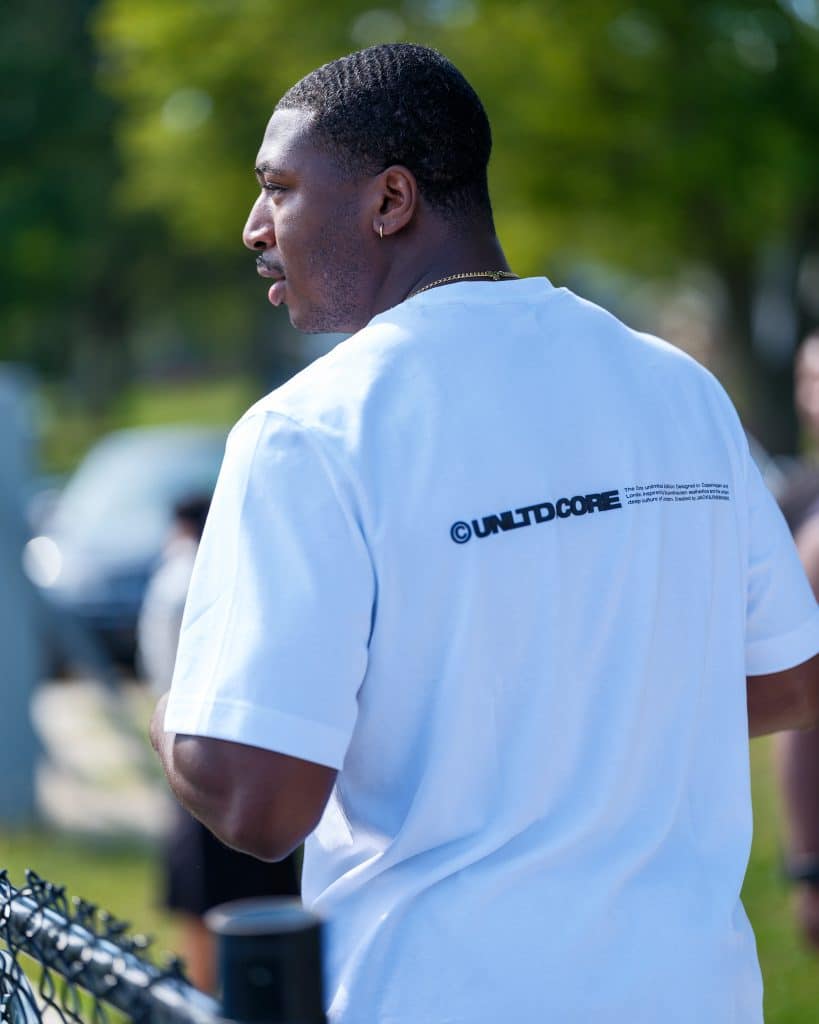
BPCKC is a simple idea with layered stakes: create a culturally familiar, Black-affirming entryway into a sport that’s exploding in popularity; let the community’s spirit, rather than a membership gate, set the tone.
This story follows Jackson and the people around him, braiding his biography with Kansas City’s history of segregated space, the laws that govern public accommodations, data about online harassment that shadows Black organizing, and the quieter thing that explains why the pickleball courts keep filling: the desire to feel a sense of belonging. On court, you can feel when an idea like that is real.
At a regular BPCKC meetup on September 26 at Klamm Park, the pattern held even without brackets: players mixed across ages and skill. Newcomers weren’t quarantined; they were paired and brought into real rallies. That openness does the teaching.
Jackson says he picked up pickleball “about two or three years” ago at the firehouse, often as the only Black player, and began imagining a different entry ramp for his own community.
“I started at the fire station, and most of the time I’m the only Black guy playing. I wanted to bring representation to the game and present something new to our youth, our young adults, and our older members. Another way to stay fit besides the usuals like basketball or football. Something different I could introduce to our community.”
By his account, a TikTok invitation to an Independence facility for the first BPCKC meetup in early September drew more than a hundred people on the first night. The flood of comments leading up to it, hundreds, told him the hunger was real. He filed the paperwork to form an LLC and sketched a wider vision: regular weekend meetups; a code of play that prizes good vibes and volume in equal measure; and, down the line, youth classes, school partnerships, even a team.
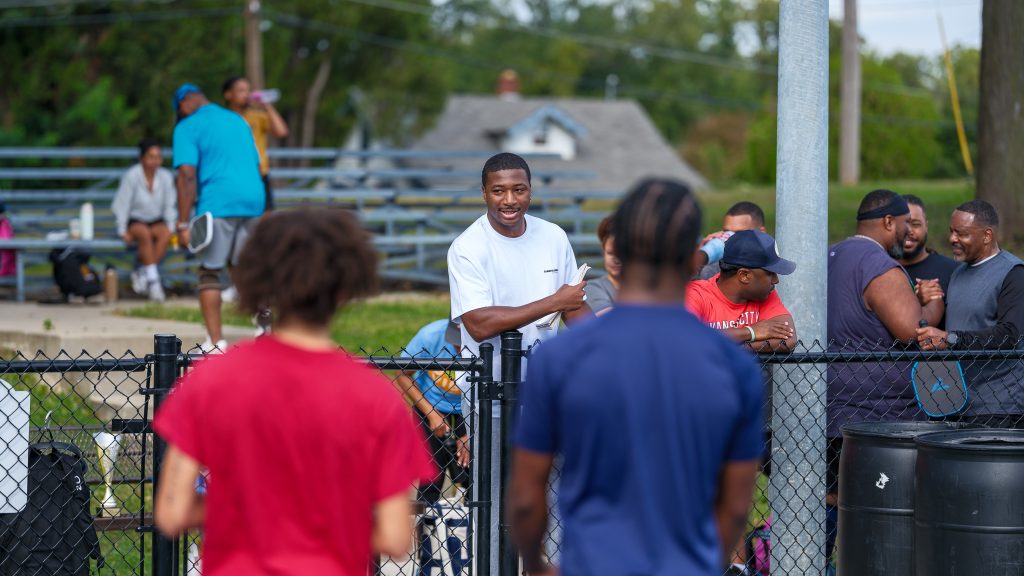
“Every time we do events like this, I find there are a lot of players better than me,” he laughed. The point is discovery, not necessarily competition. “Be loud with being different,” he said.
His blueprint isn’t only courts. He’s already built a room for another obsession: wrestling. “I’m a huge wrestling fan…I started a wrestling club; we do watch parties every month for WWE and their PLEs,” he says. What keeps him hooked isn’t spectacle but story: “These are people telling stories in the ring…once you watch week to week and the callbacks they have, years and years of storyline. There’s nothing like it. It’s unlike movies. It’s unlike television.” Next up is a vinyl-listening night that’s open to everyone. “I’m a big music lover…every first Thursday I’d host the space, present a vinyl, go up and speak about it, dress to the nines in a suit,” Jackson says. The throughline is civic and simple: “Use my hobbies in a positive way and introduce certain things in the community.”
Building a Court Culture
Here is what BPCKC feels like on court: the club runs on rotations and generosity. Jackson facilitates. Clipboard in one hand, a timer in the other. He calls scores, checks matchups, and coaches without ever grabbing someone’s paddle. Corrections, when they come, are verbal and light. Beginners jump into real points, and advanced players anchor them without condescension.
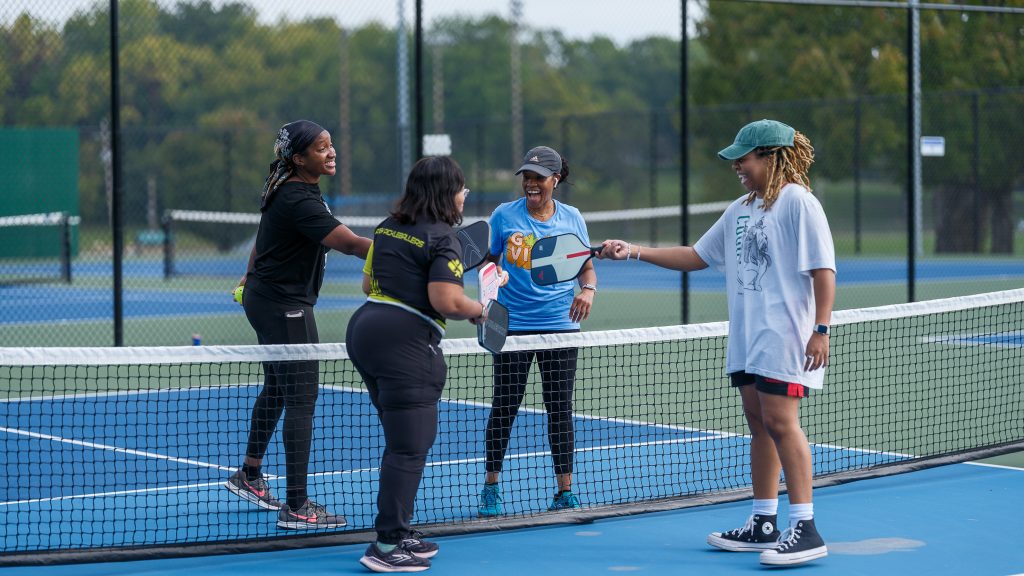
Most games are doubles on a small court with a light plastic ball. You serve underhand across the court. After the serve, the ball must bounce once on each side before anyone hits it out of the air. If you’re standing right next to the net, you can’t hit it out of the air there; you have to let it bounce first. Games go to 11, and you have to win by 2.
On a typical BPCKC meetup night, roughly 40 to 50 people cycle through over a couple of hours. That is enough to keep the energy high, but not so many that newcomers get stranded.
Zoom out and the scale makes sense. About 19.8 million Americans played pickleball in 2024, up roughly 46 percent from 2023, and it has been the fastest growing sport in the country for four straight years.
In tournament play the edge sharpens. Points last longer, the sideline gets louder, and the post-point talk stays light. Someone leaves with a trophy, yet the prize still feels collective.
On regular meetups, Jackson will slide into the advanced games: big-framed, firefighter-strong, surprisingly quick. Friendly smile, competitive core. Underestimate him and you’ll find out. The paradox makes the room work: facilitator first, fierce player when the bracket allows.
Why Black-led spaces are not a scandal
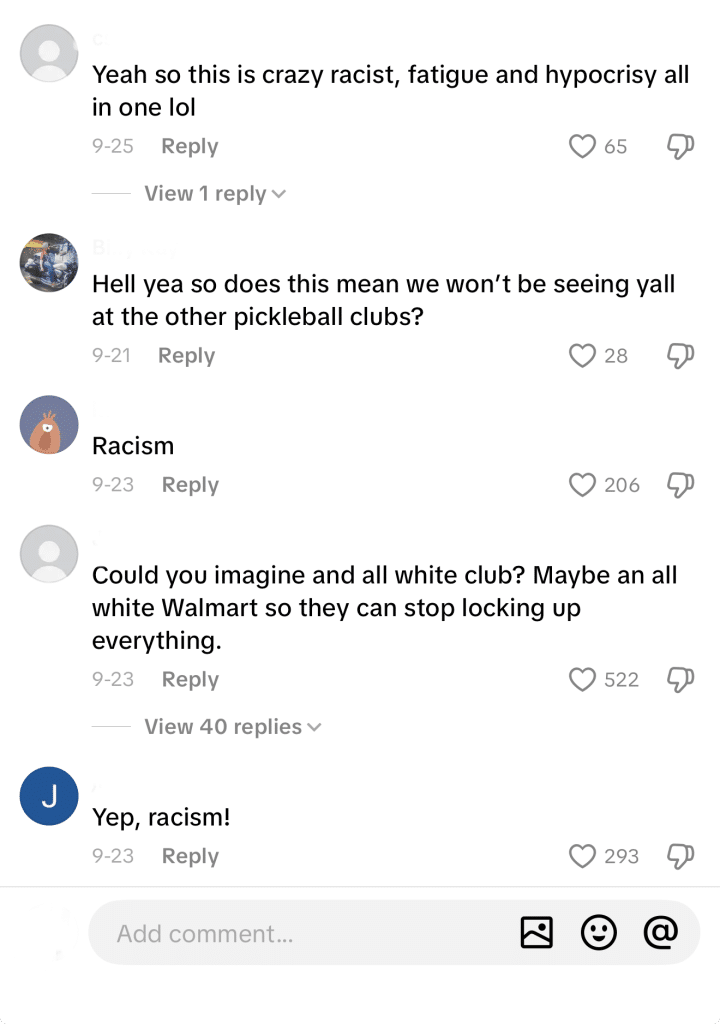
Some online critics called the creation of BPCKC “segregation.” Besides the absurdity of such a historically ignorant comment, that narrative ignores both the city’s history and the law. Kansas City’s racial geography did not happen by accident: redlining, blockbusting, and racially restrictive covenants shaped where people could live, play, and gather. As historian Sandra Enríquez has put it, “Race is so embedded into the way that urban development happened… All of these policies… were meant for white people. Not for communities of color.”
“When we walk into different spaces, we’re the minority. It’s an uncomfortable spot, especially when it’s competitive. Here, it’s really fun, it’s free-flowing, and we can just be ourselves.” said Jackson.
In such a city, starting in a familiar room matters. Affinity is not exclusion for its own sake,it’s a strategy for access. Learners are less guarded, more willing to fail in public, when they don’t feel like ambassadors for an entire group. When a room is designed to welcome beginners, the culture learns to stretch. That is all theory until it’s a crisp Autumn night under park lights. Then, it’s just how people move.
And according to federal law If a group operates as a private club or association rather than a public accommodation, it isn’t subject to Title II’s public-accommodations provisions. That’s not a loophole; it’s how civil-rights law has long balanced freedom of association and protections against discrimination.
A sampling from Jackson’s announcement video comment threads: accusations of “reverse racism,” claims a Black-led club is “illegal,” lazy predictions of chaos. It’s an old pattern wearing a new interface. Pew Research Center has found that social media is the most common venue for online harassment with75% of respondents saying their most recent experience happened on social media, and Black users are significantly more likely than white users to attribute harassment to race or ethnicity.
The reality is this: The first BPCKC meetup ran at APEX Sports Hub in Independence, MO, a facility with 12 dedicated courts (8 indoor, 4 outdoor) and published rental rates of $24/hour (non-prime) and $33/hour (prime). The club rents time and fills lanes with members and guests; other players simply book another hour. In other words, no one was being kept from pickleball.
Even if no one from BPCKC ever plays for a paycheck, the club is already building the deeper thing: social infrastructure sturdy enough to hold joy. Nationally, pickleball has exploded with—19.8 million U.S. participants in 2024, a 45.8% jump from 2023, but local culture still decides what the sport is for. In Kansas City, BPCKC is a template for growth with values attached.
Jackson talks about forming a team, youth clinics on both sides of the state line, and building a ladder from rec to competitive play. That ladder now exists locally: the Kansas City Stingers, part of the National Pickleball League, launched in 2024 and announced a 2025 home base near the stadium corridor at the new SW19 at the Stadium facility.
How to join BPCKC
There’s no gate to clear. Right now it runs like open-ticketed sessions (details circulate via GroupMe and their Instagram @BPCKC); show up, get folded in, learn by doing. Location note: recent sessions have been hosted at Klamm Park in Kansas City, Kansas.
What comes next
The clubs beyond pickleball further validate the proof of concept. The wrestling nights are already monthly; the vinyl club awaits a partner venue and a good stereo. If you’re interested in joining the meet ups, you can follow BPCKC on Instagram or join their GroupMe for updates!
Short-term, Jackson wants consistency: weekend meetups for BPCKC (firefighting schedule permitting), a co-organizer to guarantee cadence, and standard rituals so first-timers always have a place to land. Mid-term, youth classes and guest clinics—including school-gym demos with tape lines and a portable net. Long-term, a team that can hold its own at regional events—and a civic footprint beyond sport. The point has less to do with brand extension and more to do with increasing accessibility for the community.
I didn’t arrive at Klamm Park a pickleball person, but I left one. That’s the secret: you show up for a sport you’re not sure you like and leave already plotting the next game, less for the points than for the feeling that, for a couple of hours, you belonged to a room that wanted you there.