NAIROBI, July 6, 2026: The Kenyan national soccer team did not qualify for this year’s World Cup, but 28-year-old Humphrey Otiero, “like Bogart,” he says, still has a dog in the fight, rushing home on the evening of June 25 after a double shift driving his cab to watch South Africa take on South Korea in the knockout round of the quadrennial soccer tournament.
He was displeased with the outcome, however; South Africa won 1-0.
“Ah, I hate Bafana Bafana,” Otiero said, referring to South Africa’s national team by its nickname. “I am a proud pan-Africanist but this year I am not ashamed to say that I am cheering for whatever team plays the South Africans.”
Otiero’s annoyance with Kenya’s neighbor reflects a consensus across the continent as South Africa is in the throes of a xenophobic pogrom that is entering its fourth month.
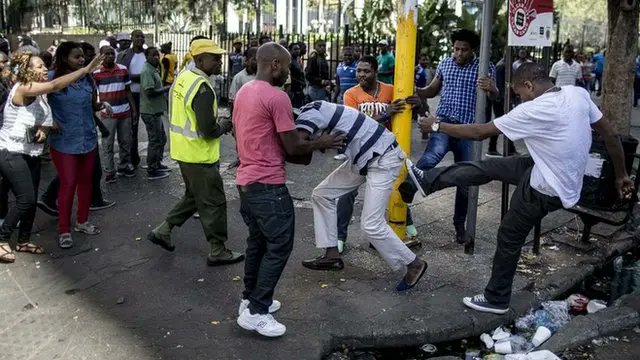
Since mid-April, mobs of Black South Africans, armed with machetes, clubs and spears, have gone door to door in Johannesburg and Durban demanding that employers fire foreign nationals and hire Black South Africans, and terrorizing immigrants from neighboring countries such as Zimbabwe, Malawi, Mozambique, Zambia, Nigeria and Ghana, chanting “abahambe,” a word in both the isiZulu and isiXhosa languages meaning “they must leave.”
Mobs have killed at least six people so far, most of them Mozambican and Malawian nationals, drawing uncomfortable comparisons to the MAGA movement and the Trump administration’s attacks on Latino immigrants carried out by ICE stormtroopers.
Thousands of protesters poured into the streets across the nation on June 30 to coincide with a deadline set by the primary anti-immigrant organization, March and March, for all undocumented residents to leave the country. One demonstrator told reporters:
“I am asking them: please go back to their countries. Enough is enough. I am tired. Go!”
South African police reported more than 900 arrests on the day of the protest but described the demonstrations as largely peaceful. Tebello Mosikili, a deputy national police commissioner, told reporters that 108 of the 120 nationwide marches were peaceful while twelve required police intervention.
South African President Cyril Ramaphosa has sent mixed messages, condemning the attacks in a speech last month on the one hand, but also describing as legitimate complaints made by groups such as March and March about immigrants engaging in criminal activity and taking jobs from locals. He met last week with organizers of the march at Pretoria’s Union Buildings, South Africa’s White House.
African diplomats have publicly criticized Ramaphosa for not doing enough to protect immigrants. The combination of what Africans widely interpret as the South African government’s weak response, and a series of videos depicting mob attacks that have gone viral on social media, has cast South Africa as the villain in ways not seen since high apartheid nearly 40 years ago, when LAPD detectives Martin Riggs and Roger Murtaugh, played by Mel Gibson and Danny Glover, demolished a criminal ring run by South African diplomats in the Hollywood blockbuster Lethal Weapon 2.
A Familiar Scapegoat, in Johannesburg as in Kansas City
What’s happening today in Africa is nothing short of surreal.
The continent erupted in jubilation following Mexico’s 2-0 victory over South Africa in their opening World Cup match, publishing videos on social media of Africans donning Mexican jerseys, taunting Bafana Bafana with mariachi memes, and waving the Mexican flag. Said one woman in a livestream:
“On behalf of all Africans, thank you so much Mexico!”
A Nairobi hotel clerk who did not want to give her name for fear of antagonizing her boss by driving away South African tourists told the Kansas City Defender:
“The South Africans attacked a friend of mine. She is not a criminal, she is not undocumented and she took no one’s job. Bafana Bafana can go to hell for all I care!”
According to South Africa’s census figures, foreign-born migrants account for only 4 percent of the country’s population of 62 million people, and the Institute for Security Studies reported in July of 2017 that foreign nationals accounted for 7.5 percent of all inmates locked up in South African prisons.
African diplomats report repatriating 25,000 of their citizens so far. But those numbers are just a drop in the bucket; the larger problem is that Nelson Mandela’s ruling party, the African National Congress, has failed to redistribute wealth from a tiny white minority to the teeming Black majority since assuming control of the government’s reins. The official unemployment rate stands at 32.7 percent, up sharply from the mid-1990s, and the country’s wealth remains more unevenly distributed than anywhere else on earth, just as it was during apartheid.
The country’s woeful economy has left Black South Africans frustrated, and immigrants make for convenient scapegoats just as they do in the U.S., which is also in the midst of economic decline, although American workers are obviously nowhere near as destitute as South Africans. In 2008, anti-migrant riots left 62 people dead, and in July 2021, unrest sparked by the jailing of former president Jacob Zuma killed more than 350 people in the country’s deadliest violence since the end of apartheid.
The irony is that Africans widely view South Africans’ xenophobia as a betrayal of the same pan-African values that were instrumental in liberating the country from apartheid. Scores of dissidents and ANC revolutionaries found refuge in Tanzania, Ghana, Zambia and Mozambique during white minority misrule, and universities across the continent often waived tuition for South African students during the apartheid era. In the late 1980s, Fidel Castro sent 30,000 soldiers, mostly Afro-Cuban, to the Angolan city of Cuito Cuanavale to help government forces defeat rebels supported by South African Defense Forces, in a battle that many, including Mandela, believed was the last nail in the coffin for an apartheid government already staggering under international sanctions.
That sanctions movement traces its lineage to September of 1970, when two African American employees at Polaroid in suburban Boston, Caroline Hunter, a chemist, and Ken Williams, a photographer, noticed a bulletin board mock-up of an identification card on their way to lunch. The caption read: “Department of the Mines, Republic of South Africa.” The pair did some digging and discovered the ID cards were used by South Africa’s white minority to enforce apartheid’s police state. When Hunter and Williams raised their objections to Polaroid executives, they were initially ignored, and ultimately fired, yet they went on to birth the international divestment movement that was instrumental in apartheid’s abolition in 1994.
Said the Kenyan cabdriver, Otiero:
“If you know how the white people treated you during apartheid why would you turn against your own people and treat them the same way?” – Humphrey Otiero, Nairobi cabdriver
A Congenital Defect in South Africa’s Liberation Movement
The latest spasm of xenophobic violence in South Africa also airs some of the continent’s dirty laundry. It is hardly a secret that many Africans have historically viewed Black South Africans as less militant than the rest of the continent, or only marginally better than African Americans, who many here view as more white than Black. Africans who are familiar with U.S. politics draw comparisons not only to MAGA but to the American Descendants of Slavery (ADOS) movement in the U.S. that seeks to exclude African immigrants and Afro-Caribbeans from any reparations deal.
Similarly, some pan-African scholars compare South Africa’s xenophobic hysteria today to the 1937 Parsley Massacre, in which the Dominican Republic’s strongman, Rafael Trujillo, ordered the slaughter of an estimated 30,000 Haitians, identifying them by a shibboleth: their inability to roll the “r” in perejil, the Spanish word for parsley.
“It’s correct to say that what Africans are experiencing in South Africa is a new version of apartheid,” the Kenyan historian and political scientist Peter Kagwanja told a local radio station last week. “Basically, it’s a spin-off of the politics of apartheid which was very xenophobic…South African Blacks are themselves victims of xenophobia, white xenophobia…Most of them have suffered centuries of xenophobic innovation.”
Kagwanja and several African scholars have attributed South Africans’ mob attacks on foreign nationals to a number of historical factors.
First there is the African National Congress, founded in 1912. Initially, the ANC represented an indigenous bourgeoisie, a professional class (Mandela was an attorney) that demanded to be cut in on the spoils that the British and Afrikaner settlers were dividing between themselves. In 1914, a five-man delegation from the South African Native National Congress, which later became the ANC, sailed to London to petition King George V to veto the Natives Land Act of 1913 and return to the indigenous population land given to fewer than 350,000 European settlers.
But in their appeal, they acknowledged British sovereignty over their land, which is antithetical to resistance movements in Africa or elsewhere, Ndumiso Dladla, a Senior Lecturer in Jurisprudence at the University of Pretoria, said in an interview last week. In the petition, Dladla noted, the ANC’s delegates called George V their lawful king, themselves his humble children, and his conquest of their territory legitimate:
“To conquer someone is not to kill them. It’s not to imprison them. To conquer someone they must live but agree that you are now their master. The foundation of the colonial order and even slavery is conquest. The ANC submits and says you’ve conquered us and as a result of this conquest are now the rightful lawgiver…But a movement for national liberation is precisely about the repudiation of the idea that the white man can rightfully rule with no other authority than that he has beaten them in warfare in an unprovoked and unjustified war.”
Historians and political analysts often compare the ANC’s reformist politics to that of the NAACP, founded three years earlier. The introduction of apartheid in 1948 radicalized the ANC, and by necessity it became more of a broad-based political movement similar to other continental liberation organs.
Secondly, the ANC did not win independence on the battlefield like their counterparts in Angola, Algeria, Zimbabwe or Mozambique, but at a negotiating table, such as an infamous 1985 meeting in Zambia with a group of corporate executives led by the chairman of the Anglo American Corporation, Gavin Reilly, who said that a transition to democracy would only be possible if the nation’s assets remained under white control. Six years later, following his release from prison, Mandela reversed the ANC’s longstanding intention to nationalize the mining industry once it took power. In his book A History of Inequality in South Africa, 1652-2002, the economist Sampie Terreblanche wrote:
“The ANC’s core leaders effectively sold its sovereign freedom to implement an independent and appropriate socio-economic policy for a mess of pottage when it entered into several compromises with its corporate sector and its global partners. These unfortunate ‘transactions’ must be retracted or re-negotiated.”
When white supremacists in 1993 assassinated the enormously popular Chris Hani, the head of South Africa’s Communist Party and the leader of the ANC’s militant wing known as the Spear of the Nation, they effectively resolved an internecine party dispute between exiled party members who wanted to court Western investment with business-friendly reforms and a more radical cadre of ANC stalwarts that did not flee political persecution and proposed that Black South Africans control the means of production in the country of their birth.
Following Hani’s murder, the ANC launched a campaign to discredit Mandela’s charismatic estranged wife, Winnie, who sided with Hani in championing socialist policies for post-apartheid South Africa.
“They Are Scared of White People”
Thirdly, many Africans, both inside and outside of South Africa, believe that Black South Africans suffer from a kind of Stockholm Syndrome in which they identify with their oppressors. Anti-apartheid icons such as Steve Biko and Robert Sobukwe were critical of the ANC’s collaboration with white liberals who benefited from apartheid and tended to harbor paternalistic attitudes towards Blacks.
Sobukwe went even further, excoriating the ANC for its integrationist approach and arguing that African independence movements needed autonomy to succeed.
Compounding matters is that the ANC did not invest in education as heavily as other African countries in the post-colonial era. For example, Robert Mugabe, the first head of state in neighboring Zimbabwe, eliminated tuition at all public universities and colleges after the former British colony won its independence in 1980, although he later reinstated the fees.
Descending from German, Dutch and French Huguenots, the Afrikaners who began settling in South Africa in 1652 would ultimately exploit African labor to build the most developed and industrialized country on the continent with the intention of living there rather than just stealing its wealth and subsequently returning home to Europe, as, say, the Portuguese did after Africans won their independence in Angola and Mozambique.
But Africans have for decades asserted that some Black South Africans claimed their oppressors’ triumph as their own, similar to the house Negro described by Malcolm X, and continue to do so to this day, as evidenced by the demands made on Black foreign nationals to return home, while few demands are made of white South Africans who remain in possession of most of the country’s arable land, its manufacturing sector and wealth.
“When they speak to a white person, they are very respectful, they show manners. When they speak to a Black person they are violent.”
Julius Malema, Economic Freedom Fighters
Julius Malema, the popular leader of a South African opposition party, the Economic Freedom Fighters, advocates for a borderless Africa, as did Libya’s head of state, Muammar Gaddafi, before his 2011 assassination by rebels backed by the U.S. and NATO. In a recent address, Malema said the anti-immigrant protesters are largely motivated by a kind of self-loathing that leaves them unable to imagine a society in which whites aren’t always in charge. He said:
“They are scared of white people. Look at them. When they speak to a white person, they are very respectful, they show manners. When they speak to a Black person they are violent. But let’s ask a question: after you’ve marched and said you don’t want Zimbabweans, you don’t want Nigerians, you don’t want Ghanaians, you’ve closed shops, you march, why are you not coming back to tell us the following day that after that march you’ve expelled 10 Zimbabweans and out of those 10 Zimbabweans you were able to give 10 South Africans jobs. There is no such a report. Why? Because those are slaves’ jobs. They don’t pay anything. You want proper jobs. You want a job with a payslip, with an appointment letter, with pension, with medical aid, and you deserve it. But why are we fighting each other? It is the same people who made us fight each other during apartheid.”
Back in Nairobi, Otiero has his ritual. Come home from a double shift, turn on the match, and cheer, without shame, for whoever lines up across from Bafana Bafana.
Frequently Asked Questions
What does “abahambe” mean?
Abahambe is a word in both the isiZulu and isiXhosa languages meaning “they must leave.” It has become the rallying chant of the anti-immigrant mobs and marches sweeping Johannesburg and Durban since mid-April 2026.
What is March and March in South Africa?
March and March is South Africa’s primary anti-immigrant organization. The group set a June 30, 2026 deadline for all undocumented residents to leave the country, a demand that drew thousands of protesters into the streets nationwide and led to more than 900 arrests.
Why are Africans across the continent rooting against South Africa at the 2026 World Cup?
Many Africans view South Africa’s xenophobic violence as a betrayal of the pan-Africanism that helped liberate the country from apartheid, when nations like Tanzania, Ghana, Zambia and Mozambique sheltered ANC revolutionaries and universities across the continent waived tuition for South African students. The continent erupted in celebration after Mexico defeated Bafana Bafana 2-0 in their opening World Cup match.