His hands did the work. Maurice Copeland was a tool and die supervisor at the Kansas City Plant for the last twelve of his thirty-two years there, and for most of that time he passed chemicals he did not know were poison across a workbench to men he supervised.
He was a Black Vietnam veteran when Bendix Corporation hired him in 1968, one among thousands of Black returning soldiers Bendix brought in as the Cold War pushed weapons assembly to wartime pace.
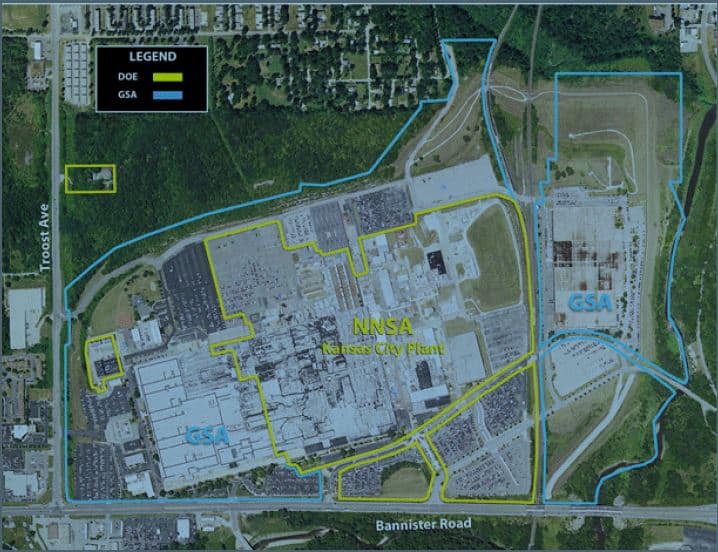
The plant at 1500 East Bannister Road sat at the edge of Troost Avenue, the apartheid line that has divided this city since before he was born. What Copeland and the men he supervised handled with their bare hands, included benzene, beryllium, trichloroethylene, polychlorinated biphenyls, asbestos, mercury, lead, and depleted uranium. Group 1 carcinogens.
Chemicals that entered their lungs, that rode home on their shirts into their wives’ laundry, that settled into their children’s bedding. The federal government did not tell them what they were working with. Not for seventy years.
“I gave it to them, told them to go make this part,” Copeland told The Defender in 2024, his voice raspy. “They took that contamination and exposure home with them.” What Copeland described has a name in occupational health: take-home exposure, the secondary poisoning of families who never set foot in the plant.
This is a story about Kansas City. It is also a story this city does not know about itself.
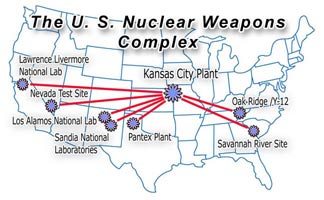
Since 1949, the Kansas City Plant, now renamed the Kansas City National Security Campus, has manufactured roughly 80 percent of every non-nuclear component in every American nuclear weapon.
Every arming fuse. Every electronic guidance system. Every miniature electromechanical device. Every carriage that holds the plutonium and uranium and tritium at the core of the bomb.
The fissile material is shaped at Los Alamos in New Mexico. The weapons are tested at the Savannah River Site in South Carolina. The warheads are finally assembled at Pantex in Texas. But between all of those places, quietly, consistently, for most of a century, Kansas City has been making the body.
Most of the people in our city have no awareness that we produce more nuclear weapon components than anywhere else on planet earth, or how much of a target that makes us geo-politically. Most of the workers’ families also do not know. The young Black and brown Kansas Citians who ride the MAX down Troost past the land where the old plant stood ten miles south of downtown Kansas City, whose parents and grandparents’ water has been fed by the aquifer beneath that ground, do not know.
Kansas City has been a bomb factory for seventy-seven years, and the people most poisoned by it have been its own.
On the night of Thursday, May 7, the National Nuclear Security Administration (NNSA) will hold a formal public hearing at Hillcrest Community Center, at 10401 Hillcrest Road in south Kansas City, to receive comment on a draft Programmatic Environmental Impact Statement released this month.
The document concerns federal plans to sharply expand the production of plutonium pits, the softball-sized radioactive cores at the center of every modern American thermonuclear weapon.
The hearing will follow a ninety-minute open house, where agency staff stand beside display boards and answer questions one at a time, and two and a half hours of formal comment.
The Union of Concerned Scientists has called the draft document “a legal fig leaf.” The NNSA has already exceeded the production quotas the document claims to analyze. The Los Alamos quota of 30 pits a year was quietly doubled to 60 while the draft document itself was still being written. The agency is studying an expansion already under construction.
Hillcrest Community Center, May 7: How to comment at the Kansas City nuclear weapons hearing
The hearing will begin at 5:00 p.m. The formal public hearing will run from 5:30 until 8:00. There is no virtual option. Kansas Citians who wish to comment must come in person. Written comments may also be submitted to PitPEIS@nnsa.doe.gov until midnight on July 16. The document number is DOE/EIS-0573. The Kansas City hearing is one of five being held nationally. The others are in North Augusta, South Carolina; Livermore, California; Santa Fe, New Mexico; and Washington, D.C. The cities where the bombs are being made, and the capital where the decisions were made years ago.
But the meeting is coming to Kansas City. And there is a story this city should hear before it walks in the door.
The Apocalyptic Nuclear Bomb Was Dug by Black hands
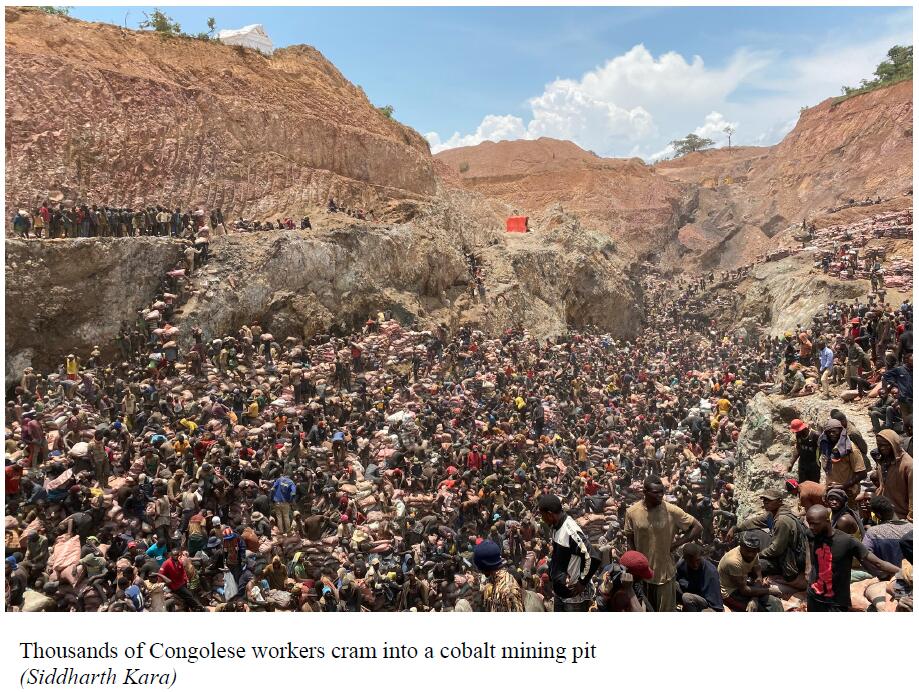
The uranium that incinerated at least 90,000 humans in Hiroshima on August 6, 1945, could not have been mined in the United States or Canada, where ore deposits averaged less than 1 percent uranium, too dilute to produce weapons-grade material at the pace and scale the Manhattan Project demanded. The richest uranium on earth sat in a single mine in Katanga Province, in what was then the Belgian Congo. Its ore averaged 65 percent uranium oxide. The Manhattan Project could not exist without it.
The mine was called Shinkolobwe. It was worked by Congolese miners under the Belgian colonial forced labor (slavery) system that Belgium’s own colonial charter, Article 3, nominally prohibited and in practice allowed.
General Leslie Groves, the director of the Manhattan Project, struck a secret deal with Edgar Sengier of Union Minière du Haut-Katanga to ship hundreds of tons of uranium ore per month from the Congo through the port of Matadi to American processing facilities, bypassing congressional oversight.
The Congolese miners were not told what the ore was for. They dug with their bare hands into some of the most radioactive soil on the planet. A 2021 analysis in the MIT Faculty Newsletter, written in part by Congolese scholars, concluded that the Shinkolobwe mine furnished nearly two-thirds of the uranium used in the bomb dropped on Hiroshima.
Isaiah Mombilo, founder of the Congolese Civil Society of South Africa, has spent years attempting to make this history visible. At a Hiroshima commemoration in Cape Town in 2022, he described the Congolese miners as having been used “like slaves” to produce the ore the bomb required.
From the Congo to Kansas City, the chain was set. The ore from Katanga flowed through American processing facilities. The Atomic Energy Commission was established in 1946 to formalize the wartime apparatus into a permanent American weapons complex. Three years later, the Commission contracted Bendix to begin manufacturing the non-nuclear components of American bombs at a former Pratt and Whitney engine plant at Bannister and Troost in Kansas City. The Congolese hands dug. The Black American hands assembled. The decisions, then as now, were made somewhere else.
Los Alamos, the low country, and the pattern
The structural logic of the American nuclear complex has remained virtually unchanged over the decades.
Much like superfund sites, data centers or other poisonous facilities that exacerbate environmental racism, when the federal government has chosen where to build its weapons factories, it has chosen places whose residents had the least political power to refuse.
Los Alamos National Laboratory, where every American plutonium pit is produced, sits on land sacred to the Pueblo peoples, whose cultural and burial sites the Department of Energy recently approved in some instances to be paved and replaced with parking lots.
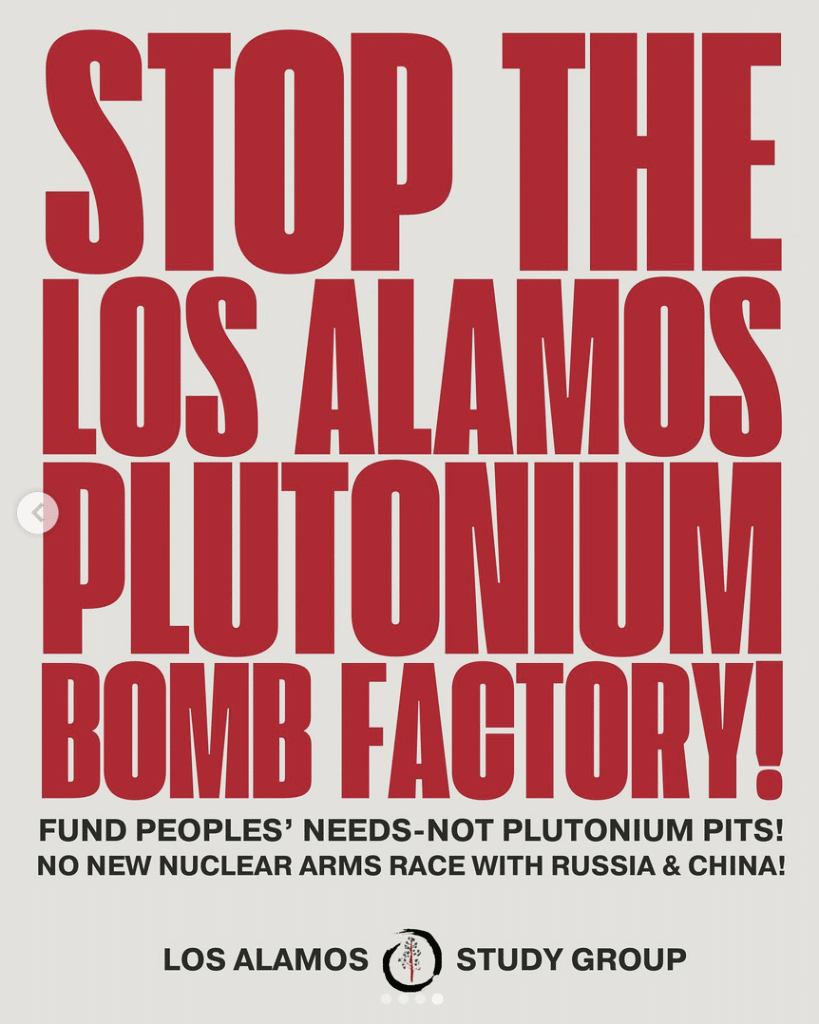
The Savannah River Site, slated to produce 50 plutonium pits per year once expansion is complete, is located on the traditional land of the Gullah/Geechee Nation, the sovereign Black community of the Sea Islands of Georgia and South Carolina.
Radioactive waste from the entire national pit program will be shipped to the Waste Isolation Pilot Plant in New Mexico, on land that was Puebloan and Mescalero Apache before it was American.
In June 2021, four organizations sued the federal government over its plutonium pit expansion plans. They were Nuclear Watch New Mexico, Tri-Valley Communities Against a Radioactive Environment, Savannah River Site Watch, and the Gullah/Geechee Sea Island Coalition. The lead plaintiff from the Gullah/Geechee Nation was Queen Quet, the Chieftess and head of state.
In September 2024, Judge Mary Geiger Lewis of the United States District Court for the District of South Carolina ruled in the plaintiffs’ favor. The federal government had violated the National Environmental Policy Act, the court found, by pushing forward a massive expansion of nuclear weapons production without considering its cumulative national impact.
The settlement that followed required the NNSA to produce a Programmatic Environmental Impact Statement, to solicit public comment, and to hold hearings in the affected communities. That settlement is the reason the federal government is coming to Kansas City on May 7.
The Gullah/Geechee Nation won a lawsuit that forced the federal government to hold a hearing in Kansas City. Black frontline organizing in coastal Georgia has opened a door that Black Kansas City now has a chance to walk through.
The Killing Field at Bannister and Troost
During the half-century the Kansas City Plant operated at the Bannister Federal Complex it used more than 2,400 distinct chemical compounds.
The federal government eventually admitted to 785 toxic substances, including radioactive ones, a number that likely reflects what officials are willing to admit to, not the full scope of exposure.
Workers were not informed of what they were handling. The soil and groundwater were extensively contaminated with trichloroethylene, a known human carcinogen, and polychlorinated biphenyls, a probable human carcinogen. The plant used depleted uranium, by the ton, more on than off, since 1959.
In 1989, the Environmental Protection Agency discovered a spill of promethium-147, a radioactive isotope, that had gone undetected for years, impacting employees at Honeywell, the IRS and GSA.
The incident involved take-home exposure where employees had been tracking radioactive material into their homes and vehicles for some time.
The Bannister Federal Complex became one of the few facilities in American history to house both nuclear weapons manufacturing and federal office workers under the same roof. Internal Revenue Service employees, General Services Administration employees, and postal workers shared air with the machinists and chemists who were handling the weapons-grade materials.
Over time, their bodies broke down together.
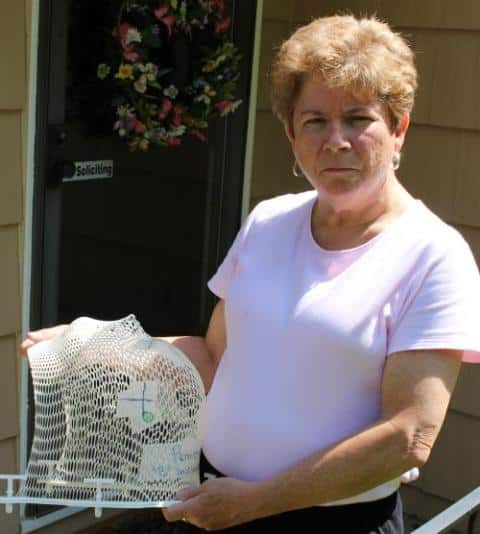
Barbara Rice, a retired GSA data analyst with thirty-one years of service, began tracking her former colleagues in 2009 after she noticed that too many of them had died. Within three weeks, her informal spreadsheet contained more than a hundred entries. Sixty of them were cancers.
Rice’s story and the count she kept were reported in detail by the National Catholic Reporter in a 2019 investigation. The American Federation of Government Employees later reported that of the forty-person professional trades and craft staff in the Maintenance and Operations Division, roughly 80 percent had died. Russ Ptacek, an investigative reporter at KSHB-TV, the local NBC affiliate, documented across a multi-year investigation what he described as an alarming pattern of pancreatic cancer deaths among IRS employees who had worked at the complex.
In 2011, the federal General Services Administration, which had denied for years that any toxic materials were present on its side of the plant, finally admitted the contamination. The regional administrator’s apology was its own indictment of a half-century of denial.
More than 1,500 workers have filed claims for toxic exposure. Approximately 150 deaths have been directly linked to the plant by the Coalition Against Contamination, the organization the workers built when no one else would help them and whose claim tally NCR cited in its reporting. Maurice Copeland, the Bendix Corporation supervisor, whose hands opened this piece, is a founding member.
The workers’ compensation fight has been its own form of violence. In 2000, President Bill Clinton signed Executive Order 13179, creating the Energy Employees Occupational Illness Compensation Program Act. The program was supposed to pay the workers for what the government had done to them.
Workers and their attorneys have a name for the impossible process: deny until you die.
As recently as 2017, a Department of Labor whistleblower described what he characterized as explicit hostility toward claimants from inside the program. Maxine Pennington, a retired KC Plant chemist who has helped hundreds of her former colleagues file claims, has said the process seems designed to discourage workers by denying them first.
The Bomb Factory on the Apartheid Line
The plant sat on Troost, the color line and the boundary whose east side the Home Owners’ Loan Corporation shaded red in the 1930s, whose west side the racist mastermind, J.C. Nichols, and his successors would not sell a Black family a home in for a half-century afterward, whose east side is still written into every public health outcome, every mortgage denial, and every closed school.
When the Atomic Energy Commission chose where to build the plant that would manufacture the body of the American nuclear bomb, the federal government chose the apartheid line. When Bendix went looking for workers for that plant in the 1960s and 1970s, it reached for the Black Vietnam veterans coming home to a segregated city in search of a good-paying job.
The truth at the core of this story is that the American federal government held out two hands to Black Kansas City. One held the best wage in a redlined city. The other held the chemicals that would bury the men who took it. They were the same hand.
The Bannister Federal Complex was sold to a private developer in 2017. The old plant has been demolished. The land is being redeveloped for industrial use. The contamination remains in the soil and the groundwater, moving slowly, the way uranium moves. It sits beneath Kansas City still.
The Blue River, which borders the Bannister site on the east, drains into the Missouri River through neighborhoods on the east side of Troost. Barrier walls were installed during cleanup to prevent contaminated groundwater from reaching the river.
And now, again
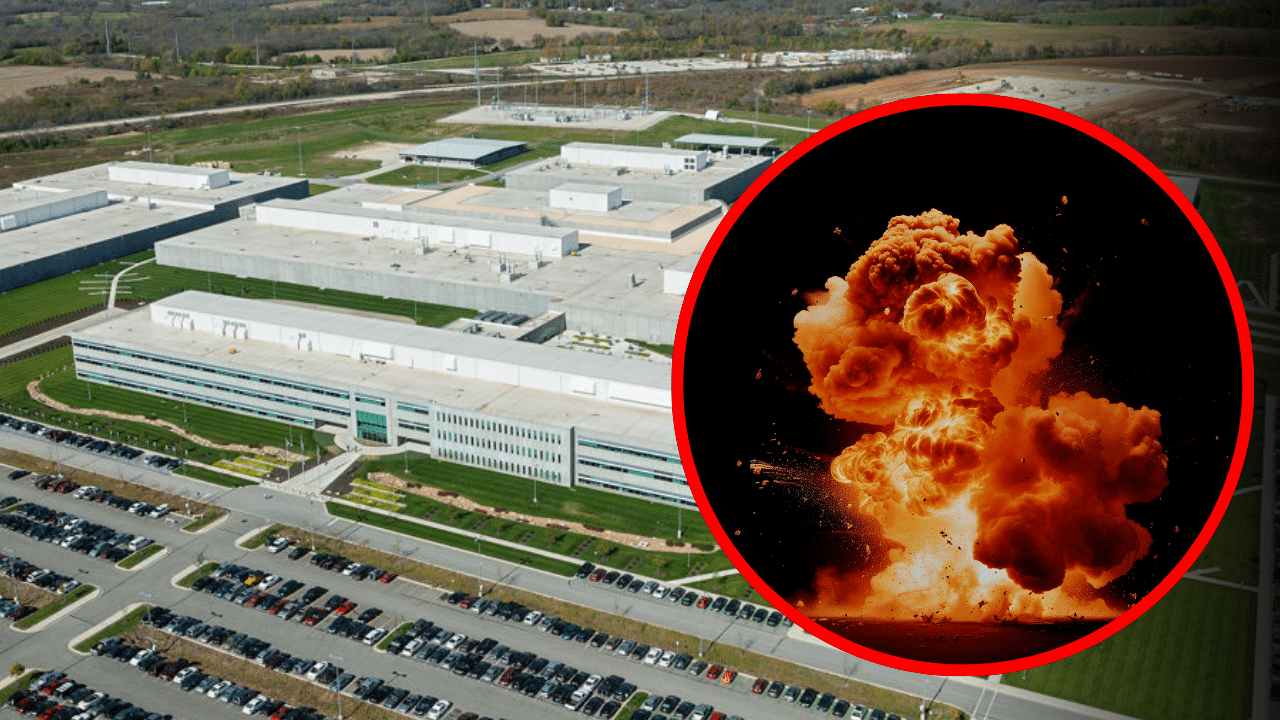
The Kansas City National Security Campus moved from Bannister to a new facility at 14520 Botts Road in far south Kansas City in 2014, built through a private developer financing arrangement on 185 acres at a cost of $713 million.
Employing nearly 7,000 people, it continues the plant’s mission. It produces, as its contractor Honeywell states plainly on its own website, approximately 80 percent of the non-nuclear components that go into the American nuclear stockpile.
The arrangement at Botts Road is, by the federal government’s own description, the first privately owned nuclear weapons component facility in U.S. history. Title to the land sits with a Kansas City quasi-public agency, which leases it through a chain of private holding companies before subleasing it back to the federal government, an arrangement Pulitzer Prize-winning historian Richard Rhodes, author of The Making of the Atomic Bomb, called “an aberration in the history of the military-industrial complex.”
When the lease expires, the private holding company keeps the building. The federal government will then have spent more than $1 billion in lease payments to manufacture nuclear weapons inside a facility it does not own, and that ownership will pass into private hands.
It is now expanding. The KC NExT project (Kansas City Non-Nuclear Expansion Transformation) broke ground on a 245-acre site immediately east of the existing campus in 2024.
Phase 1, a 700-person office building, is scheduled for federal possession at the same time Kansas City is being asked to comment on whether the expansion should proceed. The full project runs 15 phases into the 2040s, ultimately adding approximately 1.8 million square feet of manufacturing and office space at a projected cost of nearly $2.5 billion. The NNSA has issued a finding that this expansion will have no significant environmental impact.
The developer is Promontory 150 LLC, which is connected to Platform Ventures, the same real estate firm the Defender investigated for trying to sell a warehouse at 14901 Botts Road to ICE. Terry Anderson, co-president of Platform Ventures, represented Promontory 150 before the Missouri legislature when the company lobbied for the tax break that subsidized the expansion.
Kevin Breslin, principal of Bannister Transformation & Development LLC, the entity that holds the former contaminated Bannister plant site, is also the registered lobbyist for Promontory 150.
The same financial network that holds the poisoned land at Bannister is building the new weapons campus at Botts Road.
To smooth the way, Missouri’s legislature passed SB 1388, a state sales tax exemption covering construction materials for the expansion. The bill passed in 2024 with bipartisan support and was signed into law. The bill was projected to cost Missouri nearly $61 million in foregone public revenue over ten years.
The same legislature that exempted nuclear weapons construction from sales tax is, this spring, refusing to fully fund the state K-12 school formula by roughly $190 million, cutting child care subsidies, and threatening cuts to higher education and disability care across Missouri.
State Sen. Maggie Nurrenbern, a Kansas City Democrat, told the chamber in April that Missouri would have an additional $3.8 billion in revenue if not for the tax cuts the legislature has stacked up in recent years. “A lot of these problems in our budget really are self-inflicted,” she said. The bipartisan supermajority that found money to subsidize a nuclear weapons factory has not found money for the children of the state that houses it.
What the federal government is making in Kansas City now is the W87-1 nuclear warhead, a new-design thermonuclear weapon intended for the LGM-35A Sentinel intercontinental ballistic missile.
The Sentinel will be placed in 450 silos across Wyoming, Montana, Nebraska, North Dakota, and Colorado, replacing the aging Minuteman III. The W87-1 is the first American warhead in more than thirty-five years to require newly manufactured plutonium pits.
It is expected to carry multiple warheads per missile, a counterforce posture meaning it is designed to destroy an enemy’s weapons before they can be launched, consistent with first-strike capability and inconsistent with the Pentagon’s official doctrine of deterrence.
According to NNSA Administrator Jill Hruby at the KC NExT commencement ceremony in August 2024, the campus is simultaneously supporting seven active warhead modernization programs, including two in full-rate production, two preparing for production, and three in design.
The Trump administration’s FY27 budget increased the W87-1 warhead program by 41 percent, from $650 million to $913 million, with projected annual costs averaging $3.5 billion from 2028 through 2031. The submarine-launched W93 warhead, actively lobbied for by the United Kingdom, jumped 37 percent. A new Future Programs line item of $99.8 million was added for feasibility studies on yet more new-design nuclear weapons. Plutonium pit production funding alone was nearly doubled. The full plutonium pit program is projected at more than $60 billion over 30 years. The full American nuclear modernization, warheads and missiles and submarines and bombers together, is projected at roughly $2 trillion over 30 years.
Every dollar of that budget is a dollar Kansas City does not receive. Not for the schools this city has systematically underfunded. Not for the mental health crises the Kansas City Police Department meets with guns instead of care. Not for the Black homeowners this city’s redlines created and whom Platform Ventures and the broader real estate apparatus this publication has tracked elsewhere continue to re-affirm.
The money flows outward to build weapons aimed at poor and working people in Russia, in China, in a nuclear Iran the United States refuses to allow to exist, and the cycle that began with the Manhattan Project, the secret World War II program that built the first atomic bombs, continues.
And Still
The Chicago Defender, the Black newspaper after which this publication is named, carried news through Mississippi when white mobs beat Black readers for being caught with it. It was the paper Ida B. Wells used to count the lynched. It was among the institutions that carried the arguments of W.E.B. Du Bois, who named the color line as the problem of the twentieth century. The Black radical press in this country has, for two hundred years, held one responsibility above all others. It has told the truth about empire to the people on whom empire is built and with whom empire is buried. It has named what the state would not name. Counted what the state would not count. Said what the state would not say.
The truth about Kansas City is that this city has made the body of the American nuclear bomb for seventy-seven years, that its Black workers and their families have been poisoned for it, that the federal government is now expanding the plant and accelerating production of new weapons for new wars.
The hearing on May 7 asks Black Kansas City whether it is willing to finish the next one.
Black Kansas City has always known the answer.