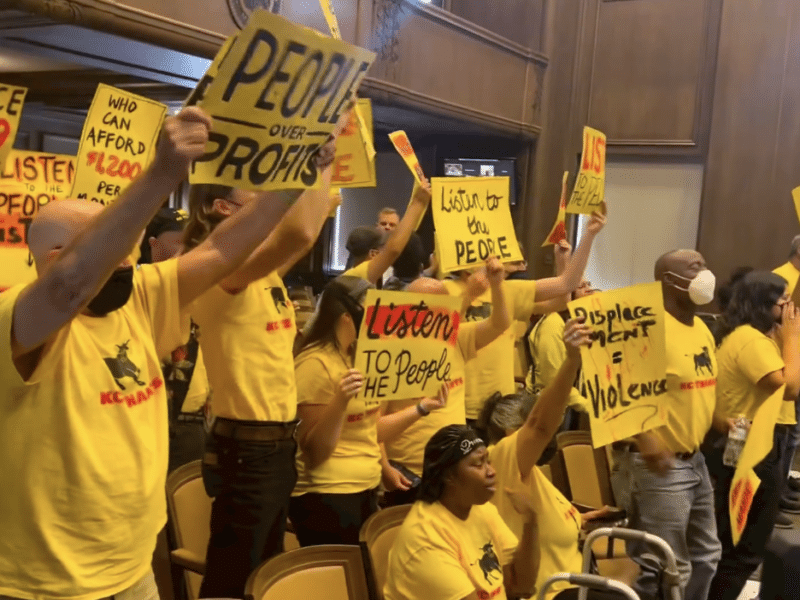
On January 25th, the Kansas City Council passed Ordinance 231019 that prohibits landlords from discriminating against prospective tenants based on their income.
The ordinance, which takes effect on August 1st, bans source of income discrimination–referring to how landlords treat tenants based on how they pay rent (such as with Section 8 vouchers). Additionally, the ordinance prohibits denying tenancy solely on the basis of prior (non-violent) criminal convictions, credit scores, and prior evictions.
Late last year, over 100 Black Kansas City women came together to write a letter calling for City Council to take action on this matter; KC Tenants also played a large role in mobilizing toward banning source of income discrimination.

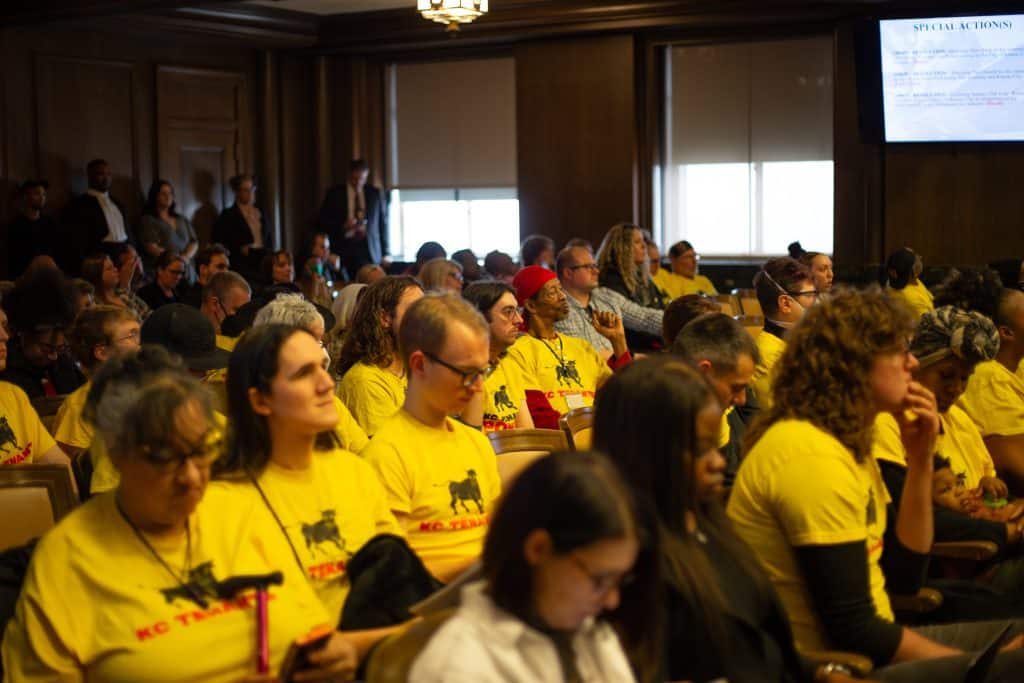
This ordinance, similar to those already passed in 85 US cities and seventeen states, seeks to ensure all renters can access housing of their choice. Such access will contribute to undoing the damage of discriminatory housing practices that have prevented many Black Americans and minorities from obtaining safe housing in the location of their choosing.
Exclusionary zoning promotes segregation
The United States has a long history of using exclusionary zoning ordinances to keep Black Americans and other minorities from living in white, affluent neighborhoods.
In addition to promoting segregation, these zonings contribute to degrading Black American neighborhoods into slums. When coupled with urban development that sacrificed inner-city, usually minority neighborhoods for projects like highways that facilitated predominantly white suburban commutes, these discriminatory zoning practices facilitated the movement of polluting and unsafe industries into inner-city Black American neighborhoods, increasing health problems and crime and further depressing housing values.
Relocating from these neighborhoods became even more difficult as higher-paying jobs fled to more affluent areas and the educational resources that could enable social mobility declined in quality. (Rothstein, 2017)
The results of these discriminatory zoning practices can still be seen today. The gap in homeownership rates between Black and white Americans is higher than what it was in 1960, when racial discrimination in housing was legal.
According to the Annual Homeless Assessment Report to Congress, Black Americans – despite making up just 13% of the US population – account for about 40% of the nation’s homeless population.
Only 43% of Black households own a home in comparison to 72.7% white Americans. Low income and bad credit scores are key factors keeping families from achieving their housing dream.
The Annual Homeless Assessment further explained that since the start of the Covid-19 pandemic many Black adults in households had faced uncertainty about their ability to pay housing.
The new ordinance promotes equal access to basic human needs
The Section 8 Housing Choice Voucher Program was established in 1974 to help low-income families attain “decent, safe, and affordable housing.”
According to an Urban Institute study, in some cities, more than 70 percent of landlords refuse to rent to voucher holders, often citing restrictive program requirements and concerns that tenants using vouchers will wreck their property.
This decision can leave tenants who could otherwise afford housing in the location of their choosing unable to find a landlord who will accept them, funneling them back into the unsafe communities they sought to leave.
With the passage of this ordinance, the Kansas City Council seeks to break this cycle and put the power of choice into the hands of the tenants.
Housing discrimination has a lasting impact on individuals and communities. Black Americans living in impoverished, segregated neighborhoods often live farther away from grocery stores, education facilities, and adequate healthcare.
When communities do not have access to these resources, their lack can perpetuate poverty and segregation and limit access to quality education and economic opportunities.
Unbinding centuries of racist policies won’t be achieved overnight, but this ordinance reminds us that there are advocates working to close the gap. And there are policy and behavioral changes that can get us moving in the right direction: toward humanity. Set to take effect on August 1, Kansas City’s housing ordinance will open more doors for poor and working-class tenants to find affordable housing.
It’s a big step toward creating a more inclusive, equitable and just community.

References & Further readings
Calacal, C. (2024, January 26). Kansas City renters who use housing vouchers now have more protection against discrimination. KCUR – Kansas City News and NPR. https://www.kcur.org/housing-development-section/2024-01-26/kansas-city-renters-who-use-housing-vouchers-now-have-more-protection-against-discrimination
U.S. Census Bureau. (2022, April 12). COVID-19 pandemic hit Black households harder than white households, even when Pre-Pandemic Socio-Economic disparities are taken into account. Census.gov. https://www.census.gov/library/stories/2021/07/how-pandemic-affected-black-and-white-households.html
U.S. Homeownership Up, but Black-white Gap Persists. (2023, March 2). www.nar.realtor. https://www.nar.realtor/newsroom/more-americans-own-their-homes-but-black-white-homeownership-rate-gap-is-biggest-in-a-decade-nar
Mandell, L. J. (2023, February 28). What is Section 8 Housing? Help paying rent (and not just in Low-Income neighborhoods). Real Estate News & Insights | realtor.com. https://www.realtor.com/advice/rent/what-is-section-8-housing/
Pettigrew, M. (2023, December 13). Kansas City tenants and landlords spar over housing vouchers (Kansas City Star, December 11, 2023) – PRRAC —. Poverty and Race Research Action Council — Connecting Research to Advocacy. https://www.prrac.org/kansas-city-tenants-and-landlords-spar-over-housing-vouchers-kansas-city-star-december-11-2023/
Rothstein, R. I. (2017). The Color of Law: A forgotten history of how our government segregated America. https://openlibrary.org/books/OL27353030M/The_Color_of_Law
Ryan, M. (2023, December 5). KC ordinance barring landlords from relying on financial, criminal, eviction history could make housing less affordable, available – The Heartlander. The Heartlander https://heartlandernews.com/2023/12/05/kc-ordinance-barring-landlords-from-relying-on-financial-criminal-eviction-history-could-make-housing-less-affordable-available/