Pride month was born out of protest.
In the early hours of June 28, 1969, a police raid at the Stonewall Inn in New York City sparked several days of resistance by trans and queer people who were tired of being criminalized, profiled and pushed out of public life. One year later, activists marked the anniversary with marches that helped lay the foundation for what Pride would become.
More than 50 years later, Pride is celebrated around the world. But as Pride has grown from protest into parade, festival and global cultural phenomenon, queer communities have continued to debate what is lost when liberation becomes entangled with corporate sponsorship, police presence, political branding and institutional approval.
In Kansas City, those tensions have long surrounded KC PrideFest, the city’s main Pride festival. Over the years, community members have raised concerns about police involvement, corporate co-option, financial barriers attached to ticket costs, accessibility and whether the event remains accountable to the queer and trans people most pushed to the margins.
Earlier this month, KC PrideFest marked its first year operating under the umbrella of Our Spot KC, a Black-led LGBTQ community organization. PrideFest organizers described the move as a practical step toward making one of Kansas City’s largest annual celebrations more financially and organizationally sustainable. But as PrideFest weekend unfolded, the leadership change did not settle deeper questions that have long surrounded the festival for many queer Kansas Citians: who is Pride for, and what kind of power should be allowed to shape it?
Those are the questions People’s Pride KC was created to answer. Founded as an explicitly anti-corporate alternative, the event rejects corporate sponsorships and policing, relying instead on donations, volunteer labor, local queer artists, street medics and community safety teams.
For many organizers, alternative events like People’s Pride KC represent a return to the roots of Pride — a riot meant to protest police brutality and the subjugation of queer identity. But for others, large-scale festivals remain critical for community resources that provide health care services, family programming, scholarships, housing, and economic opportunities throughout the year.
The Cost of Scale
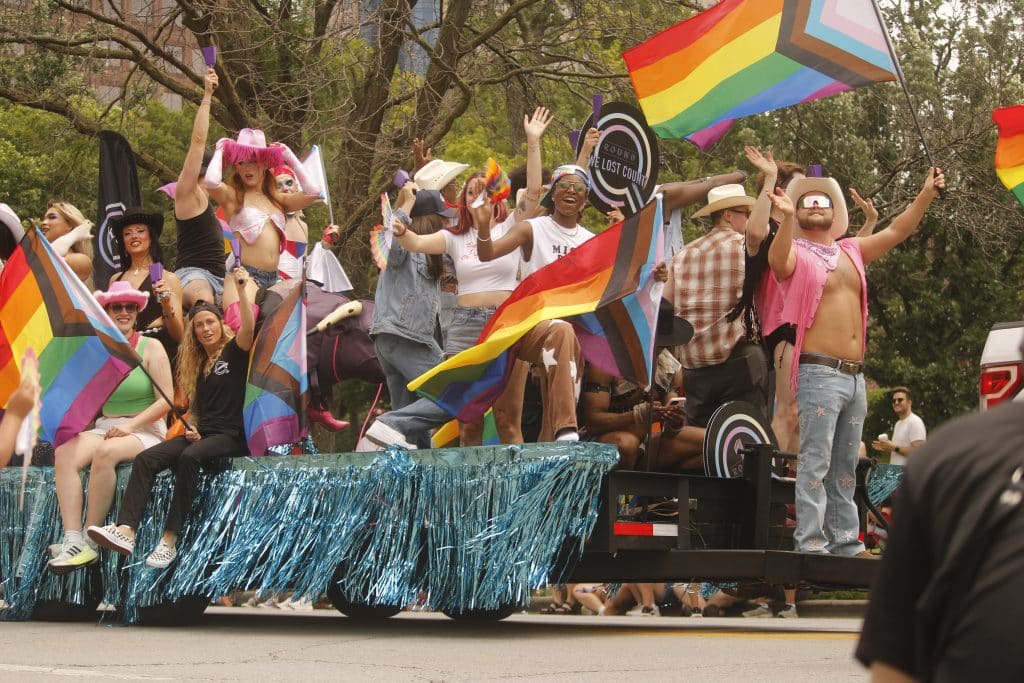
At KC PrideFest 2026, corporate presence was impossible to miss. Banks and financial institutions appeared so frequently in the parade that it was hard to keep track, with groups like Visa, Bank of America and U.S. Bank represented.
Alongside those corporate sponsors were police officers around the vicinity of the parade, churches and religious organizations, health care organizations, and other institutions. The festival itself required a $10 admission fee.
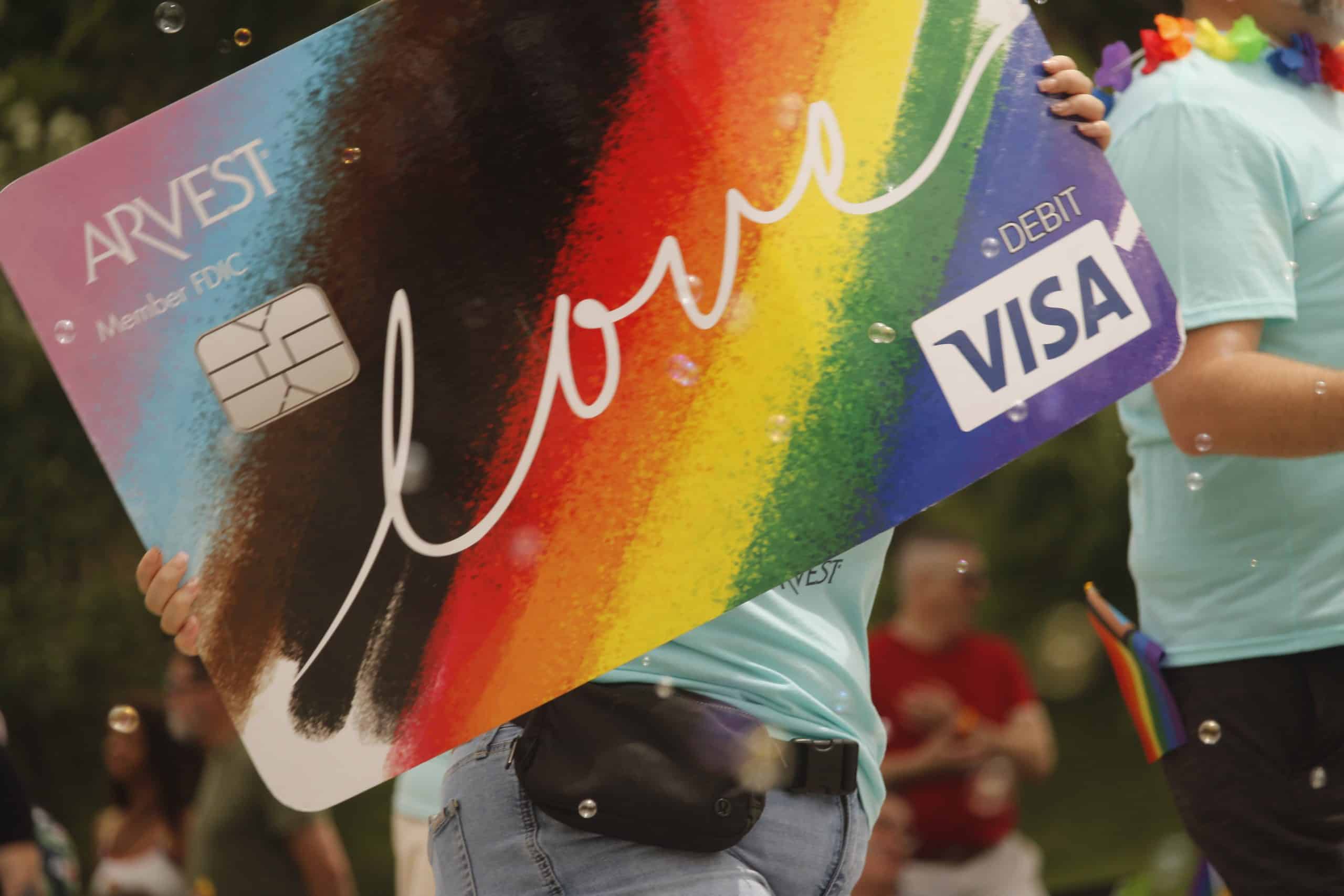
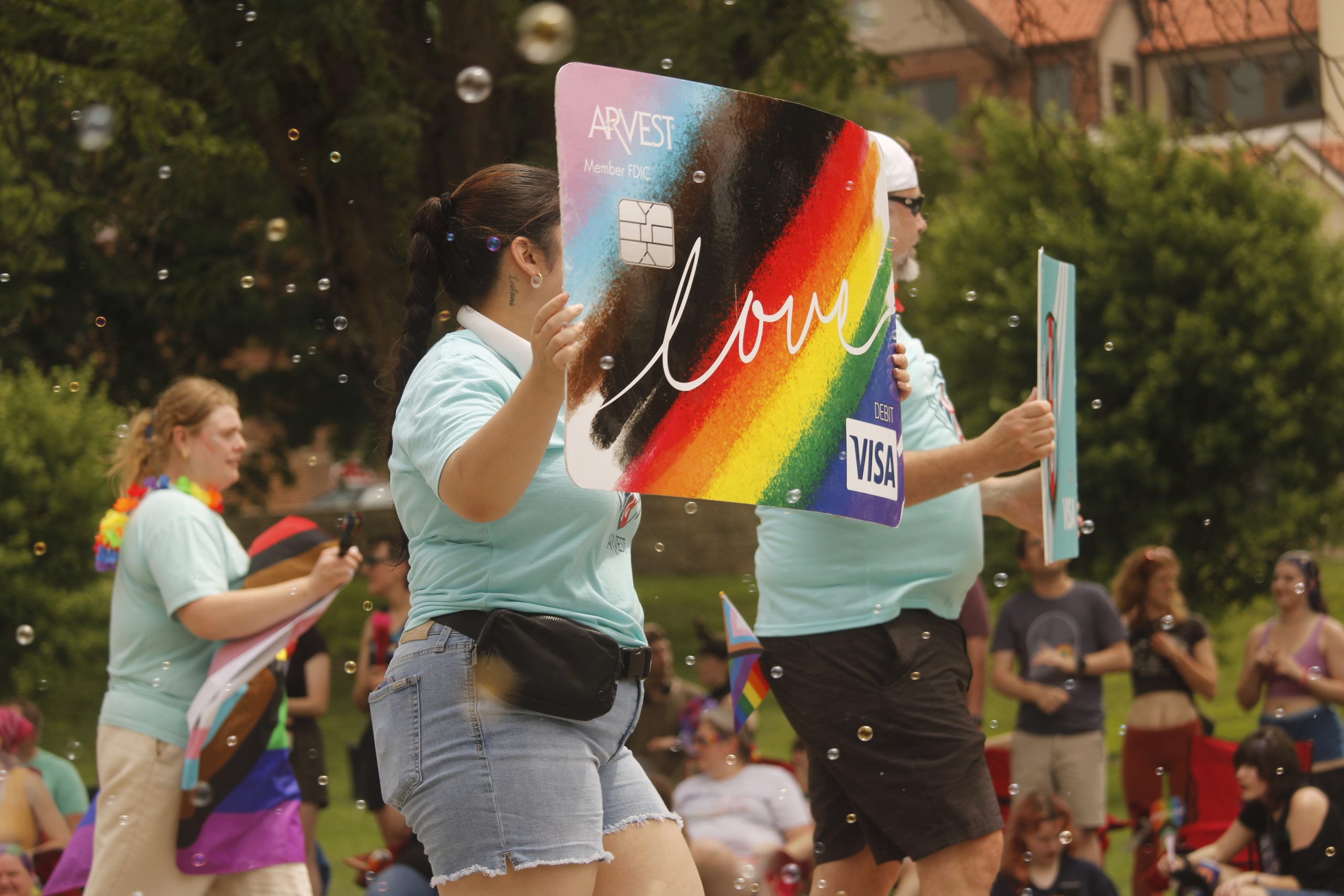
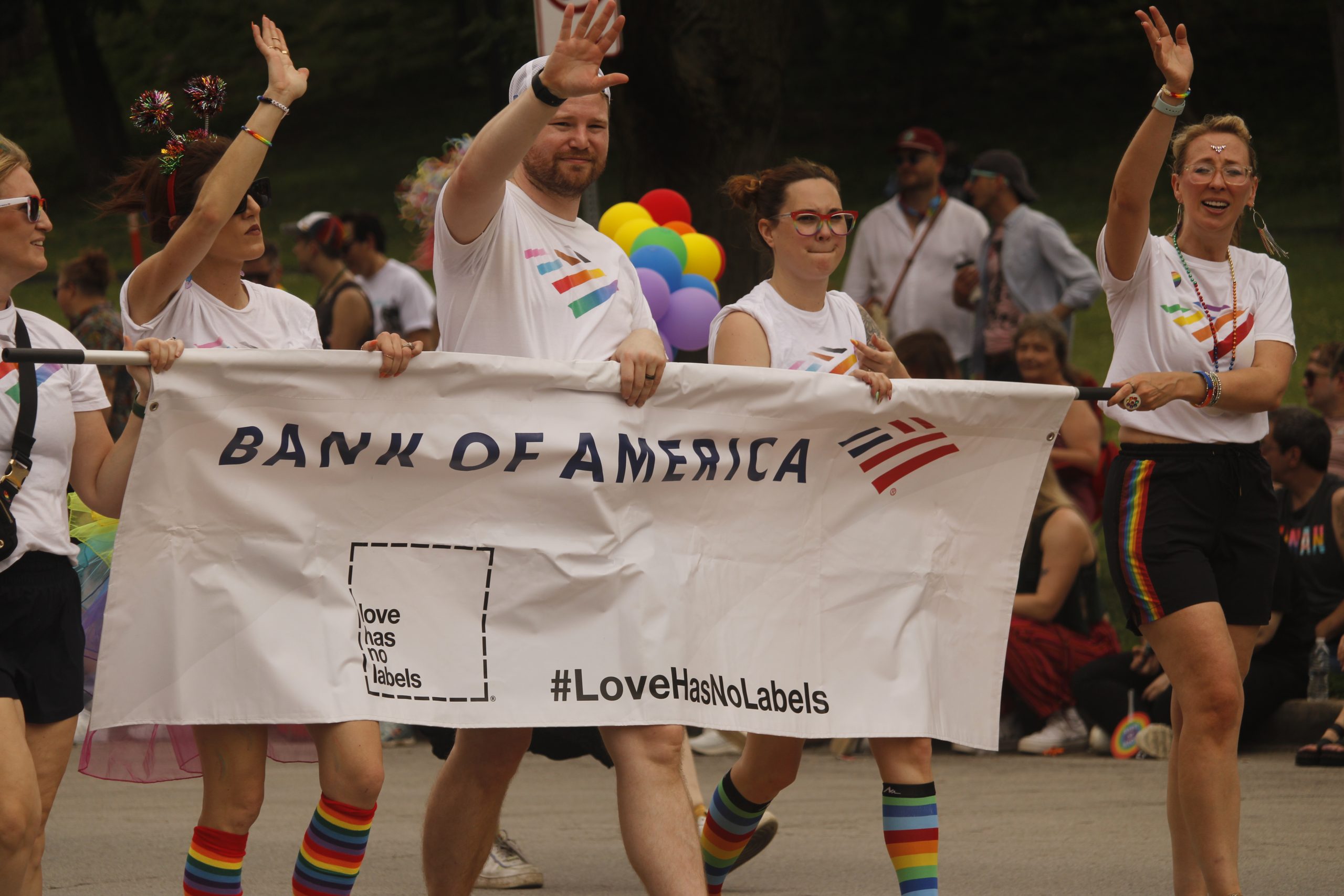
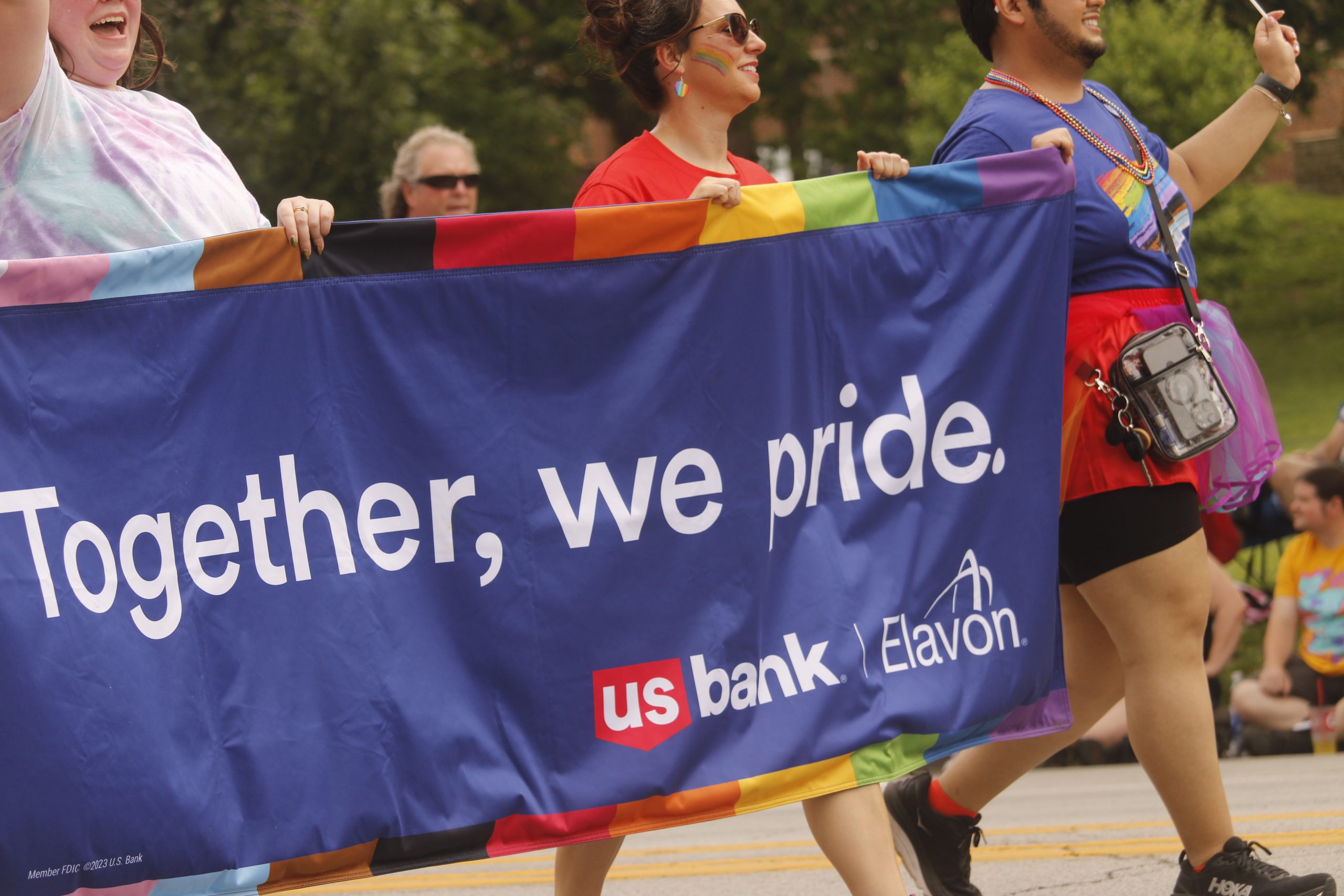
The mix of corporations, institutions and community voices at PrideFest reflected a broader tension within Pride celebrations nationwide over the balance between visibility, access and political roots.
At the heart of the debate are two competing models. One views partnerships with corporations, city officials, police and major institutions as necessary tools for sustaining large-scale Pride events and the resources attached to them. The other argues that those same relationships move Pride further from its roots in rebellion and closer to assimilation, reshaping queer liberation into something more acceptable to the institutions Pride was created to resist and reinforcing the erasure of crucial aspects of queer political life.
That tension has intensified following the transition of KC Pride operations under Our Spot KC, a Black-led LGBTQ+ organization.
Critics have raised concerns that placing Pride under the umbrella of another organization could limit independent oversight, reduce community input and concentrate decision-making power within one group.
At the center of this tension is Star Palmer, a Black queer community organizer, founder and executive director of Our Spot KC, who said the transition does not represent a dramatic shift in leadership, but rather a formalization of a relationship that existed behind the scenes for years.
Palmer said three of KC Pride’s five board members over the last five years already worked for Our Spot KC before the transition.
Additionally, she argued the shift came from a need for sustainability rather than a consolidation of power.
“We’re now the biggest parade in the city except for when the Chiefs or Royals win something,” Palmer said.
As KC Pride expanded, so did the resources required to operate it. Palmer said the festival faced significant financial challenges in recent years, including approximately $200,000 in lost sponsorship funding tied to anti-DEI backlash. Severe weather during last year’s Pride weekend also resulted in substantial revenue losses.
Those setbacks raised questions about whether or not a volunteer-led organization could continue supporting an event of that scale.
In considering next steps, Palmer examined Pride in cities such as Denver and other mid-sized areas where year-round LGBTQ+ centered organizations help support their festivals.
Taking inspiration from Denver, Palmer decided to merge KC PrideFest under Our Spot KC.
She said these structures provide dedicated staff, financial oversight, and organizational stability — resources that KC PrideFest has struggled to maintain as the event grew.
Yet, larger and more institutionalized Pride events may not be the answer.
Stonewall only had approximately 200 people in the crowd, still managing to make important steps toward liberation — so why does a Pride event that draws 22,000 people annually feel the need to continuously grow?
For many organizers and community members, the scale of KC PrideFest raises a deeper question: If Pride requires corporate funding, extensive policing, assimilation to corporate wishes, and institutional partnerships to operate at its current scale, should Pride remain that large in the first place?
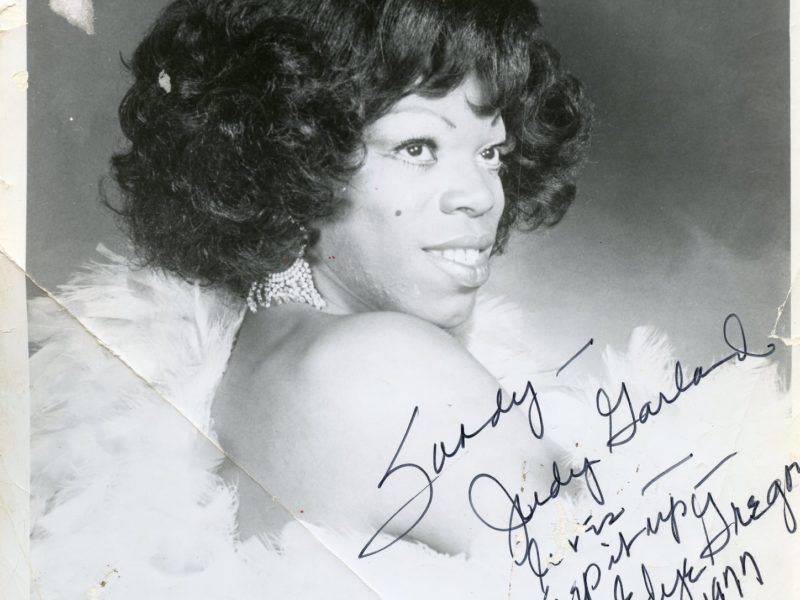
The first Pride marches emerged from the Stonewall uprising, a rebellion led largely by poor transgender women, drag queens, sex workers, and other criminalized queer people who would find themselves excluded from many of the institutionalized, “family-friendly” pride events of today.
So, as corporate logos become increasingly visible at pride festivals across the nation, some organizers argue visibility alone is not liberation, particularly if the systems being celebrated continue to produce inequity for the most marginalized members of the queer community.
Especially when it means certain expressions of queerness are welcomed into the public view and others are made fun of, ostracized and labeled predatory by the public.
WHEN PRIDE BECOMES PALATABLE
In Here Be Dragons, Black gay essayist and cultural critic James Baldwin argued that American society relies on rigid binaries to maintain social order: “cowboys and Indians, good guys and bad guys, butch and f*ggot, black and white.” Critics of corporate Pride argue that similar dynamics can emerge when queer identity is packaged for public consumption, rewarding forms of queerness that can be easily assimilated while marginalizing expressions tied to nonconformity or radicalism.
Lynnie Holl, founder of This Is Ours KC, said those tensions can appear in seemingly small decisions about what is permitted within corporate Pride spaces, such as whether organizations like the Douglas County Sheriff’s Office are allowed to have a booth at PrideFest.
For organizers who share that perspective, the concern is not simply whether corporations sponsor Pride. It is about what comes with that sponsorship — when corporations reshape Pride into something commercial, more palatable, and less political, celebrating queer visibility so long as it distances itself from the forms of resistance that made that visibility possible in the first place.
For some attendees, that shift shows up in the atmosphere and structure of pride itself: increased police presence, higher costs, and the inclusion of institutions that have historically excluded queer communities.
Jaxon Kincaid, a Pride attendee, said corporate sponsorships may be necessary to organize large-scale events, but it simultaneously dilutes the meaning behind them.
“Once LGBTQ people start being merchandise and commercialized, it loses the entire meaning,” he said. “I also feel that policing is excessive. I saw over 20 different cops, all of whom did not seem to want to be there.”
Southern Hxll, a prominent Kansas City drag king, also argued that police presence is incompatible with the political origins of pride.
“If police are at a Pride event, it’s not a Pride event,” he said, pointing to Stonewall and the history of police raids on queer spaces that helped spark the modern Pride movement.
For Hxll, those contradictions highlight what he sees as a disconnect between Pride’s origins in resistance and its present-day institutional form.
“Stonewall wouldn’t have happened if police were protecting us,” he added, arguing that police presence at Pride functions as part of a broader system of control rather than safety.
Hxll pointed to PrideFest’s vendor culture as another example of the tension between visibility and inclusion.
“PrideFest last year especially felt like walking through an ad mall straight from hell,” he said. “Corporations were shoving products in your face, asking you to sign up for text alerts or subscriptions just for a free bracelet, and we completely lost the plot.”
Olive Cooke, a former Pride attendee and current People’s Pride organizer, said she struggled to find vendors that felt connected to the queer community rather than commercialization.
After finding a pair of transgender pride earrings, Cooke said she was repeatedly misgendered by the vendor while trying to purchase them.
“I was just like, this is straight people selling us our culture in this incredibly environmentally and economically destructive way,” Cooke said.
That critique, for organizers, also manifests in how labor is handled behind the scenes, especially in the treatment of performers.
Hxll said his experience performing at last year’s PrideFest left him hesitant to participate again this year, citing concerns about miscommunication, scheduling issues, a lack of accountability and whether the people coordinating talent were connected to Kansas City’s local drag and queer performance communities.
Although he remained cautious, Hxll ultimately decided to participate again after seeing what he described as improved communication and clearer delegation of responsibilities among organizers and volunteers.
For Hxll, those changes emphasized the importance of safety, accountability and accessibility in Pride spaces, which is determined by how power is structured within leadership.
CHANGING THE FACE OF PRIDE
Conversely, the debate over corporate sponsorship and police participation is also inseparable from the questions of race.
For many Black queer individuals, dissatisfaction with KC Pride did not begin or end with the recent transition under Our Spot KC.
Several community members interviewed for this story described KC Pride’s previous leadership as overwhelmingly white and disconnected from the experiences of many Black queer residents.
Holl said Kansas City’s Black queer communities are often less visible within broader Pride spaces compared to other places in Missouri.
“We have twice as many people as St. Louis,” they said. “So one would assume that you would have twice as many Black people, but we do not. We have the same number of Black people as St. Louis. And here in KC, our Black queer communities just seem more drowned out.”
Holl said that the dynamic reflects broader questions about who Pride is designed to accommodate.
“Kansas City is very populated with a lot of white people, and I think that informs a lot of what shapes Kansas City because we have to be palatable to (white) leaders,” they said. “I would hope that at some point we can just inform ourselves, we can organize without having to necessarily always think about being the safe space or the ‘safe Negro’ for white people.”
Palmer acknowledged parts of that history. Before becoming one of the most visible leaders associated with KC PrideFest, she had previously been involved with KC PrideFest itself as a board member. She has also spoken about experiencing racism and exclusion within those spaces.
But, she argued, KC PrideFest leadership has become more diverse and intentional about centering Black and Brown performers, organizations, and community members over time.
“As a Black person going into predominantly white spaces — and some say Pride is a predominantly white space — you can’t negate the fact that I’m bringing in certain vendors and being intentional on who’s helping me curate this space,” Palmer said. “The people that show are the people that show up — Black, Brown, white and different. I’m not going to turn those folks around. They are showing up for this common cause of queer joy.”
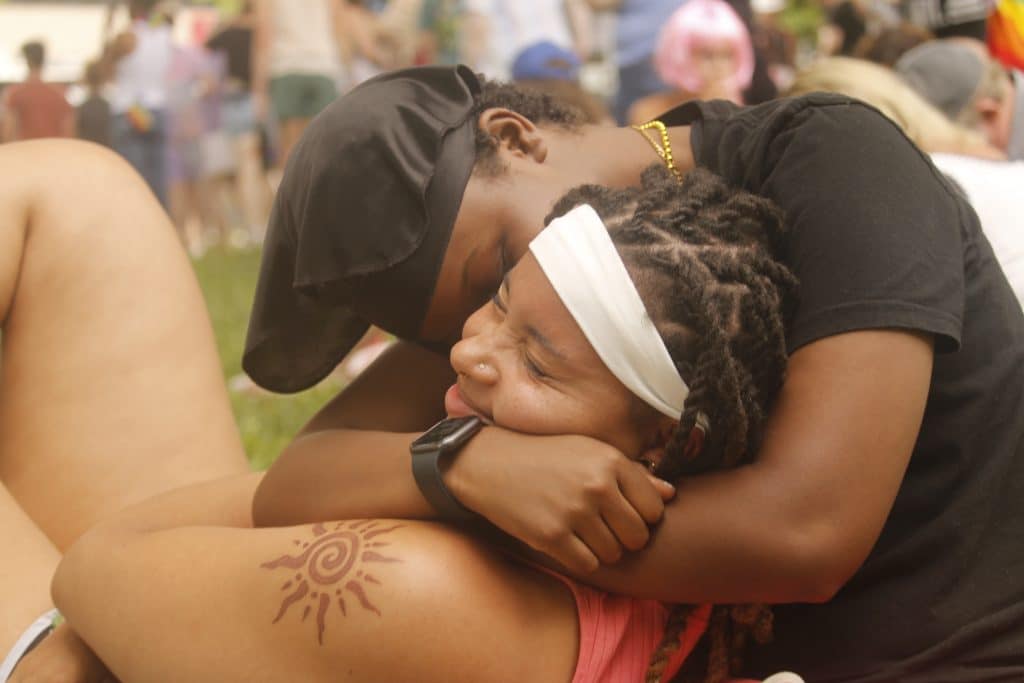
However, for many, these concerns around KC PrideFest do not resolve when Black people are visible in leadership positions. Oftentimes, institutions can respond to demands for change by diversifying leadership while leaving larger systems of power and harm untouched — a concern often discussed as tokenism. That means a Black-led Pride can still reproduce the structures community members have long criticized if it remains tied to corporate sponsorship, police presence, institutional approval, and limited community input.
Polar, a Black queer community member, said representation cannot be treated as the endpoint of social change.
“The work doesn’t end there,” Polar said. “It is about us as a collective, honoring not only our individual paths but everyone’s individual path and safety.”
Palmer emphasized that meaningful change also requires participation from the broader community, not only from those already in leadership.
“I hope that people get more involved and start to learn for themselves about the ins and outs of what it takes to put on this event and how they can help,” Palmer said. “If you have a problem with it, go help. That’s how I got to the table.”
PEOPLE’S PRIDE KC
People’s Pride KC emerged in 2022 as a response to growing frustration among local queer organizers over the commercialization and institutionalization of Pride. Founded by a collective of grassroots organizers and queer creatives, the event was born as an explicitly anti-corporate alternative — one built around community pride rather than large-scale expansion.
In their first year, organizers originally expected roughly 80 people at their first event, but more than 300 showed up — a response People’s Pride coordinators Cooke and Aphra Marie said showed there was a real demand for a Pride space outside the corporate and institutional model.
For Cooke, experiences like being misgendered by a vendor selling trans Pride merchandise at KC PrideFest made it clear that an alternative model was necessary.
“With People’s Pride, we were like, what if it was free to attend, there weren’t cops, there weren’t corporations, and all of the vendors and performers were queer folks who were from Kansas City for the most part, and that, you know when you’re buying there, you’re buying handmade things?” Cooke said.
Rather than relying on corporate sponsorship, People’s Pride operates through community donations, volunteer labor, optional vendor fees and locally produced goods. Cooke and Marie said the event’s only fee is for vendors, which is optional and typically around $40.
“We pay performers what they ask to be paid,” Cooke said. “I would estimate that 85 percent of our money is going to queer folks.”
For People’s Pride, success is not measured by how large the event becomes or how many corporate sponsors it attracts. Instead, they look to community participation and relationships.
Marie pointed to the energy within the event itself as an indicator.
“I feel like one of the metrics is how loud the parade is,” she said. “That’s probably the biggest thing: how hyped we can get people and how energized we can get the parade for the streets.”
Polar has attended both corporate and alternative Pride events in other cities, and said People’s Pride KC created a different atmosphere.
“People’s Pride had more of a collective vibe than corporate Pride typically does,” he said.
That sense of collective responsibility also shapes how organizers approach safety. While larger Pride festivals often cite security and legal concerns as reasons for police presence, Cooke said People’s Pride relies on volunteer security teams with experience in safety work, street medics, and de-escalation protocols.
“The idea is we can keep each other safe if we’re attentive and prepared,” she said.
However, organizers acknowledge that building an alternative model does not eliminate the challenges that come with putting together large-scale events.
Without corporate sponsorship or institutional backing, People’s Pride relies heavily on volunteer labor, fundraising and the capacity of the organizers who are often balancing the work with other responsibilities.
The event has also faced questions about diversity within its own organizing structure.
“People’s Pride was started by three white people, and I think that in itself has led to the overwhelming whiteness of it,” Cooke said.
Cooke was referring to People’s Pride’s original founding group. The current organizing team also includes Aphra Marie, who is Afro-Latinx. Still, organizers said increasing racial diversity within the organization remains an ongoing challenge, particularly because the work depends heavily on unpaid labor.
“It’s a lot to ask of somebody,” Cooke said.
Marie said part of People’s Pride’s ongoing work is making sure Black queer people are centered in shaping the event. That includes bringing more Black organizers into leadership, confronting anti-Blackness within queer spaces and recognizing the specific isolation Black queer people can face both inside and outside Black communities.
“There are a lot of different prejudices toward Black queer people and queer people in general, and so combating that should definitely be one of the cores of People’s Pride,” Marie said.
For the organizers, People’s Pride is not necessarily about replacing every other Pride celebration. Instead, they see it as an example of how communities can build different events for different priorities.
Cooke and Marie said they hope to connect with other People’s Pride efforts in different cities and encourage smaller, community-based coalitions rather than focusing on becoming the largest festival in the region.
The significance of People’s Pride, according to Cooke and Marie, is not that it presents a perfect model, but it demonstrates that another model is possible.
As Kansas City moves from PrideFest earlier this month toward People’s Pride on June 27 and 28, the question facing Kansas City’s queer community is whether Pride’s future will be shaped by size, attendance figures, sponsorship dollars and institutional approval, or by its ability to remain rooted in the collective liberation that first brought people together more than fifty years ago.