IMPORTANT UPDATE:
{B/qKC} is now an independently-run archive separate from The Kansas City Defender. For more information visit, www.kansascitydefender.com/bqkc.

Figure 1. Pictured is a Black organizer holding two signs, one in each hand, in protest of an unknown year of Kansas City’s Pride Festival and their entry fees. In their right hand, the sign reads “pride is FREE…why isn’t this event?.” In their left hand, the sign reads “$15 for what?”. The caption for the image mocks the Black organizer’s locs, reading “The Best Damn Day of Your Life, And With That Hair, Not A Problem.” This issue of the paper, let alone this page, mentions nothing of the protest or entry fees. (Image printed in Current News. Volume 10, Issue 10 [June 7, 2000]: 3. Courtesy of the Gay and Lesbian Archives of Mid-America.)
“Man is human only to the extent to which he tries to impose himself on another man in order to be recognized by him. As long as he has not been effectively recognized by the other, it is this other who remains the focus of his actions. His human worth and reality depend on this other and on his recognition by the other. It is in this other that the meaning of his life is condensed.”1
Frantz Fanon
The Dixie Belle Bar is lauded, perhaps, as one of the most nostalgic places for Kansas City’s LGBT nightlife from 1983 to 20062––but it was also once one of Kansas City’s most racist queer establishments. On July 27, 1993, Yul Stell, a Black organizer with Men Of All Colors Together–Kansas City, penned an open letter to the Dixie Belle3. In the letter, he condemned the bar for displaying a confederate flag and called out racial practices the bar upheld––requiring that Black folk show four to five pieces of identification for entry into the establishment and placing a quota on Black folk who could be in the bar at one-time4. Since the bar closed in 2006, Dixie Belle has developed a cult-like following: former patrons have hosted throwback events and posted nostalgic photos, and the bar was most recently featured as a stop on the Kansas City Rainbow Tour5.
· · ·
The Dixie Belle Bar is but one example of an unspoken issue in Kansas City: that Black queer Kansas Citians have faced, not only erasure, but immense anguish for the sake of white LGBT progress––demonstrating a deeply seeded anti-Blackness that needs to be upended in order for true LGBT freedoms to exist. The following paper seeks to examine how infringement of Black queer space, Black joy and the subsequent sexual violence enacted on Black queer folk has created a long-reigning racial power-imbalance within Kansas City’s queer community––ultimately leading to the subjugation of Black queer Kansas Citians.
The Racial Commodification of Kansas City’s Pride
Kansas City’s Pride is the prime event for local LGBT folk: a three-day event encompassing a parade, performances and queer vendors––but the event here has been plagued with accusations of racism, transphobia and classism. Kansas City’s Pride was originally founded by Black lesbian Lea Hopkins in 1977, and served as a protest march––with a small group of 25-30 people advocating for representation and LGBT rights6. In 2001, John Koop, more commonly known by their stage name, Flo, created Show Me Pride, LLC7 to run what we now know as today’s Pride parade. With this change in management, Kansas City’s Pride became a capitalist spectacle: charging vendors for table space, up-charging food and refreshments, and, most notably, charging an entry fee for attendees. According to John Koop, the fees were to combat financial mismanagement8. However, in interviews with four Black queer Kansas Citians (who’ve requested anonymity), the fees were meant to bar low-income folks from attending the celebration (see fig. 1). By making it difficult for low-income folks to attend Pride, Show Me Pride, LLC prevented those most affected by poverty (particularly Black people) from attending an event that was originally founded as a protest and celebration of identity. The festival has also been marred by Rick Bumgardner––who bought out Show Me Pride in 2008––when he moved the parade to the Power & Light District (P&L) in 2012. The Power and Light District was already under fire for its funding by the Cordish Company, an organization (with no queer ties) that is responsible for the $850 million dollar development project that is P&L and, thus, dually responsible for third and fourth-wave gentrification that pushed out Black gay nightlife9. Moving the parade to this location was met with protests10 and immense vitriol11.
The Loss of Black queer Space(s); The Gentrification of Power & Light

In the early 2000’s, Black queer Kansas City nightlife was more than an activity. Soakie’s and Tootsie’s were unofficial Black gay bars in Downtown Kansas City that were filled to the brim with local Black queer folk12. So much so that the Soakies-adjacent parking lot became an extension of the club: hosting balls, performances and the signature ‘parkin’ lot pimpin’ that Black queer eldership reminisces on today. The clubs, however, shut down as Downtown became more gentrified at the hands of government-sponsored beautification projects. Soakie’s would shut down in 2004. And Tootsie’s, a hang-out space for (Black) lesbians, would undergo a “remodel” and clientele shift where lesbians were ultimately pushed out13 to allot room for swingers. The club closed down completely in 2010.
Now, no Black gay bars exist in Kansas City. Instead, folks must rely on local organizations like Lyfestyle Entertainment or Queer Black KC to produce life-affirming events and make use of other spaces. These same organizations, however, rely on white (LGBT) entities for event space, funding, resources, and connections. This has created a cycle wherein Black queer Kansas Citians cannot attain their needs, or “move” towards freedom, without the actions of their white counterparts and white capital. The same centralizing of resources can be seen at Kansas City’s Pride festivities held annually in June.
Kansas City’s Pride Festival (now run by the Kansas City Community Pride Alliance for the past few years) has remained an event that folks need to pay to get into. In 2022, the entry fee was $10 and in 2023, $5. Despite the lowering of this entry fee, various aspects of Pride still revolve around obtaining capital: food vendors that price-gouge due to the fenced-in festival area, vendor fees upwards of $1,350 as of this year, and liquor partnerships and laws that force attendees to solely purchase alcohol from Boulevard Brewing’s stand14. Although the price-gouging at Pride started with white organizers, today’s Pride is managed by mainly Black organizers15. This maintenance of the status quo demonstrates how racism is meant to function: by permeating through systems, space and time as long as we can name things as Black and white, and preserving the social structures that reify white supremacy.
In writing this section, I caution those in seeking solutions to “reclaim ownership”––because this implies that at one time, any of these spaces belonged to Black queer Kansas Citians; and dually implies that ownership liberates. Kansas City history––and American history, at large––tells us these places were never “owned” to begin with, and will never be owned.
(Sexual) Violence–The Fetishization of Black gay Kansas City Men

Figure 3. A Map of Gay Bars in Kansas City in 2000. All of these bars no longer exist aside from Missie B’s and SideStreet Bar. 17 total bars are shown here––only 8 (officially) exist in Kansas City now. (Map printed in KC Exposures. Volume 1, issue. 31 [June 8, 2000]: 31, Courtesy of the Gay And Lesbian Archives of Mid-America.)
In conjunction with loss of spaces, we also must examine how sexual desire has served in the oppression of Black queer Kansas Citians.
The Black gay male community of Kansas City, particularly, suffers from this sexual exploitation––as can be seen in the case of the organization, Black-White Men Together-Kansas City (BWMT-KC). Founded by Michael J. Smith in 1980, the National Association of Black and White Men Together (NABWMT) was expressely founded for white gay men to more easily find Black men to have sex with16. Smith was described by his peers to be an ‘interracialist’, believing that Black men were more well-endowed; he would face vitriol in the media for his comments and actions. Despite this, chapters of the organization opened across the nation, including in Kansas City. The local chapter was able to accomplish a great deal in pushing sex education and creating systems of support for gay men, at large––but part of the violence faced by Black queer men is sexual exploitation, which includes fetishization based on race.
Similarly to the loss of Black queer space, this sexual violence and the need to feel desired limits access to new futures. Desirability ultimately creates a cycle that seeks not to end white supremacy, but to further it by developing unattainable standards (e.g. sexual endowment) and unwritten codes (e.g. hyper-masculinity) that create power structures amidst Black queer men in competition of the white male gaze. To end white supremacy is to put an end to this sexual desire; and to eradicate the tools by which white men use to subjugate Black queer men to (sexual) dependence.
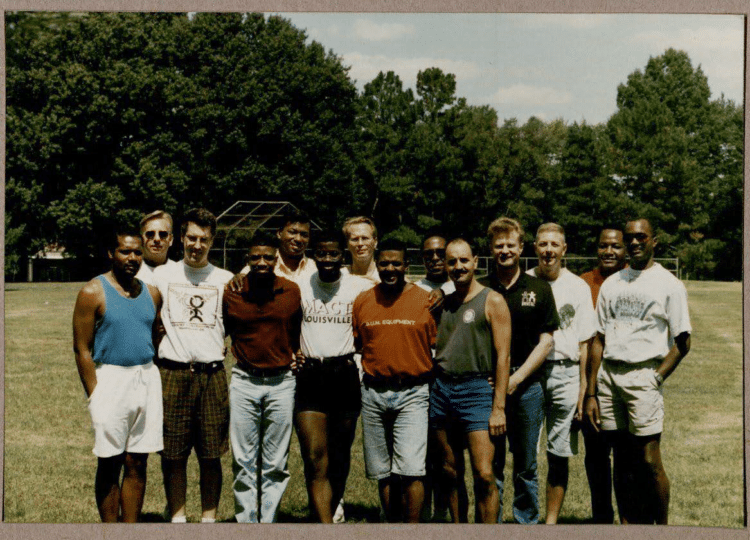
Simply put, the Chapter (no matter its goals) was ontologically violent; Black men in BWMT-KC sought safety in this group during a period where being sexually-open was more readily pathologized than today. But this illusory feeling of safety is undermined by what the group was meant to do––to create pathways for white men and Kansas Citians to sexually pursue Black gay men, as stated in a marketing brochure the group used in the 90’s: “If you are having problems with friends not understanding or giving you a hard time because you date outside of your race; then MACT is for you”17. In-line with Frantz Fanon’s pedagogy, Black gay men based their safety off of feeling ‘recognized’ by white counterparts and, thus, built this organization in a condensed view of their freedom.
From Redlining to … Rainbow Crosswalks

There exists a paradigm in Kansas City’s queer community: wherein Black queer Kansas Citians are made reliant on white LGBT progress in order to progress themselves––yet, Black queer struggles for power (as specifically examined in this paper, space and sexual triumph) have proven that Western governing bodies are only meant to uphold whiteness. It is this paradigm that has led to a mass erasure of Black queer history, and led to LGBT progress being celebrated in Kansas City even if it has come at the expense of Black folks in that struggle. This paper is not meant to target non-Black queer Kansas Citians, and should not be mistaken by bigoted, cisgendered-heterosexual Black folk to be validation of their homophobic or transphobic desires. Instead, this paper should serve as what history should always be used to do: to inform the future. And that future is one where Black queer Kansas Citians must not create within the bounds of white power structures, but to destroy servility in order to build anew.
I encourage folks looking to create new Black queer futures to read more pedagogy (Frantz Fanon, Da’Shaun L. Harrison, James Baldwin), join local movements for abolition (such as the Reale Justice Network and the Kansas City Defender), and protest rainbow capitalism by holding your own Pride protests and, both, in-and-out of June. If you’re not, both, Black and queer, I implore you to seek out Black queer folk, listen to them, and fulfill their needs: donate to gender-affirming surgery funds, bail out Black queer folk in jail, organize against criminalization of queerness, and create true systemic change–rainbow crosswalks will not save you nor I.
An abridged version of this essay, titled “The Unseen Struggles: Erasure and Racial Inequities in Kansas City’s Queer Community,” was originally published in the Urban League of Greater Kansas City’s 2023 State of Black Kansas City | FROM REDLINING TO CHALK LINES: THE COSTS OF ECONOMIC INJUSTICE. The report can be found on their website.
- Fanon Frantz. 2008. Black Skin White Masks. London: Pluto.
↩︎ - Ferruzza, Charles. “Oldest Gay Bar in Kansas City Has Closed.” The Pitch, July 26, 2019. https://www.thepitchkc.com/oldest-gay-bar-in-kansas-city-has-closed/.
↩︎ - [Scrapbook clippings of BWMT/MACT-KC]. (ca. 1980-1999). Gay and Lesbian Archive of Mid-America, LaBudde Special Collections, Miller Nichols Library, Kansas City, MO, United States.
↩︎ - Ibid.
↩︎ - Barrett, J. B. (2023, June 3). KC Rainbow Tour: A Drive from UMKC to the Kansas City Museum. VoiceMap. Retrieved July 27, 2023, from https://voicemap.me/tour/kansas-city/kc-rainbow-tour-a-drive-from-umkc-to-the-kansas-city-museum
↩︎ - Jackson, D. W. (2016). Changing Times: Almanac and Digest of Kansas City’s LGBTQIA History (50th Anniversary Commemorative Edition, pp. 115–116). The Orderly Pack Rat.
↩︎ - Anonymous. (2010, June 22). Pride and its High Dollar Pony. Queer Kansas City. Retrieved July 27, 2023, from https://queerkc.wordpress.com/category/big-gay-scandals/
↩︎ - Current News. “Gay Pride Edition,” June 7, 2000, Volume 10 edition, sec. Issue 10.
↩︎ - Thompson, A. “GENTRIFICATION THROUGH THE EYES (AND LENSES) OF KANSAS CITY RESIDENTS.” University of Missouri, December 2011.
https://mospace.umsystem.edu/xmlui/bitstream/handle/10355/14577/research.pdf?sequence=2&isAllowed=y. ↩︎ - B, Steven. “Move Pride Back to Liberty Memorial or Riverside Park: Petition.” Change.org, May 16, 2012. Accessed July 28, 2023.
https://www.change.org/p/show-me-pride-llc-move-pride-back-to-liberty-memorial-or-riverside-park.
↩︎ - Ferruzza, Charles. “KC’s Pride Fest Isn’t Such a Gay Time for Some.” The Pitch, July 26, 2019. https://www.thepitchkc.com/kcs-pride-fest-isnt-such-a-gay-time-for-some/. ↩︎
- KC Exposures, “Nightlife City Map”, KC Exposures, Volume 1, issue. 31 (June 8, 2000): 31, Gay And Lesbian Archives of Mid-America. ↩︎
- Anonymous. “Tootsie’s.” Lost Womyn’s Space, May 4, 2011. Accessed July 27, 2023. http://lostwomynsspace.blogspot.com/2011/05/tootsies.html.
↩︎ - KC Pride Alliance. “2023 Vendor Info.” KC Pride Community Alliance, May 3, 2023. https://kcpridealliance.org/vendors/. ↩︎
- Banks, J.M. “Black Pride: A New Generation of LGBTQ Organizers Lead the Parade in Kansas City.” The Kansas City Star, June 1, 2022. Accessed July 27, 2023. https://www.kansascity.com/news/local/article261066887.html. ↩︎
- Burgin, Sarah Nicole. “The Workshop As the Work: White Anti-Racism Organising in 1960s, 70s, and 80s US Social Movements.” The University of Leeds, School of History, September 2013.
↩︎ - [MACT-KC Brochure]. (ca. 1990-1995). Gay and Lesbian Archive of Mid-America, LaBudde Special Collections, Miller Nichols Library, Kansas City, MO, United States. ↩︎