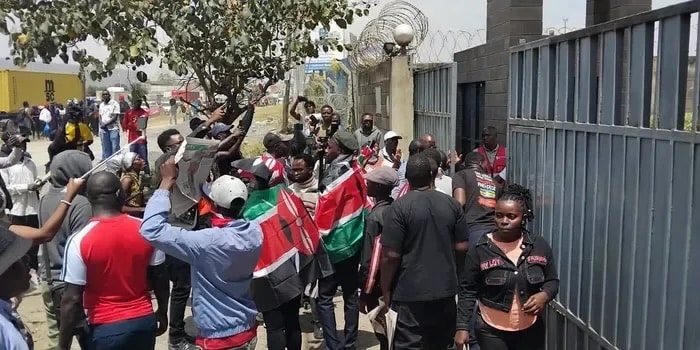
NAIROBI, Kenya, October 12, 2026—Waving flags, tooting plastic horns, and obstructing traffic underneath a busy highway overpass, scores of cheering protesters assembled outside the main office of the country’s oldest newspaper, the Standard, on Oct. 2 to denounce “negative and critical headlines targeting the government” of President William Ruto.
Tensions had been mounting for months with Ruto accusing the Standard of producing shoddy journalism as leverage to extort his administration, and his supporters posting menacing content on social media. Ahead of the demonstration, a member of the pro-Ruto group Bunge la Mwananchi warned The Standard in a video circulated on social media: “Many people have warned you for a very long time that you ought to change but every day you post inflammatory statements and useless things. We as youths, we are going to surprise you.”
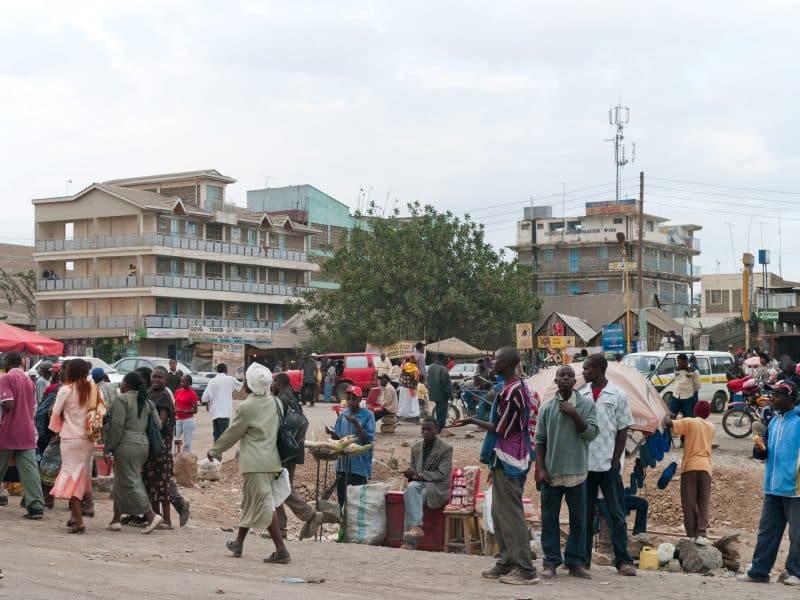
But as protesters addressed the crowd gathered outside the publishing house in the capital city on Friday, the energy shifted abruptly when another demonstration organizer, Moses Gazemba, began handing out 400 Kenyan shillings–the equivalent of roughly $3–to each of the protesters.
The problem was that many of the youthful demonstrators, who lived in the city’s largest slum known as Kiberra, had been promised $8.
George Abere, a Nairobi security guard told the Defender:
“Our president, that guy, he can’t get anything right, not even a bribe. I think he is trying too hard to be like his idol Trump.”
From Argentina’s President Javier Milei to Italy’s Prime Minister Giorgia Meloni, Brazil’s former President Jair Bolsonaro to Hungary’s former Prime Minister Viktor Orban, a number of white politicians have emerged in the 21st century to ape Donald Trump’s belligerence, lack of decorum, far-right policies and naked appeals to xenophobes and racists.
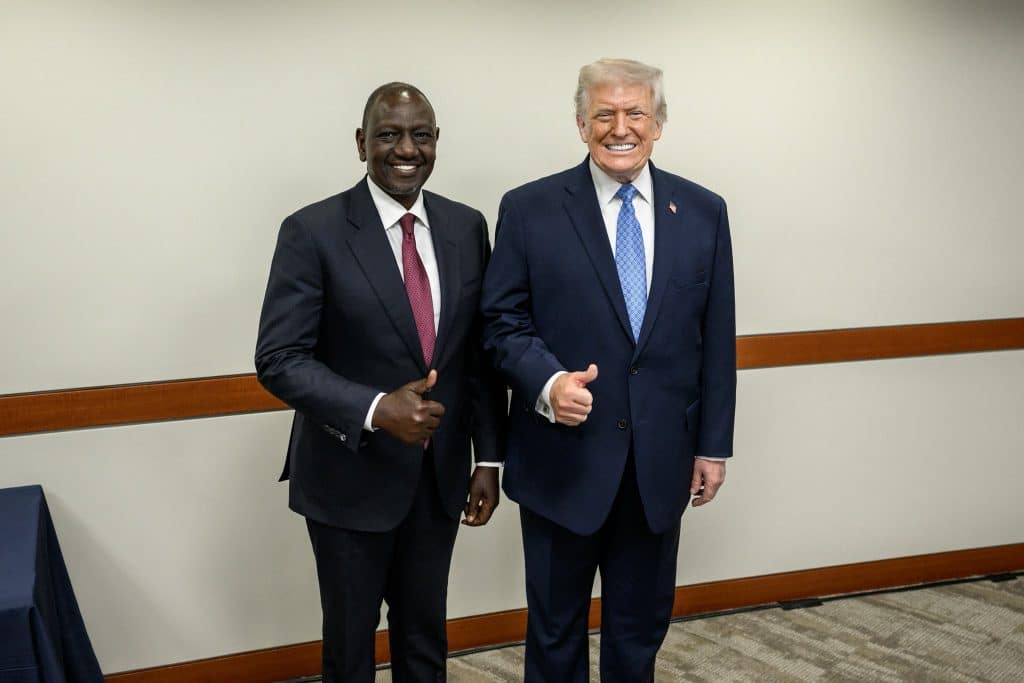
But if there is a Black Trump, it is almost certainly Kenya’s Ruto, who has earned a reputation in his first term that is almost eerily similar to the 47th U.S. president.
While there don’t appear to be any public opinion polls on the matter, it is common to hear ordinary Kenyans, journalists, and scholars compare the two heads of state, and with good reason.
A War on the Press
For starters, both men share hostile relationships with the news media. Trump, of course, practically coined the term “fake news” in his first term to discredit reporting that is critical of him, and he has only escalated his attacks in his second term, sending F.B.I. agents to reporters’ homes to serve subpoenas, seizing at least one journalist’s communications devices, requiring journalists who cover the Pentagon to restrict their reporting to official sources, and stripping funding from public television and radio.
Last month, the president wrote on Truth Social that he was “banning” CNN, MS NOW and Politico from the White House “as a result of their constant ‘reporting’ FAKE NEWS!” The move backfired, however, when television news networks, including the ultra-conservative Fox News, suspended their footage of White House events until the administration reinstated CNN. In a September 26 article, the New York Times wrote of Trump:
“When he held an elaborate ceremony on the South Lawn on Monday to unveil a new helipad, one of his primary home improvement projects, audio problems marred the official White House video feed; Mr. Trump was stuck pantomiming as viewers heard only white noise.”
Kenyans widely see in Ruto’s antagonism of the news media the same oafishness that characterized Trump’s bumbling attempt to silence the Fourth Estate’s criticism of him. The main difference is that while a little more than a quarter of all Americans say they trust reporting by newspapers, broadcast television and radio, 68 percent of all Kenyans express confidence in their news media, more than almost any country in the world.
The Standard is especially well regarded for its aggressive efforts to hold Ruto’s administration accountable. In early August, four masked men armed with assault rifles and driving a Subaru equipped with a siren abducted the newspaper’s Associate Editor, Alex Kiprotich, at gunpoint but released him unharmed hours later. The abduction occurred only days after the newspaper published an expose revealing that a $22 million contract to supply the national police department with new uniforms had been awarded to a company with close ties to Ruto, his wife and daughter. Standard reporters quoted Stephen Mutoro, head of Kenya’s Consumer Federation, who said of the deal:
“This isn’t just greed. It’s a system engineered so that every shilling squeezed from overtaxed, struggling Kenyans finds its way back to one family’s orbit.”
“This isn’t just greed. It’s a system engineered so that every shilling squeezed from overtaxed, struggling Kenyans finds its way back to one family’s orbit.”
Profiting From Power
Mutoro’s claims echo widespread criticisms that Trump has used the White House to enrich his family, adding $2.2 billion to his investment portfolio so far in his second term in the Oval Office. Nearly $1.4 billion of his windfall accrued from the family’s cryptocurrency business, according to financial disclosure forms he filed in June. Conversely, nearly one million investors in the same crypto scheme lost almost $3.8 billion.
Trump’s 2025 income nearly quadrupled the $622 million he reported in 2024, the year before he returned to office.
“There’s just no precedent for this,” Barbara Perry, a presidential historian at the University of Virginia’s Miller Center, told BBC reporters. “It’s beyond anything we’ve ever seen in the presidency.”
Ruto’s net worth is estimated at $516 million in a country where nearly half the population of 59 million people live in extreme poverty, earning the equivalent of $1 per day, according to the international aid organization Oxfam. Despite Ruto’s wealth, he portrayed himself to voters in his 2022 presidential campaign as a champion of Kenya’s poor and working class—the “hustlers”—to differentiate his policies from those of his most prominent political rivals who hailed from the country’s political dynasties that have governed the country since its liberation from the British nearly 63 years ago.
“I am the hustler-in-chief,” he said to an interviewer on the 2022 campaign trail. “Because I have come very far.”
Populist Promises and Abandoned Realities
The signature program of Ruto’s first-term in office was the Financial Inclusion Fund—known as the Hustler Fund—that invested the equivalent of about $385 million in micro-loans for small business startups and expansion. But the incubator fund quickly ran aground, with many borrowers receiving loans of roughly $4, which was much too small to either start or grow a business.
Two years in, government data found that more than half of all Huster Fund borrowers had defaulted on loans totalling more than $92 million
Ruto’s populist rhetoric is redolent of Trump, who positioned himself as a political outsider in his presidential campaigns, railing against out-of-touch, liberal elites as represented by Hilary Clinton and Kamala Harris, and what he described as wasteful spending on foreign wars, environmental regulations and Diversity, Equity and Inclusion programs for African Americans and other people of color.
Trump signed an executive order in March prohibiting DEI in federal contracting but has angered even his most ardent supporters with his military attacks on Iran at Israel’s behest, an estimated $911 billion in cuts to Medicaid over a decade, and federal workforce reductions under his administration that eliminated nearly 256,000 positions across 22 major agencies. Trump’s actions have combined to increase inflation and shrink consumer buying power, leading many economists to predict an imminent—and possibly catastrophic–financial downturn.
Trump’s handling of the U.S. economy has caused his approval ratings to plummet to 32 percent, or about 13 percentage points lower than Ruto’s, currently at 45 percent, although he has polled as low as 21 percent.
Bullying and Scapegoating the Vulnerable
And like Trump, Ruto can also resort to bullying, using epithets like “brainless,” “fools” and “fat” to insult elected officials who question his government. Even more disturbing is that Ruto parrots Trump’s nativism, but while Trump scapegoats African Americans, Arabs and Latinos to deflect from his administration’s failures and gin up support among his MAGA base of uneducated whites, Ruto relies on tribalism to achieve the same objective.
Saying that Kenyan jobs should be reserved for Kenyans, Ruto in September issued a 90-day ultimatum for foreign nationals from neighboring African countries working as street vendors in the country to either obtain the necessary work permits and business licenses or leave the country.
The crackdown followed a similar effort in South Africa earlier this year and drew broad criticism from Kenyans that Ruto is trying to stoke ethno-nationalist tensions to deflect from his administration’s failure to address youth unemployment in a country where low-wage, informal sector jobs hawking goods on the street or delivering goods to retailers account for 84 percent of the workforce. An economist here, Odhiambo Ramogi, noted that Kenya exports $56 million annually to neighboring Burundi. He told the BBC:
“Now, if you got $56 million out of a country, why are you worried about a hawker who’s just trying to make, say, $200 in a month? It absolutely makes no sense what the president has done.”
Alliances of Convenience
While there are profound dissimilarities between Kenya and the US, the two countries have a lot more in common than one might think. The British colonized both countries, inspiring violent revolutions, with Kenyans winning their independence in 1963. Both countries have grappled with disputed presidential elections and assassinations, including, most notably, a dashing Kenyan politician named Tom Mboya who befriended President John F. Kennedy; Mboya was fatally shot in downtown Nairobi in 1969, six years after Kennedy’s assassination in Dallas.
Aside from demographics, however, the biggest difference between the two countries is their rung on the industrial ladder. While Kenya never developed the manufacturing base that is the cornerstone for economic growth, the U.S. began to ship its industrial sector overseas in the 1980s, effectively killing its cash cow.
The similarities between Ruto and Trump extend beyond their domestic politics to their approaches to international relations.
In a white paper published in July, 2025, Macharia Munene, an associate fellow at Kenya’s Mashariki Research and Policy Center, wrote that Ruto seeks to paper over the country’s industrial deficits through building a closer relationship with the U.S., while the Trump White House is trying to slow China’s economic rise by strengthening ties to countries in the global South that produce the raw minerals that are necessary to sustain economic growth, particularly in the growing tech sector. The Biden administration in 2024 designated Kenya a major non-NATO ally, and that same year Ruto deployed 960 police officers to Haiti as part of a Multinational Security Support Mission to combat gang violence.
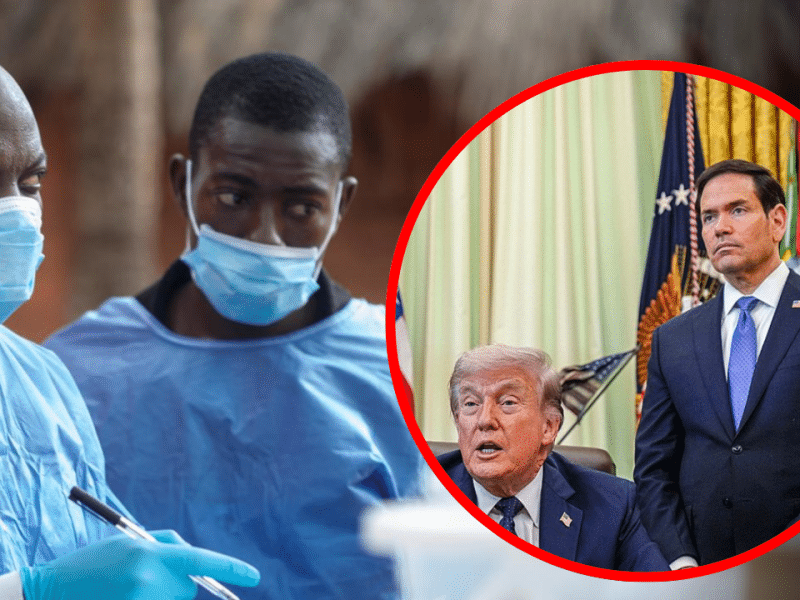
In June, Ruto reaffirmed his administration’s commitment to build a 50-bed tented facility in central Kenya to host Americans who might be exposed to the Ebola virus, which has infected hundreds amid an outbreak that began in May 2026 in the Democratic Republic of Congo. Despite a court order forbidding the facility, and only a single one reported case of Ebola in Kenya, Ruto told reporters:
“It would be most unfortunate if on one request by the Americans to set up a facility at their cost, we would refuse; we would look very inhuman.”
Both the Ebola facility and the deployment of a peacekeeping force in Haiti has outraged Kenyans who complain that their tax burden and inflation have spiked under Ruto, while their standard of living has declined. In August, Rigathi Gachagua, Ruto’s vice president who, similar to Mike Pence, was sacked by his former boss, spoke of a consumer crisis that is remarkably similar to what their peers in the U.S. are experiencing in the moment:
“Today, households continue to experience severe financial squeeze due to cumulative tax changes, high utility costs, transport costs and a stagnant job market that has limited formal opportunities.”
Continuing, Gachagua said:
“Today, we have an imperial presidency, economic apartheid and power under a ruthless dictator.”